
Last Updated: November 4, 2026
Quick Summary
Digital marketing systems for manufacturing companies are the connected set of web, search, email, CRM, and ERP tools that move an industrial buyer from first search to signed order without manual handoffs. Build the strategy before the tools, and choose platforms by integration depth with your CRM and ERP rather than by demo.
- 74% of B2B buyers research online before they ever speak with a supplier.
- Define audience, buyer journey stages, value proposition, and ROI measurement before evaluating any platform.
- Pick tools on CRM integration, sales cycle fit, ERP compatibility, and account-based capability.
- Run ABM against a target list of 50 to 200 named enterprise accounts with coordinated touchpoints.
- Give every product family, capability, and application its own indexable URL with structured data.
Table of Contents
- Why Manufacturers Need Digital Marketing Systems
- Build a B2B Manufacturing Marketing Strategy First
- Choose Industrial Lead Generation Tools That Fit Your Sales Cycle
- Apply Manufacturing Website Design Best Practices
- B2B SEO for Manufacturers: Get Found Before the RFP
- Book Your Free Strategy Call
- Frequently Asked Questions
Why Manufacturers Need Digital Marketing Systems
According to Forrester research cited by Sales Layer, 74% of B2B buyers research online before they ever speak with a supplier. That single number explains why digital marketing systems for manufacturing companies have moved from optional to essential.
At Uncommon Web Design, we build these systems for manufacturers, distributors, and wholesalers, and we have watched the gap widen between shops with a real digital infrastructure and shops relying on trade shows alone.
The old model still has pull. Lead Forensics manufacturing channel data found email was the best-performing channel for 18% of manufacturers, with trade shows second at 16%. Neither channel disappears.
Build a B2B Manufacturing Marketing Strategy First
Most manufacturers buy tools before they define a strategy, then wonder why the stack sits idle. Reverse the order.
A workable B2B manufacturing marketing strategy answers four questions: who the target audience is (design engineers, procurement managers, or both), which buyer journey stages you can influence, what value proposition separates you from the shop down the road, and how you will measure marketing ROI. Get those on one page before you evaluate a single platform.
The CMO Survey 2026 report found nearly three-quarters of companies now rate digital marketing's contribution to overall performance as strong. That confidence comes from strategy first, tools second.
If you want a deeper look at what a manufacturer site actually needs to generate qualified leads, read what B2B manufacturer websites need to generate leads before you commit to a plan.
Choose Industrial Lead Generation Tools That Fit Your Sales Cycle
Industrial lead generation tools fail when they assume a two-week sales funnel.
Pick tools against four criteria, not three:
| Criterion | What to Check | Why It Matters |
|---|---|---|
| CRM integration | Native, bidirectional sync with your existing CRM | Prevents duplicate data entry and lost leads, and keeps activity history intact when a rep leaves |
| Sales cycle fit | Long-nurture sequences with multi-stakeholder branching, not just drip campaigns | Matches the industrial buyer journey and the committee decision |
| ERP compatibility | Order, quote, and inventory data flow | Connects marketing to actual revenue and lets scoring reflect real purchase history |
| Account-based capability | Target-account lists, firmographic filtering, and account-level reporting | Lets you run ABM against high-value enterprise accounts instead of one-off leads |
Marketing automation earns its place here. Annuitas research cited by Lform associates automation with a 451% increase in qualified leads, though the original study's methodology is not published. Treat that as directional, not gospel.
Here is the workflow that separates a working stack from a pile of subscriptions:
- Capture, RFQ forms, spec-sheet downloads, and application-page visits feed the CRM with source and page-level context, not just a name and email.
- Enrich and score, firmographic data (industry, size, plant location) plus behavioral signals (repeat spec-sheet views, RFQ started but not submitted) build a score that reflects buying intent, not email opens.
- Route, high-score accounts go to a rep with the full activity history; mid-score accounts enter a long-nurture track segmented by application and material.
- Sync back, quote and order data from the ERP update the account record so marketing sees closed revenue, not just leads, and scoring recalibrates on real outcomes.
This is where account-based marketing (ABM) for manufacturing fits.
ERP integration is the piece competitors skip. Your ERP holds the truth about which accounts buy, what they buy, and how often.
For a closer look at how automation shortens the industrial sales funnel, see B2B sales automation and closing deals faster.
Watch out: the most common tool-selection mistake is choosing the platform with the best demo rather than the deepest native integration to your CRM and ERP.
Book Your Free Strategy Call →
Apply Manufacturing Website Design Best Practices
Manufacturing website design best practices start with one principle: your catalog is the sales channel. A spec-filtered product catalog, downloadable spec sheets, a structured RFQ form, and industry application pages do more for lead generation than any homepage animation.
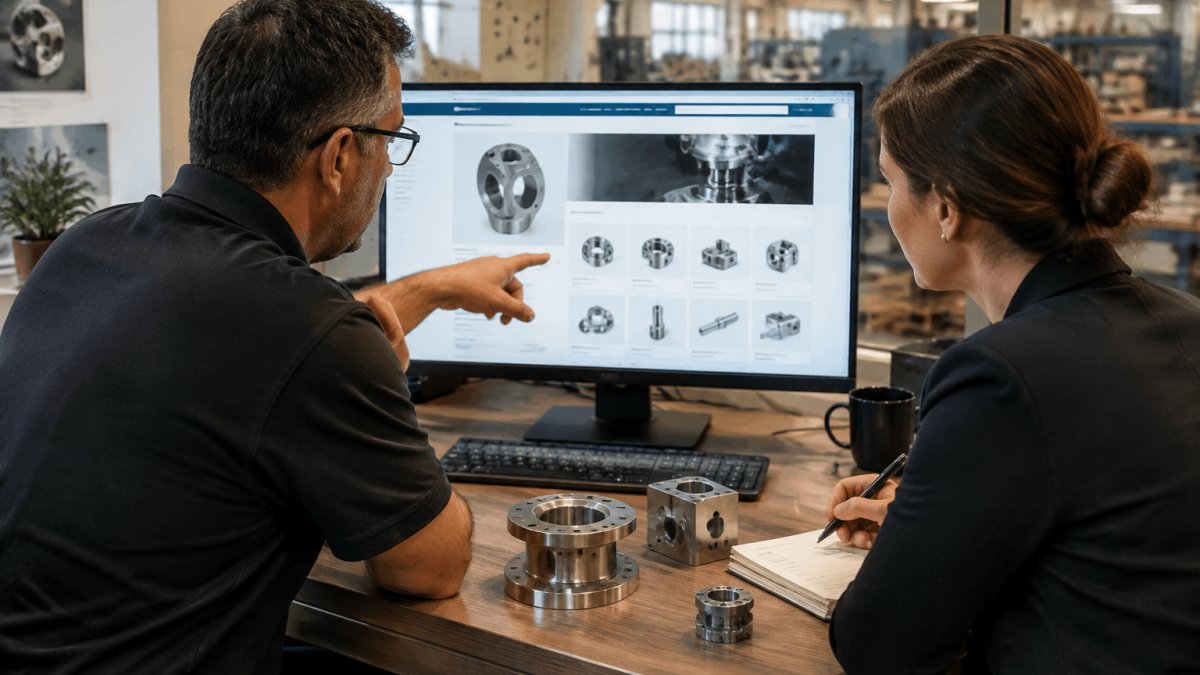
Three practices separate converting manufacturer sites from brochure sites:
- Filterable catalogs that let an engineer narrow by tolerance, material, or application in two clicks
- RFQ forms that capture quantity, timeline, and drawing uploads in a single pass
- Application pages organized by industry, not by internal product hierarchy
Watch out: the most common mistake is building a beautiful site with no RFQ path. Visitors who cannot request a quote in under a minute leave for a competitor who made it easy.
B2B SEO for Manufacturers: Get Found Before the RFP
B2B SEO for manufacturers is not the same game as consumer SEO. Your buyers search in technical language, and the winners own the spec-level queries long before a formal RFP exists.
A manufacturer's search strategy should target four query types, each mapped to a buyer-journey stage:
- Part and capability searches ("CNC machining aluminum tolerances," "5-axis milling ±0.0005 in"), bottom-funnel, high intent, and most likely to convert into an RFQ.
- Application searches ("hydraulic fittings for food processing," "corrosion-resistant fasteners for marine"), mid-funnel, where the engineer narrows options by environment and compliance.
- Comparison and standard searches ("stainless vs. carbon steel fasteners," "AS9100 vs. ISO 9001 machining"), top-to-mid funnel, where you earn authority before the RFP is written.
- Brand and supplier searches, the queries that decide whether a buyer who already heard your name finds a credible site or a competitor's.
Technical SEO carries extra weight in this sector because your catalog is the ranking asset. Three mechanisms do most of the work:
- Clean, crawlable architecture. Every product family, capability, and application needs its own indexable URL with a logical hierarchy (capability > material > tolerance range). Faceted filters that generate thousands of duplicate URLs dilute crawl budget and bury your money pages, use canonical tags and robots rules to keep filter permutations out of the index.
- Structured data on product and capability pages. Schema markup for products, organizations, and FAQs helps search engines understand spec-level content and can earn richer results. Most manufacturers skip this, which is why a well-marked-up catalog outranks a larger one.
- Page speed and Core Web Vitals. Heavy catalog pages with uncompressed spec images and third-party scripts lose rankings and conversions together. Compress images, lazy-load below-the-fold catalog grids, and audit third-party tags quarterly.
Content depth is the other half. A single capability page that lists "CNC machining" will not rank against a competitor with pages for each material, tolerance band, and industry application.
Salesforce marketing statistics report that 83% of sales teams using AI saw revenue growth, versus 66% overall.
Watch out: the most common SEO failure in manufacturing is treating the catalog as a database to be exported rather than a set of landing pages to be optimized.
Book Your Free Strategy Call
The gap between manufacturers with a working digital system and those without widens every quarter. Buyers research before they call, and the manufacturer they find first usually wins the RFP before it is written.
Uncommon Web Design builds revenue-first websites and digital marketing systems, backed by 25+ years of founder-led experience. These high-intent leads eventually require a streamlined process to convert interest into firm commitments, which is why we refine every automated client intake workflow to ensure no opportunity slips through the cracks.
If you want to see how a manufacturing site should be built, review our B2B and manufacturing web design services or explore manufacturing web design that turns your catalog into a sales channel.
Get started with Uncommon Web Design and turn your website into a system that generates qualified industrial leads. Book your free strategy call today.
Frequently Asked Questions
Why do manufacturing companies need a dedicated digital marketing system?
Buyers now do most of their research before contacting a supplier. Forrester data cited by Sales Layer shows 74% of B2B buyers research online before speaking with a supplier, so a brochure site rarely gets the first call. A dedicated system connects your website, SEO, email, and CRM so industrial buyers find you during the procurement cycle, and your team sees which pages and content precede a quote request.
How does B2B digital marketing differ for manufacturing companies?
The sales cycle is longer and involves more people. A single order may touch engineering, procurement, and finance, so content has to answer technical questions at each stage. Email remains the best-performing channel for 18% of manufacturers, with trade shows second at 16%, per Lead Forensics. That means digital marketing supports relationships that often start at a show or a referral, rather than replacing them with a single click.
What is the average ROI for digital marketing in the manufacturing sector?
There is no single published figure for manufacturing. The closest benchmark is marketing automation: Annuitas, cited by Lform, associates it with a 451% increase in qualified leads. Salesforce also reports revenue growth among 83% of sales teams using AI, compared with 66% of teams overall. Treat these as directional and measure your own pipeline, quote volume, and cost per qualified lead before scaling spend.
How can manufacturers use SEO to attract high-value industrial leads?
Target the terms buyers search when specifying a part or process: material grades, tolerances, capacity, lead times, and compliance questions. Build a page for each capability and publish technical content that answers those questions. Pair that with a fast, crawlable site and a CRM that records which pages a prospect visited. That way B2B SEO for manufacturers produces named leads your sales team can follow up with, not just traffic.
