This client asked not to be named, and we think they are right to. Ranking data shows precisely where a business is weak, and a competitor who reads it alongside a business name has been handed a map. Every figure below is real and unaltered; the business, its city and its exact search terms are withheld.
The subject is an independent auto repair shop in a Southwest metro market. It does transmissions, air conditioning, brakes and general service — the kind of work that lives or dies on whether somebody a few neighbourhoods over finds you when their car starts making a noise.
When we picked up the account, the shop was not invisible. It ranked. That was the problem with the reporting it had been getting: a single ranking number said "you're doing fine," and the phone said otherwise. A shop can sit at #1 from its own parking lot and fall off the map pack entirely by the time a searcher is a few minutes' drive away — and one number cannot tell you that is happening.
The Problem With One Number
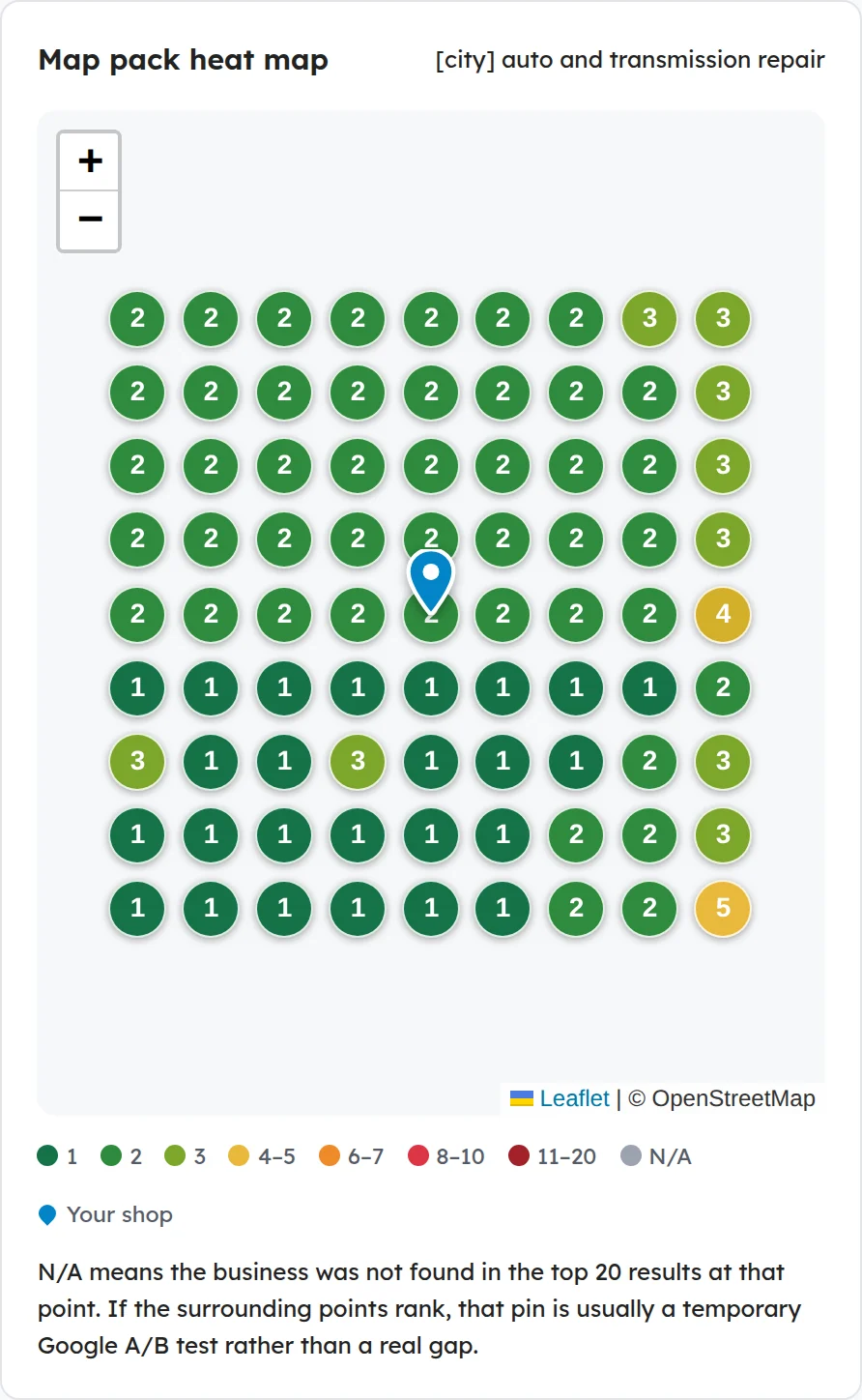
Google does not have a ranking for "auto repair near me." It has a different ranking for every place a person can be standing. Proximity is the strongest single factor in the map pack, which means your position decays as the searcher moves away from your door. That decay is not a flaw to be fixed; it is how local search works. The question worth asking is how far out you hold the top three before you drop off — and whether the shop down the road is holding ground further than you are.
So instead of tracking one position, we track 81. This shop runs on a 9×9 geo-grid covering a 1.5-mile radius around its address. Every point is a genuine search run from that exact coordinate. The result is a map of where the business wins, where it is mid-pack, and where it does not appear at all.
What We Actually Changed
The grid told us where to work, and the diagnosis pointed at categories rather than reviews. The shop's Google Business Profile carried the obvious primary category and little else, while the businesses beating it on the north and west edges of the grid claimed the specific services people were searching for — transmission, air conditioning, radiator, brakes. Google weighs the primary category far above the rest, and a specialist can outrank a better-reviewed generalist because of it.
- Category and profile work. The profile now carries the full set of services the shop genuinely performs, with the primary category matched to the highest-value term rather than the broadest one.
- Service pages that match the searches. Transmission, A/C and brake work each got their own page, so there is something on the website for Google to tie the profile claim to.
- Keyword coverage driven by competitor gaps. Tracking expanded to 17 active terms — 23 including ones since retired — chosen from what 193 competing shops in the grid were ranking for and this one was not.
- Reviews, steadily. Recency is weighted, so a consistent trickle beats a one-time push — and a burst in a single week can read as manipulation.
The Results, Keyword by Keyword
The table below compares the first full scan on 22 August 2026 with the scan on 14 September 2026. It shows only the seven keywords that were tracked on both dates — the tracked set grew during this period, and comparing a wider list against a narrower one would flatter the numbers by changing what was measured rather than what happened.
Search terms are generalized: [city] stands in for the metro name the shop actually ranks for. The percentages are exactly as measured.
| Keyword | Top 3 — Aug 22 | Top 3 — Sep 14 | Change |
|---|---|---|---|
| auto repair near me | 13.6% | 63.0% | +49.4 |
| auto repair shop [city] | 29.6% | 80.3% | +50.7 |
| [city] auto shops | 59.3% | 85.2% | +25.9 |
| car air conditioning repair near me | 74.1% | 91.4% | +17.3 |
| [city] auto and transmission repair | 74.1% | 97.5% | +23.4 |
| car shops in [city] | 81.5% | 93.8% | +12.3 |
| auto repair shops in [city] | 84.0% | 91.4% | +7.4 |
The pattern is worth reading carefully. The terms that moved most are the ones that started weakest — "auto repair near me" went from winning an eighth of the grid to winning nearly two thirds. The terms already performing well moved least, because there was less room left to take. That is the shape a real gain makes; a suspiciously uniform lift across every keyword usually means the measurement changed, not the rankings.
Who Owns the Neighbourhood Now
Rankings are only half the picture. The other half is who is taking the points you are not holding. Across the grid we track every competing business that appears, which ones outrank the client and where — 193 of them so far.
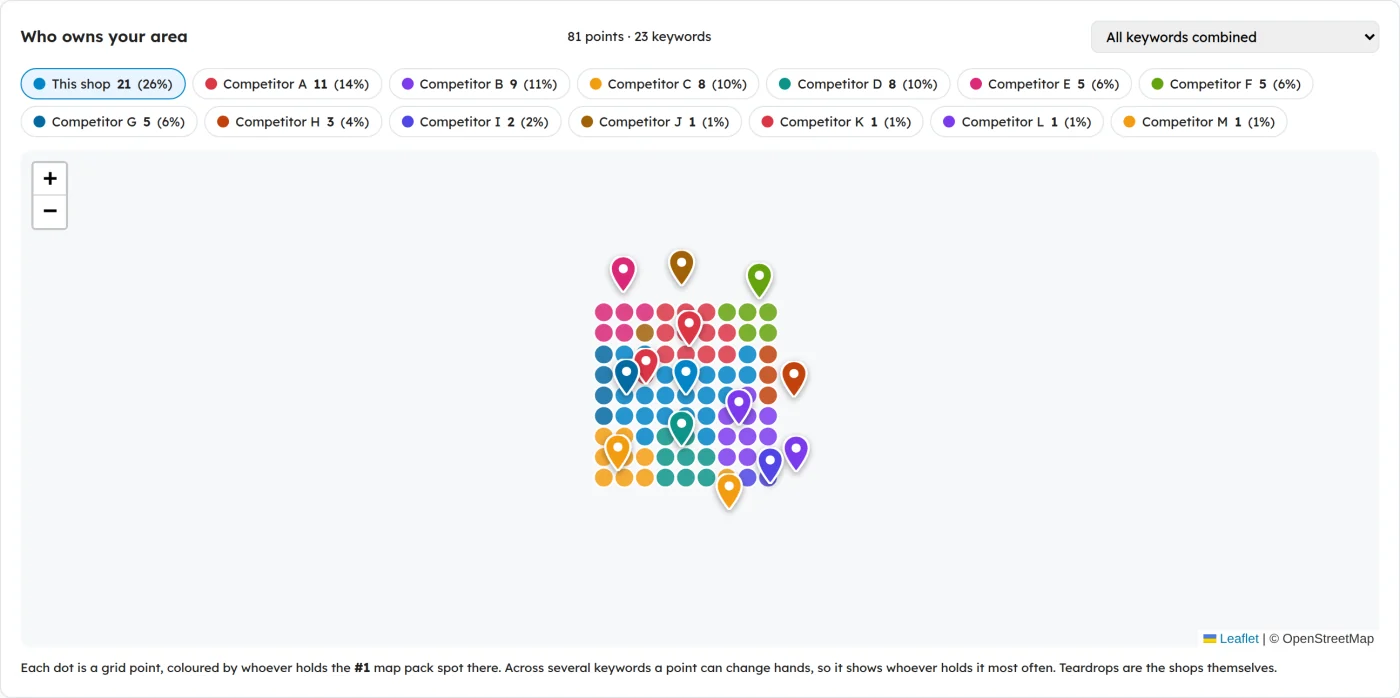
The useful signal in that view is not the shops clustered near their own addresses — that is proximity working exactly as expected. It is a shop holding ground far from its own pin, which means something other than distance is carrying it, and that something is usually copyable.
What This Does Not Show
Rankings are a leading indicator, not revenue. A shop in the top three across 86% of its service area gets seen by more people than one at 59%, and in a trade where the search happens at the moment of need that matters a great deal — but this page reports positions, because positions are what we measured.
The Short Version
This shop did not have a ranking problem it could see. It had one that only showed up when you measured from more than one place. Finding it took a grid; fixing it took category and profile work plus pages that backed up the claims. If you run a shop and your reporting is a single number, you do not currently know whether this is happening to you.