Let's be honest. Your current website probably feels more like a digital brochure than a high-performing employee. It looks fine, but it isn't bringing in qualified leads or making your job any easier. This guide breaks down the proven 7-stage process we use to transform a website from a costly expense into a strategic growth asset.
From Digital Brochure To 24/7 Salesperson
Most business owners we talk to have a website that just isn't pulling its weight. It exists, but it doesn’t actively contribute to the bottom line. This is what happens when a site is built without a clear roadmap—the crucial website development stages that tie every decision back to a real business goal.
Following a structured process is the only way to prevent costly mistakes and ensure your final website is more than just a pretty design. It becomes an automated system for attracting the right customers and guiding them to take action. When your site isn't generating leads, the problem is rarely the color scheme; it's almost always a lack of a strategic foundation.
Why A Structured Process Matters
Skipping steps is tempting, especially when you want to get things done quickly. But it’s the fastest way to end up with a website that fails to deliver any return on investment. A disciplined, stage-by-stage approach is what turns your online presence from a passive brochure into an active sales tool.
- Clarity of Purpose: You’ll know exactly who your website is for and what you want them to do.
- Budget Predictability: A clear plan prevents scope creep and stops unexpected costs from popping up later.
- Measurable Results: Each stage is designed to build a website that can be tracked, measured, and optimized for growth.
This flowchart maps out the journey from a static online flyer to a genuine, revenue-generating asset.
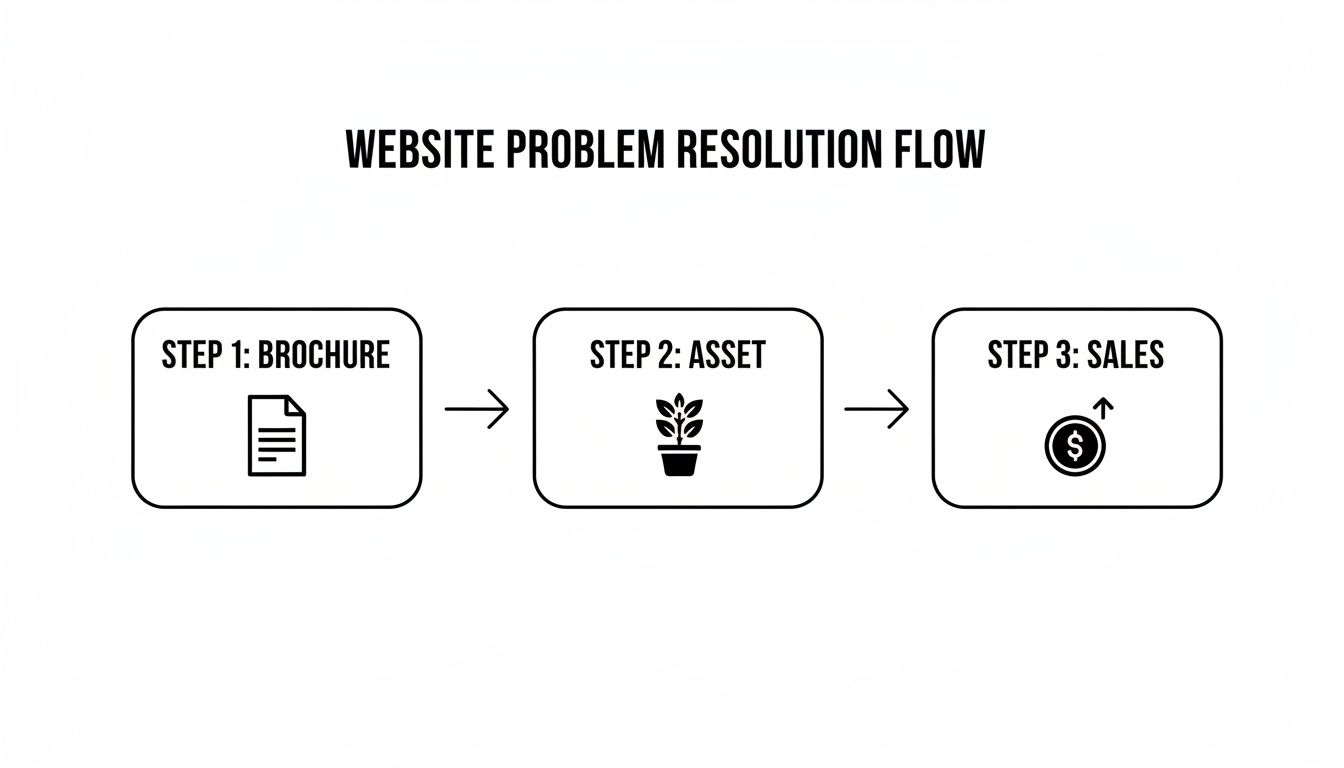
The key takeaway here is that a modern website has to evolve beyond being an information hub. It needs to become a core part of your sales engine. If your business website is underperforming, understanding how to improve website conversion rates is a critical first step.
The following sections will walk you through this exact process, stage by stage. We’ll show you how we build websites that function as your best salesperson, working 24/7 to turn visitors into paying customers.
Stages 1 & 2: Discovery and Strategic Planning
This is where great projects get their start and expensive mistakes are sidestepped. So many business owners assume building a website begins with design, but that's like a general contractor ordering windows and doors before they even have a blueprint. The first two stages—Discovery and Strategic Planning—are the bedrock of the entire project. Skipping them is the number one reason websites fail to deliver a real return.
Think of the Discovery stage less like a questionnaire and more like an in-depth business consultation. We're not just asking what you want the site to look like; we're digging into what you need your business to achieve.
- Who is your ideal customer? We go beyond simple demographics. What keeps them up at night? What problems are they trying to solve when they find you? What truly motivates them to pick up the phone?
- What is the primary goal? Is it to generate a steady stream of qualified leads for your service business? Sell products directly from an online store? Or is it to get appointments booked for your clinic? We need one clear, primary objective.
- How does your business win? What makes you the obvious choice in a crowded market? We need to find that unique value and bake it directly into the website's DNA—from the structure to the messaging.
This isn’t about filling out a form. It's a strategic deep-dive to uncover the real purpose of your new website.
Building the Project Blueprint
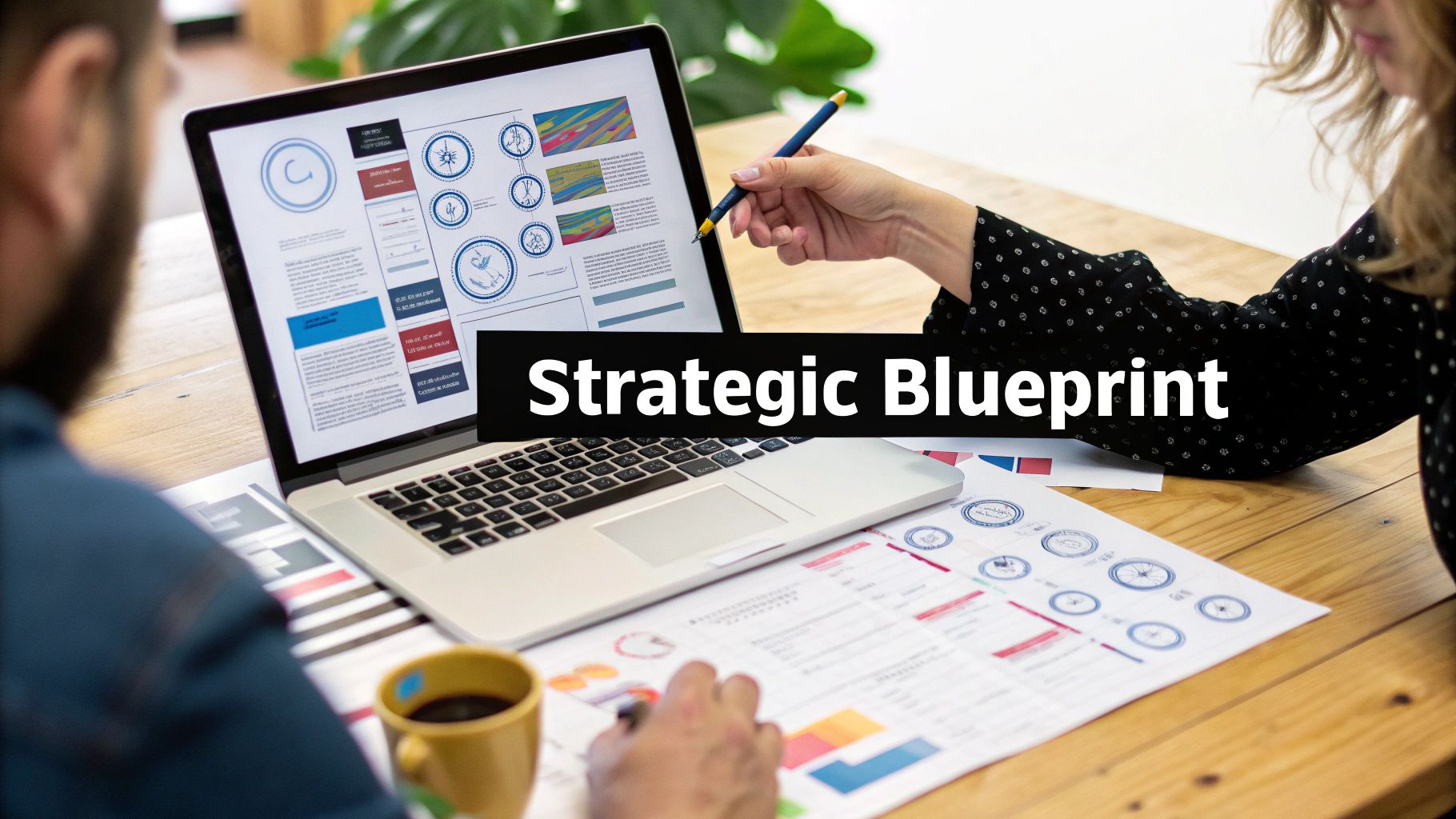
Once we’ve got total clarity on the “why,” we move into Strategic Planning. This is where we translate those big-picture business goals into a tangible project plan—the official blueprint for your new digital salesperson. A detailed plan is your best defense against scope creep, budget overruns, and features that don’t actually move the needle.
A well-defined plan is the best defense against project failure. In fact, following a transparent, multi-stage process helps prevent the common pitfalls that cause up to 70% of projects to derail due to poor planning.
This blueprint gives us three critical documents to guide the entire project:
- Sitemap: This is simply the architectural plan for your website. It maps out every single page and how they all connect, creating a logical flow that makes it easy for visitors to find what they need. For a local roofing contractor, this means clearly defining pages for "Roof Repair," "New Roof Installation," and dedicated pages for service areas like "Temecula" and "Murrieta."
- Technology Stack: Here, we select the right tools for your specific job. This includes the content management system (like WordPress), any e-commerce platforms, or integrations with software you already use, like a CRM or scheduling tool. The goal is always a seamless, efficient system.
- Project Roadmap: This document lays out the entire project timeline, key milestones, and who is responsible for what. It creates complete transparency so you know exactly what’s happening and when. Keeping a project on track requires effective project management for website development, and this roadmap is the key.
This two-part foundation ensures we're building the right website from the very beginning—one that’s perfectly aligned with your business goals before a single pixel is designed.
Want to see how this foundational work prevents headaches down the road? Take a closer look at our guide on strategic web page planning and see how a solid plan makes all the difference.
Stages 3 & 4: Design and Content Creation
With a solid blueprint in hand, we can finally start giving your website a face and a voice. This is where the strategic foundation we’ve built starts to look and sound like a real website.
Think of it this way: a great design grabs a visitor's attention, but it’s the content that truly persuades them. These two pieces, Design and Content Creation, aren't sequential tasks. They need to evolve together, influencing and strengthening one another to create a seamless experience that guides a visitor from curiosity to action.
From Wireframes to High-Fidelity Mockups
The design journey isn't a free-for-all of creative whims. It's a methodical process that translates our strategic goals into a visual language your customers will understand. Every choice is intentional.
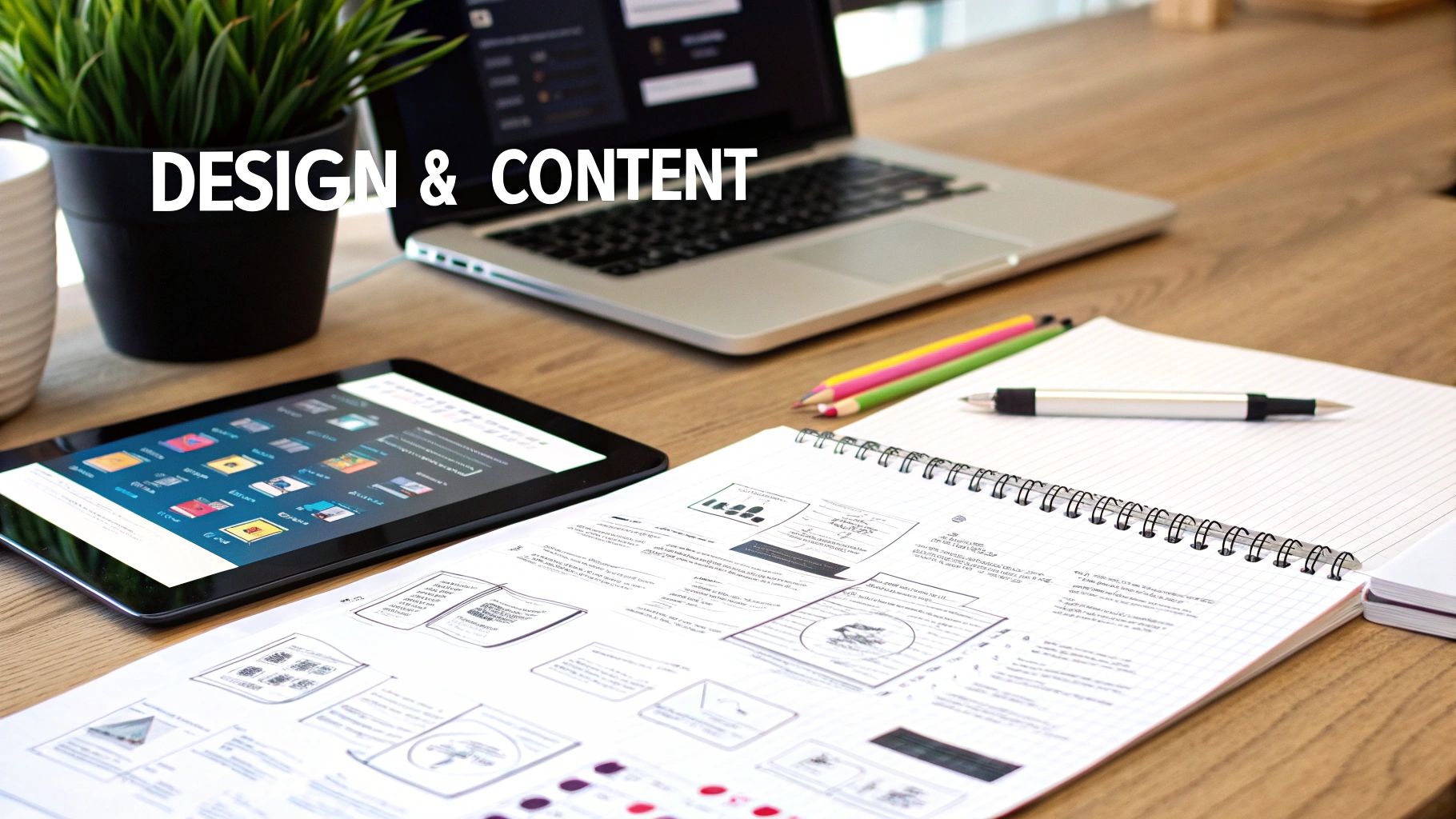
First up are the wireframes. Imagine these as the architectural blueprints for your website. They’re simple, black-and-white layouts that focus purely on structure and user flow, without any distracting colors or images.
- What goes where? We strategically place all the key components—navigation, call-to-action buttons, forms, and headlines.
- How will users get around? We map out the most intuitive pathways, making it effortless for visitors to find what they need and take the next step.
Wireframing strips away all the visual noise. By removing colors, fonts, and images, we’re forced to focus on the one thing that matters at this stage: creating the most effective user journey. It’s pure function.
Once we’ve locked in the structure, we move on to high-fidelity mockups. This is where your brand's personality comes alive. We apply your color palette, typography, and imagery to the approved wireframe, creating a pixel-perfect preview of what your finished website will look like. It’s the final visual sign-off before we write a single line of code.
Crafting Content That Closes the Deal
While the visuals are coming together, we’re also developing the words that will do the heavy lifting. Your website copy is your 24/7 salesperson, and it needs to be just as sharp and strategic as the design. Even the most stunning website will fail if the content is weak or generic.
Good content anticipates and answers your customer's biggest questions. For an auto shop in Menifee, this means a service page that doesn’t just say "oil changes." It explains why their premium synthetic oil is better for an engine battling Southern California heat. It's all about building trust by demonstrating real expertise.
All of our content is built to be:
- Customer-Focused: We speak directly to your ideal customer about their problems and goals, using language they actually use.
- Value-Driven: It’s crystal clear what makes you the best choice and why customers should pick you over the competition.
- Action-Oriented: Every page has a purpose, guiding visitors with clear calls-to-action like “Request a Quote” or “Book an Appointment.”
These first four website development stages—Discovery, Planning, Design, and Content—are the bedrock of the whole project. Getting them right is absolutely essential. For a closer look at crafting compelling copy, check out our guide on how to write website content that gets results.
Stage 5: Development – Where Your Plan Becomes Reality
Alright, this is the part where all the planning, strategy, and design mockups finally come to life. The development stage is where our team takes the blueprints and turns them into a living, breathing website. It's so much more than just making a design "work"—it's about engineering a high-performance business tool with clean, reliable code.
Think of it this way: we’ve poured the foundation (strategy) and finalized the architectural drawings (design). Now, the skilled builders come in to frame the house. They follow the plans precisely, ensuring every joint is solid and every wire is run correctly. A rushed job here creates problems that will haunt you for years. That’s why we take our time to build it right.
Front-End and Back-End: What Customers See vs. What They Don’t
The actual coding is split into two distinct but connected parts. Understanding both helps you appreciate what makes a website truly powerful.
-
Front-End Development: This is everything your visitors see, click, and interact with. It's the craft of turning those static design files into interactive buttons, smooth animations, and easy-to-use forms. Our focus is always on creating a flawless user experience on any device—desktop, tablet, or phone. For a local dental office, this means a new patient form that’s actually simple to fill out on a mobile screen.
-
Back-End Development: This is the engine under the hood. It’s the server, the database, and all the behind-the-scenes logic that makes the website do things. The back-end is the powerhouse that processes form submissions, manages customer accounts, and keeps everything running smoothly. For an e-commerce store, it’s the system that securely handles credit card payments and updates inventory in real time.
A poorly built back-end is the reason so many websites are slow, insecure, or constantly crashing. We build both sides to be fast, secure, and scalable from day one.
Why Clean Code is a Genuine Business Asset
It's easy to assume all websites are built the same, especially with so many drag-and-drop builders out there. The truth is, the quality of the code underneath makes a massive difference in your business's success. A website built on clean, modern code isn't a luxury; it's a competitive advantage.
The real difference between a template site and a custom-built asset is the code. Clean code gives you faster load times, stronger security, and makes future updates a breeze. Messy code is just technical debt that will cost you time and money down the road.
This isn't a new concept. The web itself learned this lesson the hard way. Back in the mid-1990s, the rise of technologies like JavaScript and CSS turned static pages into dynamic experiences. But inconsistent browsers made a mess of things, forcing the industry to adopt web standards to ensure reliability. You can read more about this evolution over at VisualFizz.com. We build on those same principles today to create sites you can depend on.
Here’s what a solid technical foundation actually gets you:
-
Blazing-Fast Speed: Google and your customers will thank you. Clean code is efficient, which means your pages load almost instantly. A slow site, on the other hand, is a guaranteed way to send potential customers running to a competitor.
-
Rock-Solid Security: Shoddy code and outdated plugins are like an open door for hackers. We build with security as a core priority, protecting your data and your customers' trust.
-
Future-Proof Scalability: Your business will grow, and your website needs to be ready to grow with it. A well-coded site makes it straightforward to add new features or integrate new tools later without having to start over from scratch.
In this stage, we’re not just building what you can see. We’re building a reliable, long-term asset that’s engineered for performance from the ground up.
Stage 6: Testing and a Flawless Launch
The code is written, the design is in place, and your website is technically "built." But we're not ready to pop the champagne just yet. Now comes one of the most critical stages: trying our absolute best to break everything we just created. This is Quality Assurance (QA), and it's where we shift from builders to inspectors.
Think of it like the final walkthrough before you buy a house. You open every door, turn on every faucet, and check every outlet. We do the same for your website, hunting down every bug, broken link, or slow-loading element before a single visitor ever lands on your new homepage.
A lot of agencies treat this as a quick final check, but for us, it's a non-negotiable obsession. A tiny glitch can instantly shatter a customer's trust, and that’s a risk we’re not willing to take with your reputation. We put on the hat of your pickiest, most impatient customer to make sure the real ones have nothing but a great experience.
Our Quality Assurance Checklist
This isn't random clicking. We follow a detailed, methodical battle plan to test every corner of the site and simulate every possible user journey. The goal is simple: make sure the site works perfectly for everyone, on every device, every single time.
Our comprehensive QA process covers:
- Cross-Browser Testing: Does the site look and work just as beautifully on Chrome as it does on Safari and Firefox? We check.
- Responsive Testing: We pull out an arsenal of devices—big desktop monitors, tablets, and all sorts of smartphones—to make sure the design snaps perfectly into place on any screen.
- Functionality Testing: Every button gets clicked, every form gets submitted, and every link gets followed. If something is supposed to do something, we make sure it does it right.
- Performance Testing: We run speed tests to find and eliminate any bottlenecks. In a world of short attention spans, even a one-second delay in load time can be the difference between a new customer and a lost sale.
A website launch isn't just flipping a switch. It's a carefully coordinated event designed to ensure zero downtime, protect your SEO, and make the whole process completely stress-free for you.
Orchestrating a Smooth Launch
Once your site has passed our rigorous testing with flying colors, it's go-time. Launching a website is a precise technical operation, and we handle every single step. This isn't a time for crossing your fingers; it's a time for a proven, step-by-step protocol.
Our launch plan is built to protect the authority you've already earned online and get your new site working for you from day one.
- Final Code Review and Optimization: We give the entire site one last pass, making sure the code is clean, tight, and ready for the live server environment.
- Secure Site Migration: We expertly transfer all your website files from our development server to your live hosting. It’s a delicate process, and we ensure every piece of data makes the trip securely.
- SEO Redirect Implementation: This is absolutely vital if you have an existing website. We meticulously set up 301 redirects, which are basically forwarding addresses for search engines. This tells Google exactly where to find the new versions of your old pages, preserving all the valuable SEO ranking you've worked so hard to build.
- Post-Launch Monitoring: Our job isn't done the moment the site goes live. We stick around, monitoring performance closely to catch any surprises, double-checking that analytics are tracking correctly, and confirming that the launch was a complete success.
This methodical approach is what makes the final steps of the website development stages so successful. It turns a nerve-wracking moment into a controlled, predictable, and exciting milestone for your business.
Stage 7: Maintenance and Continuous Growth
So, your website is live. Pop the champagne! But don't make the common mistake of thinking the work is over. Launch day isn't the finish line; it's the starting gun. A website isn't a "set it and forget it" brochure. It's a living, breathing part of your business that needs consistent care to deliver real, measurable results.
Think of it like buying a brand-new car. You wouldn't drive it off the lot and then never change the oil or rotate the tires, right? Of course not. You'd expect it to break down. Your website works the same way. This final, ongoing stage is what transforms your site from a one-time expense into a powerful engine for business growth.

Foundational Maintenance: The Non-Negotiables
Before we even talk about growth, we need to cover the basics. This is the essential, behind-the-scenes work that keeps your site secure, healthy, and running smoothly. It’s all about peace of mind.
- Software Updates: We are constantly keeping an eye on your website's core software, themes, and plugins, applying updates to patch security holes and ensure everything plays nicely together.
- Security Scans: Our team runs regular, vigilant scans to catch and neutralize any malicious threats before they can ever harm your website or your reputation.
- Daily Backups: We take complete backups of your site every single day. If the worst happens, we can roll it back to a working version in a snap, minimizing any downtime.
A website without a maintenance plan is an open invitation for problems. It’s not a matter of if it will get hacked or break, but when. Proactive care is always cheaper than reactive emergency repairs.
Continuous Growth: Turning Data Into Dollars
While maintenance keeps your digital storefront safe, the growth phase is where we make it more profitable. This is where the real partnership begins. We stop guessing and start measuring, using hard data to turn your site into your most effective salesperson.
This philosophy of building on a solid foundation isn't new. Back in the early 1990s, the first websites were simple, static pages. What that era taught us is the immense power of starting with a fast, reliable base. Even a one-second delay in page load time can tank conversions, making a speedy site absolutely essential. You can learn more about the evolution of web design at Fireart.studio.
We focus on continuous improvement by watching how real people interact with your site. By tracking user behavior, we find the answers to crucial questions:
- Where are visitors dropping off? We pinpoint the confusing pages or broken steps in your sales process that are costing you money.
- What content are people connecting with? We identify what your audience truly cares about, so you can create more of what works.
- How can we boost conversions? We run tests on different headlines, button text, and page layouts to find the winning combination that drives more sales and leads.
This constant cycle of testing, measuring, and refining is how your website evolves from a simple online presence into your business's most reliable growth machine.
Your Top Questions About the Web Development Process, Answered
Even with a detailed roadmap laid out, it’s natural to have questions about the practical side of things. Let's get right into the nuts and bolts. Here are the straight-up answers to the questions we hear most from business owners just like you.
How Long Does This Whole Thing Take?
For a standard, lead-generating website for a small business, you can generally expect the entire process to take 8-12 weeks. That’s from our very first discovery call to the moment your new site goes live.
That timeline isn’t just a random number. It’s carefully structured to give each stage the focus it needs—from deep strategic thinking and creative design to pixel-perfect development and thorough testing. We don’t believe in cutting corners. Of course, more complex projects, like those with e-commerce systems or special software integrations, will naturally need a bit more time.
What Does a Professional Business Website Actually Cost?
Think of a professionally built website as a core business asset, not just another expense on a spreadsheet. For the kind of strategic, lead-generating site we specialize in for service businesses, a realistic budget usually lands somewhere between $10,000 and $30,000.
Where your project falls in that range depends entirely on its scope and what you need it to achieve. A solid foundational website aimed at local SEO and capturing leads will be on the lower end. A site with advanced features, online shopping capabilities, or custom-built tools will be on the higher end. We lock everything down with a detailed, fixed-price proposal after our discovery phase, so you’ll have total financial clarity before any work starts.
Think about your website budget the same way you would any other critical business investment. The goal isn’t to find the cheapest price, but the option that delivers the biggest long-term return.
How Much of My Time Will This Take Up?
Your time is most valuable at the very beginning. Expect to be most hands-on during the Discovery and Strategy stages (our first two steps), which typically involves a few hours of focused work together.
After that initial deep dive, your main job is to provide feedback and sign off at key milestones. We’ll need your eyes on things like the sitemap, the design mockups, and the first drafts of the content. We’ve designed our entire process to do all the heavy lifting for you, so you can stay focused on what you do best—running your business. We manage the project so you don’t have to.
Ready to see how a clear, structured process can turn your website into a growth machine for your business? At Uncommon Web Design, we don’t just build websites; we build strategic assets that deliver real results.
Book a no-obligation consultation with us today and let’s start the conversation about your goals.