The difference between website design and development is simple: design is the blueprint for your digital storefront, and development is the construction that makes it work.
A designer is the architect. They focus on the customer’s journey, the visual appeal, and making sure everything feels intuitive. They map out how to turn a skeptical visitor into a confident lead.
A developer is the construction crew. They take that blueprint and write the code that brings it to life, ensuring it's fast, secure, and reliable.
Getting this right is the difference between a website that’s a glorified business card and one that’s your best salesperson.
Why Your Website Isn’t Generating Leads
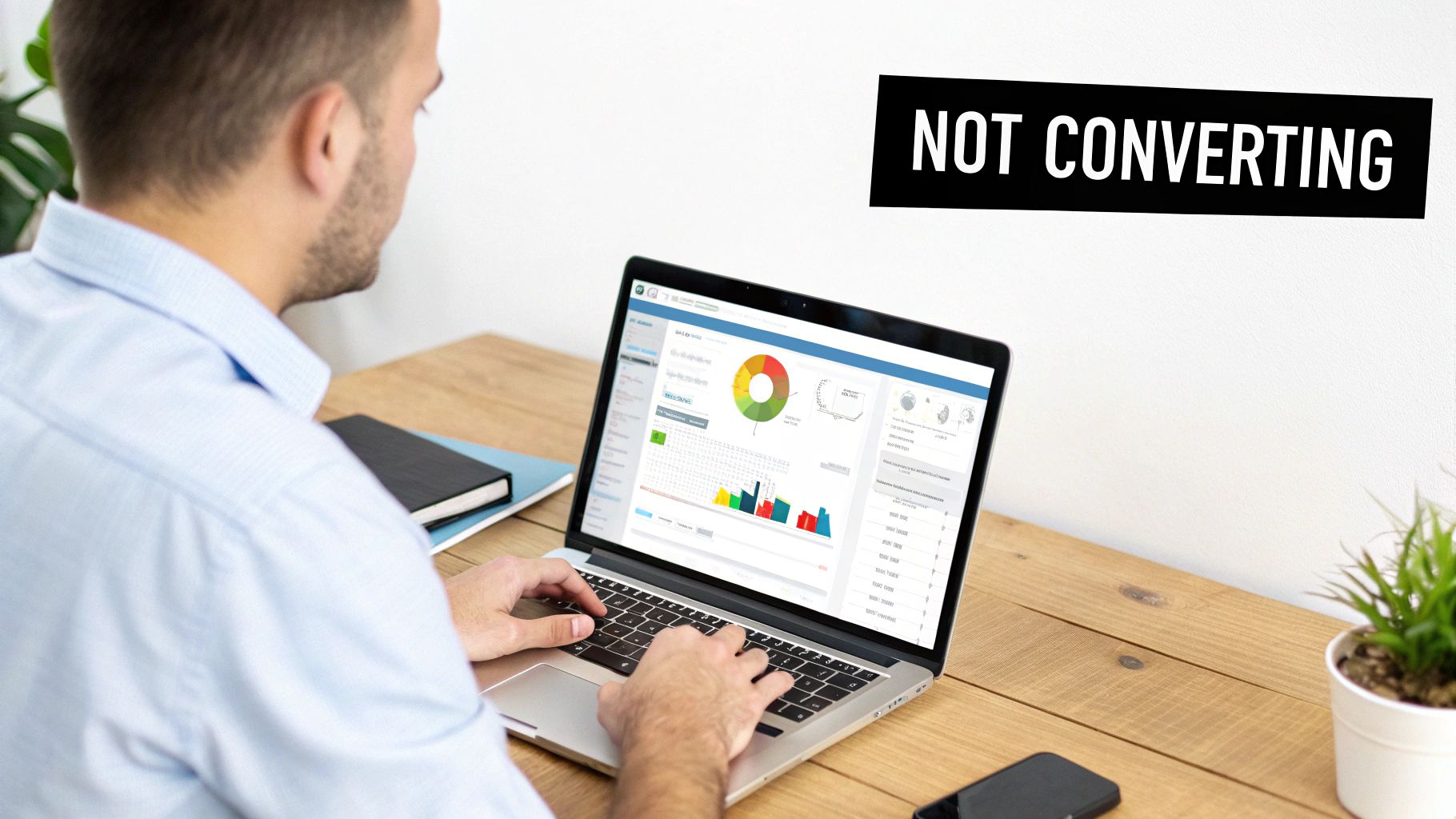
You have a website, but it’s just… sitting there. No calls, no quote requests, no new customers. This is a common and expensive problem, and the root cause is often a misunderstanding of website design vs. development.
Many business owners use the terms interchangeably. This leads them to hire for one skill when they actually need both. The result? A website that might look professional on the surface but completely fails to turn visitors into revenue. It’s like having a beautiful retail store with a jammed front door and nobody at the cash register.
The Two Sides of a High-Performing Website
To turn your website into a 24/7 sales engine, it needs to nail two distinct jobs, each handled by an expert:
- Website Design: This is the strategic and visual half. It’s responsible for earning trust, guiding people where you want them to go, and clearly communicating why you’re the best choice. It’s everything a visitor sees, feels, and interacts with.
- Website Development: This is the technical and functional half. It ensures the site is fast, secure, and works perfectly on a phone. It’s what makes sure your contact forms and payment systems run without a hitch.
When these two aren't in sync, your business pays the price. A beautiful design on a slow, buggy website will just frustrate potential customers. A technically perfect site that’s a confusing mess will never build the confidence someone needs to hand over their money.
| Aspect | Website Design (The "What" and "Why") | Website Development (The "How") |
|---|---|---|
| Primary Goal | Create an intuitive, visually engaging user experience that builds trust and guides visitors. | Build a fast, functional, and secure website based on the design's specifications. |
| Key Question | "How can we make this easy and compelling for the customer?" | "How can we build this efficiently and make sure it's reliable?" |
| Business Impact | Affects user perception, brand credibility, and how easily a lead can become a customer. | Affects site speed, security, SEO rankings, and whether features work correctly. |
Understanding this distinction is the first step to fixing a website that isn't pulling its weight. If you're not getting leads, it might be time to look at how you're capturing them. Reviewing examples of high-converting lead generation forms can spark ideas for your own site.
This guide will break down the roles, processes, and business impact of both. By the end, you’ll have the clarity to stop pouring money into a website that doesn't perform and start investing in an asset that grows your business. You can also dive deeper into our guide on how to improve website conversion rates.
The Two Sides of the Website Coin: Design vs. Development
Let’s use a custom home analogy. The first person you call is the architect. They're your web designer. They don't lay a single brick; they focus on the blueprint. They map out the flow of the house—where the rooms go, how people will move through the space, and the overall aesthetic that makes it feel like your home.
Next, you bring in the general contractor and their crew. They are your web developers. They take the blueprint and bring it to life. They pour the foundation, frame the walls, and wire the electricity. Their job is all about structural integrity and making sure everything works reliably behind the walls.
One crafts the vision and the user's experience; the other builds the functional structure. You can't have a great website without both.
What a Web Designer Really Does
A good web designer does much more than make things look pretty. Their entire focus is on user experience (UX) and user interface (UI). These aren't just buzzwords; they are the principles that decide whether a visitor trusts you and takes action or clicks away in confusion.
A designer is responsible for:
- Mapping the User Journey: They think like your customer, planning the most logical path from the homepage to a key action, like filling out a contact form.
- Creating Wireframes and Prototypes: These are the architectural sketches of your website. They map out the layout and function before any colors or images are involved.
- Applying Visual Branding: This is where they translate your brand identity into a visual language, ensuring everything from the logo placement to the button style feels authentic to your business.
- Ensuring Usability: They design an interface that’s intuitive and easy to use for everyone, whether they’re on a huge monitor or a small phone.
The takeaway: A great designer's work is measured in clarity and trust. When a potential customer lands on your site, instantly understands what you do, and feels confident you’re the right choice, the designer has succeeded.
What a Web Developer Really Does
Once the designer finalizes the blueprint, the developer takes over. They are the coders who transform a static visual concept into a living, functional website. Their work is what makes the design do something. When you need to understand modern web practices, it's crucial to look at data on what drives visibility and engagement, which is the core of effective web development.
A developer's work is typically split into two areas:
- Front-End Development: This is the "client-side." A front-end developer uses languages like HTML, CSS, and JavaScript to build everything you see and interact with in your browser.
- Back-End Development: This is the "server-side" engine. The back-end developer manages databases, processes form submissions, and builds the core logic and security that makes the site run behind the scenes.
A developer is the one who ensures your contact form actually sends an email, your pages load in under two seconds, and your site is secure. Without solid development, the most beautiful design is just a pretty picture that can't generate business.
A Strategic Comparison for Business Growth
Knowing the definitions is one thing. Understanding how design and development directly affect your bottom line is what matters. This is where we move past the technical jargon and focus on what helps you attract and convert customers.
For a business owner, the website design vs. development conversation isn't about code versus color palettes; it's about results. A great design builds that crucial first impression, stopping a visitor from hitting the 'back' button. But it's solid development that ensures the site is fast and reliable enough to turn that initial curiosity into a sale.
Think of it like building a house: the designer is the architect who creates the blueprint, and the developer is the builder who constructs the actual building.
As you can see, one role plans the experience, while the other builds the functional reality. You can't have a successful website without both working together.
How Each Role Drives Your Business Forward
Let’s dig into how this partnership directly impacts growth. We'll look at their focus, skills, tools, and—most importantly—how they influence your Google ranking (SEO) and your ability to turn visitors into leads (conversions).
Consider a local roofing contractor. Their website design needs to immediately communicate trustworthiness. Clear calls-to-action like "Get a Free Estimate" are essential. But if that estimate form is broken or the site takes five seconds to load on a potential client's phone, that beautiful design is useless.
The market reflects this dual importance. The global web design services market hit USD 58.5 billion in 2022, while the development side is projected to reach $82.4 billion by 2026. Design is responsible for 94% of a user's first impression, but development ensures your site loads in under two seconds—a critical benchmark for keeping 60% of visitors from leaving. This is why 73% of companies invest in unique design, even as they depend on robust development to handle sales and scale.
The takeaway: Your website isn't an expense; it's an asset. The goal is to invest in the right combination of design and development to deliver the highest possible return, turning your site into a predictable lead-generation machine.
To help you see exactly where your investment goes, here’s a straightforward breakdown.
How Design vs. Development Drive Business Outcomes
This table puts it all in perspective, showing how both sides work to achieve your business goals.
| Business Area | Role of Website Design | Role of Website Development |
|---|---|---|
| Primary Focus | User Experience (UX) & Conversion: Creates an intuitive, trust-building journey that guides visitors toward a specific action, like making a call or filling out a form. | Functionality & Performance: Builds a fast, secure, and reliable site that works flawlessly on all devices. This is all about making sure the "engine" runs smoothly. |
| Key Skills | Visual communication, user psychology, branding, wireframing, and prototyping. Designers understand why people click. | Coding (HTML, CSS, JavaScript, PHP), database management, server configuration, and security protocols. Developers know how to make things work. |
| Essential Tools | Figma, Adobe XD, Sketch, Photoshop. These are tools for creating visual blueprints and interactive mockups. | Visual Studio Code, Git, WordPress, various coding frameworks. These are tools for writing and managing the code that powers the site. |
When you look at it this way, it’s clear they aren't competing priorities; they're two halves of the same whole.
Impact on SEO and Conversions
Ultimately, your website needs to get found (SEO) and get customers (conversions). Here’s how design and development each play a unique role in hitting those targets.
Website Design's Impact:
- Lowers Bounce Rate: A clear, engaging design keeps people on your site longer. This sends a powerful signal to Google that your content is valuable.
- Builds Trust: Professional aesthetics and a logical layout make your business seem more credible, which is essential for convincing someone to give you their contact info.
- Guides User Actions: The strategic use of color, contrast, and layout is what we call a web page strategy. It's about directing a user's attention to your most important calls-to-action.
Website Development's Impact:
- Improves Site Speed: Fast loading times are a huge Google ranking factor. A developer optimizes code and images to ensure your site meets Google's Core Web Vitals.
- Ensures Mobile-Friendliness: With most traffic now on mobile, a developer builds a "responsive" site that works perfectly on any screen size. This is non-negotiable for modern SEO.
- Creates Clean Code: Search engines crawl your site's code, not its visuals. Clean, well-structured code makes it easier for them to understand your content and rank you appropriately.
One discipline makes the promise; the other ensures that promise can be kept. When they work in harmony, your website transforms from a simple brochure into a powerful tool for business growth.
How Design and Development Must Work Together
A beautiful website that takes five seconds to load is useless. So is a technically flawless site that’s confusing and makes your business look amateur. Neither will convince a skeptical customer to pick up the phone.
Real business growth only happens when design and development are treated as a unified strategy. The visual blueprint (design) and the functional build (development) must be in constant conversation.
Trying to separate them is like an architect designing a house without ever speaking to the construction crew. You either end up with beautiful but impossible blueprints or a well-built structure that misses the vision. Either way, you're left with a compromised asset that costs you money.
An Integrated Project Workflow
Let's walk through a real-world project. Imagine a local plumbing contractor whose outdated website is failing to bring in emergency service calls—the most profitable part of their business. They need a site that acts like a 24/7 dispatcher.
Here’s how an integrated design and development team tackles this:
- Step 1: Strategic Design: The designer maps the user's journey. They know the visitor is stressed, on their phone, and needs help now. The design must build immediate trust. That means a clean layout with a bold, click-to-call phone number locked at the top of the page.
- Step 2: Visual Mockups: With the strategy set, the designer creates a visual prototype. This isn't just about colors; it's about strategically placing trust signals like "Licensed & Insured" badges, customer testimonials, and a prominent "24/7 Emergency Service" headline.
- Step 3: The Collaborative Handoff: The developer receives a detailed blueprint, not just a static image. They sit down with the designer to ensure the technical plan can perfectly execute the strategic vision.
This back-and-forth is crucial. It stops costly surprises. The developer might flag a design choice that could slow the site down, allowing the team to find a solution that preserves both aesthetics and performance.
From Blueprint to a High-Performing Asset
Now the developer takes the lead, but the collaboration continues. The goal is a website that’s not just visually persuasive but technically perfect for a user in a hurry.
- Step 4: Mobile-First Development: The developer writes clean code using a mobile-first approach. This guarantees the site loads instantly on a smartphone. With over 74% of users more likely to return to a mobile-friendly site, this is non-negotiable for capturing those emergency calls.
- Step 5: Performance Optimization: The developer obsesses over speed. They compress images, streamline code, and configure the server for the fastest possible load times. They engineer the site to crush Google’s Core Web Vitals, which directly impacts search rankings.
- Step 6: Rigorous Testing: Before launch, both the designer and developer test every part of the site. The designer checks the visual experience on different devices, while the developer ensures every button, link, and form works perfectly.
The result: The plumber’s new site is a finely tuned machine. The design builds instant trust, and the development ensures a lightning-fast experience. The outcome is a dramatic increase in emergency calls because the website successfully addressed both the emotional and functional needs of its target user.
This example proves why the website design vs. development debate is the wrong question. The real question is, "How can we integrate them?"
Making the Right Hiring Decision for Your Business
Now for the big question: who should you hire? The right answer depends on your business goals, not just your budget.
Getting this wrong is one of the most expensive mistakes we see businesses make. A company hires a talented freelance designer, only to realize six months later their beautiful new site can't rank on Google or automate lead capture. Or they hire a developer and get a site that's technically sound but fails to build the trust needed to make a sale.
The key is to match your hire to the business problem you’re trying to solve.
When to Hire a Freelancer
Hiring a freelance designer or developer is a great option for specific, well-defined tasks.
You might hire a freelancer if:
- Your goal is a simple visual update: You just need to modernize the look of your existing, functional website.
- You have a small, specific technical problem: Your contact form is broken, or you need a single new feature built.
- Your budget is tight and your needs are simple: For a basic "digital business card" website, a single skilled person might be all you need.
The main risk with freelancers is the lack of an integrated strategy. They are experts in their field, but they aren't set up to manage how design, development, and your sales process all fit together.
When to Hire an Agency
A web design agency is more like a general contractor for a custom home. You get an entire team of specialists—strategists, designers, and developers—all working in sync. This is crucial when your goals are tied directly to business growth.
The takeaway: Hiring an agency is an investment in a strategic growth partner. The goal isn't just to get a website; it's to build a system that consistently generates leads and revenue.
You should partner with an agency if:
- You need to generate leads and sales: This requires a seamless blend of persuasive design, high-performance development, and SEO—something a single freelancer can rarely provide.
- You want to automate business processes: If you need your site to handle appointment scheduling, client onboarding, or e-commerce, you need a team that understands both the user experience and the back-end logic.
- You value long-term support: An agency doesn't just hand over the keys. We stick around to manage hosting, security, and updates, ensuring the site continues to perform as your business evolves. Check out our guide on how to choose a web design agency.
Making a Decision Based on ROI
The demand for technical skill is skyrocketing. Web development jobs are projected to jump by 16% between 2022 and 2032, easily outpacing design roles. This highlights a critical shift: while looks matter, it’s a site's performance and functionality that truly drive business results. Retailers lose billions simply because 60% of users will ditch a site that takes more than two seconds to load—a problem that only expert development can solve. You can find more details on these critical web statistics on nxtwat.com.
Your hiring decision should come down to the return on investment you expect.
If your website is just an online brochure, a freelancer is a cost-effective choice. But if you expect your website to act as a 24/7 salesperson that actively grows your company, you need an integrated team. The initial investment in an agency is higher, but the long-term return from a site that consistently turns visitors into customers will far outweigh the cost.
Answering Your Questions About Web Design and Development
Even with a clear breakdown, it's normal to have questions. This is where many business owners get stuck, which leads to bad decisions or no decision at all. Let's clear up the questions we hear most often.
Which Is More Important: Design or Development?
Neither. Asking which is more important is like asking if the engine or the wheels are more important on a car. You need both to work together perfectly.
Good design grabs a visitor and builds instant trust. Solid development makes sure the site actually works when they click a button. A gorgeous site that breaks is just as useless as a technically perfect site that’s ugly and confusing.
Can One Person Do Both Web Design and Development?
It’s possible, but finding someone who is a true master of both is incredibly rare. Design is rooted in visual communication and human psychology. Development is about logic, clean code, and technical problem-solving. They are different mindsets.
For a very basic website, one person might be able to handle it. But if you're building a serious business tool designed to make you money, you’ll get a far better result from a team where a dedicated designer and a dedicated developer collaborate.
How Much Should a Professional Website Cost?
The price can range from $5,000 for a solid, professional site to over $25,000 for something with complex custom features or e-commerce. The key is to shift your mindset from "cost" to "investment."
A properly built website should pay for itself by generating leads and streamlining your sales process. Be wary of rock-bottom quotes. They almost always lead to a site that underperforms and ends up costing you more to fix later on.
Do I Need a Designer If I Use a Template?
Yes, absolutely. A template from a builder like Squarespace or Wix gives you a container, not a strategy.
A professional designer knows how to take that generic layout and customize it to guide your specific visitors toward a profitable action. They bring expertise in user experience and conversion design to turn a template into a tool that actually works for your business. Without that strategic eye, you just end up with a site that looks like thousands of others and doesn’t convert.
Ready to build a website that's more than just a digital brochure? At Uncommon Web Design, we integrate expert design and rock-solid development to create online systems that drive real growth for your business. Schedule a free consultation to discuss your goals.