The web development process isn't just about building a website; it's a structured journey from an idea to a fully functioning business tool. The whole point is to take a business goal—like generating more qualified leads—and turn it into a digital asset that actually delivers a return on your investment.
Why Your Website Might Be A Liability, Not An Asset
Let's be blunt. If your website isn't actively bringing in qualified leads or sales, it’s not an asset. It's a digital expense, like paying rent on an empty storefront. Too many business owners have a website because they feel they're supposed to, but it completely fails at its one crucial job: growing the business.
This is a common problem, but thankfully, it’s fixable.
An underperforming website usually has obvious warning signs. Maybe you’re getting almost no traffic, or visitors leave your site immediately (that's called a high bounce rate). Perhaps the most telling sign is a contact form that’s collecting digital dust. These are symptoms that your online presence just isn't resonating with the people you want to reach.

From Online Brochure to Sales Machine
This is exactly why we approach the web development process as a strategic investment, not just a creative project. The goal is to build a high-performance sales tool. Think of your website as your best salesperson—one who works 24/7, never calls in sick, and flawlessly communicates your value to every single person who walks through the digital door.
A disciplined, goal-driven process is the only way to build that "salesperson." It’s how we transform a static online brochure into a machine that consistently generates customers. Understanding what goes into each phase is key to seeing a real return on your investment.
To fix the problem, you first have to diagnose it. We often find that underperforming sites suffer from a few common issues:
- A Confusing Message: Visitors land on your site and can't figure out what you do in the first five seconds.
- Poor User Experience: The site is a nightmare to use on a phone, takes forever to load, or makes finding a phone number feel like a scavenger hunt.
- No Clear Call-to-Action: You haven’t told visitors what to do next. There's no clear "Request a Quote," "Book a Demo," or "Call Us Today" button guiding them.
An effective website answers three questions for a visitor almost instantly: What do you offer? How will it make my life better? What do I need to do to get it? If your site fails this test, it's failing your business.
Taking the First Step Toward a Real Asset
Pinpointing these weak spots is the first step toward building something better. For a more detailed guide on evaluating your current site, our web audit checklist gives you a structured way to identify exactly where things are going wrong.
Once you have a clear diagnosis, you can build a new website with purpose, ensuring every single element is designed to attract and convert your ideal customers.
Phase 1: Discovery and Strategy – The Blueprint for Success
Every great project, whether it’s a custom home or a new product, begins with a solid blueprint. The same holds true for building a website that actually delivers results. This first phase, discovery and strategy, is hands-down the most important part of the entire process. It’s also the one most people—both clients and agencies—tend to rush through.
This is where we go way beyond surface-level chats about colors and fonts. We get to the heart of what real success looks like for your business, ensuring we’re building with a clear purpose right from the start.
Defining Your Business Goals First
Before we even think about a single page on your website, we need to talk about your business. What are you really trying to accomplish? The answers we find here will steer every decision we make down the line.
For example, a local contractor might need their site to bring in five solid quote requests every week. A dental practice, however, might be aiming to book ten new patient appointments each month. These are completely different objectives that call for entirely different game plans.
Our focus is on tying every feature and design element back to a measurable business outcome. This keeps the project from becoming a pretty but pointless art project and turns it into a genuine investment in your growth.
Who Is Your Ideal Customer?
You know your customers best, but our job here is to get laser-focused. We're not just sketching out a general audience; we’re building a detailed ideal customer profile. Think of it as a character sketch of the exact person who needs what you offer and is most likely to become a long-term fan.
Building a website for "everyone" is a surefire way to connect with no one. A clear customer profile acts as a filter, ensuring the messaging, design, and user experience resonate deeply with the right people.
An auto shop that restores classic cars isn't targeting "car owners." Their ideal customer sees their vehicle as a prized investment and values true craftsmanship over a quick, cheap fix. That insight alone changes the entire tone, look, and feel of the website.
If you want to dive deeper, our guide on creating a powerful web page strategy breaks down how knowing your audience is the key to building a site that actually converts.
Analyzing the Competitive Landscape
Finally, we have to size up the competition. We’ll take a hard look at what your competitors are doing online—both what works and what doesn't. This isn't about copying anyone. It's about finding gaps and opportunities to make your business the obvious choice.
We dig into their websites to answer a few key questions:
- What’s their core message? How are they positioning their brand?
- What are they asking visitors to do? Is their call-to-action strong and clear, or weak and confusing?
- Where are they dropping the ball? Are there crucial customer questions they fail to answer that you can address head-on?
- How does their site work on a phone? A competitor's clunky mobile site is a massive opportunity for you.
By the time we wrap up this phase, we don't just have a collection of ideas; we have a strategic roadmap. This document lays out the site's structure, must-have features, and the key actions we want visitors to take. It's the blueprint that ensures we’re building a strategic business asset, not just another website.
Phase 2: Design and Content – Building Your Digital Storefront
Once we have our strategic blueprint locked in, it's time to roll up our sleeves and start building. This is the exciting part of the web development process where your brand’s personality really starts to shine. We'll translate all that planning into a tangible, visual experience that looks fantastic and, more importantly, guides visitors to take action.
This isn’t just about making things look pretty. Every design choice and every word we write has a job to do. We start with the skeleton and methodically add the layers until your website is ready to welcome its first visitor.
From Blueprint to Visual Reality
Our first move is to create a wireframe. Think of it as the architectural drawing for your website. It’s a simple, black-and-white layout that maps out the structure of each page. We're focused purely on function here: where the logo lives, how the navigation works, and the placement of that all-important "Request a Quote" button.
A wireframe’s sole purpose is to get the user flow right without the distraction of colors or images. By nailing down the structure first, we ensure the user experience (UX) is intuitive and solid from the ground up.
Next up is the full-fidelity mockup. This is where the wireframe bursts into color and life. We'll apply your branding—your logo, color palette, fonts, and imagery—to create a pixel-perfect preview of what your final website will look like. It’s our chance to fine-tune every visual detail, ensuring the user interface (UI) is not just functional but genuinely engaging.
Design isn't just what it looks and feels like. Design is how it works. Your website's design should make it incredibly easy for a customer to solve their problem and take the next step with your business.
Crafting a Message That Converts
Running parallel to the visual design is content creation. A stunning website with mediocre copy is like a beautiful shop window with empty shelves inside. The words on your site have to connect directly with your ideal customer's problems and frame your business as the obvious solution.
We need to answer a visitor's key questions almost instantly:
- What do you do? A crystal-clear headline that gets straight to the point.
- What problem do you solve? Show them you understand their pain points to build instant rapport.
- Why should I choose you? This is where you highlight what makes you the best choice.
For instance, a roofing contractor's website could say, "We Fix Roofs." That’s okay. But what if it said, "Protect Your Home with a Leak-Proof Roof Guaranteed for 10 Years"? The first is a statement; the second is a solution that addresses a customer's biggest fears and offers them real peace of mind. Every single word has to earn its spot on the page.
This diagram shows how these core elements—goals, customers, and competitors—drive every decision we make in both design and content.
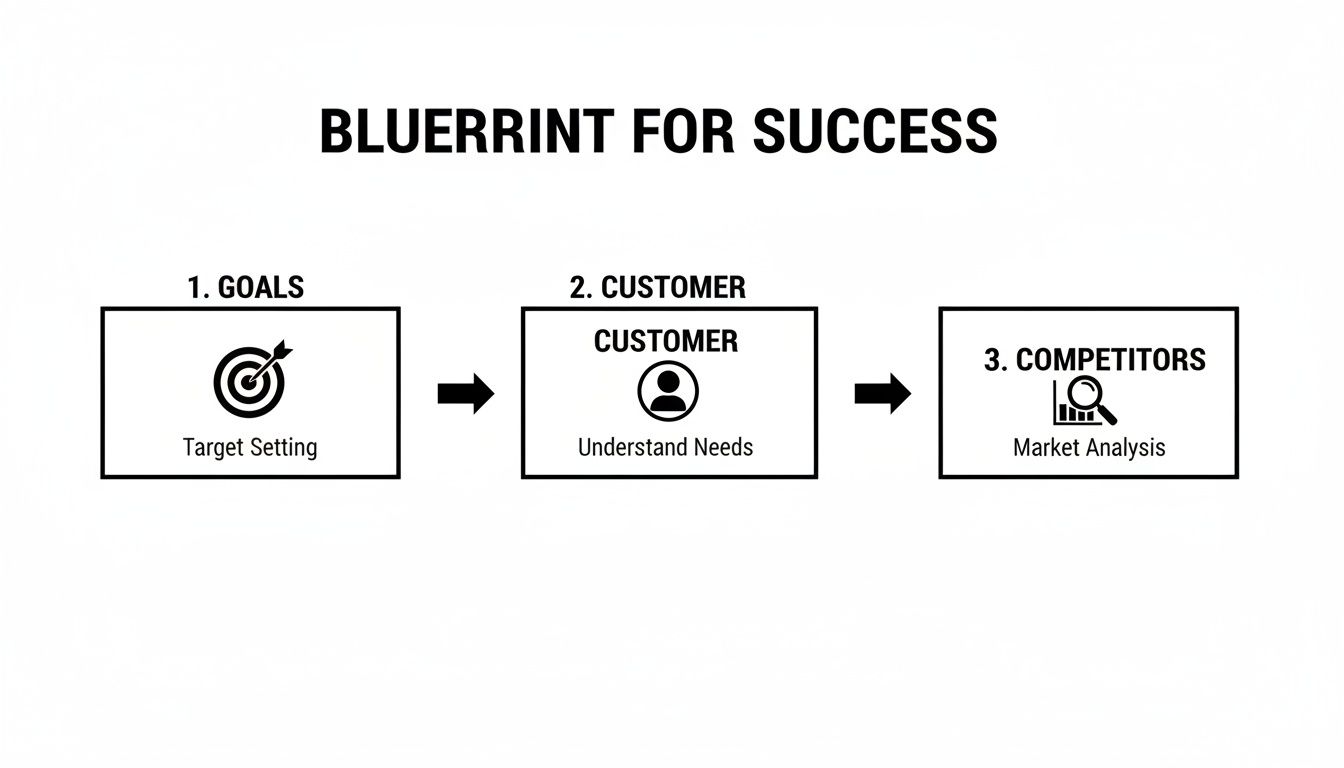
It’s a constant reminder for us: every design element and every line of copy must tie back to your business goals, serve your target audience, and set you apart from the competition.
Key Deliverables in Each Web Development Phase
To give you a clear picture of what to expect at each stage, here’s a breakdown of the key deliverables you'll see and approve. This ensures we're always on the same page and you know exactly what’s being produced.
| Phase | Key Activities | Primary Deliverable |
|---|---|---|
| Phase 1: Strategy & Planning | Discovery, competitor analysis, keyword research, defining sitemap and user flows. | Project Brief & Sitemap: A comprehensive document outlining goals, audience, and site structure. |
| Phase 2: Design & Content | Wireframing, UI/UX design, mockup creation, and copywriting. | Full-Fidelity Mockup & Content: A visual prototype of the site and the finalized text. |
| Phase 3: Development | Front-end and back-end coding, CMS setup, and feature implementation. | Functional Beta Website: A private, clickable version of the website for review and testing. |
| Phase 4: Testing & Launch | Quality assurance testing, bug fixing, final content migration, and server setup. | Live Website: The fully tested and functional website, accessible to the public. |
| Phase 5: Post-Launch | SEO monitoring, performance analytics, security updates, and ongoing maintenance. | Monthly Performance Report: A summary of traffic, rankings, and recommended next steps. |
These deliverables act as critical checkpoints, guaranteeing that the final product is exactly what you envisioned—or even better.
Phase 3: Development And Coding – Building Your Website's Engine
This is where the blueprints become a reality. With the design locked in and the strategy clear, our team rolls up their sleeves and gets to the coding. It's one thing to have a beautiful design, but it’s another to make it work.
Think of it like building a high-performance car. The design phase gives us the sleek body, the custom paint job, and the plush interior. This development phase is all about building the engine, wiring the electronics, and tuning the transmission—it's what gives the car its power and makes it go.
Front-End vs. Back-End Development
You don’t need to be a coder to follow along, but it’s helpful to know that development is really two sides of the same coin. We build them simultaneously to create a seamless final product.
-
Front-End: This is everything you and your visitors can see and touch on the screen. It's the layout, the fonts, the drop-down menus, and the animations. Our front-end developers are obsessed with making sure the site looks pixel-perfect and feels intuitive on any device, from a giant desktop monitor right down to the phone in your pocket.
-
Back-End: This is the server, the database, and all the behind-the-scenes logic that makes the website smart. When a customer fills out your contact form, the back-end is what processes that information and sends it to your inbox. A solid back-end is the key to a fast, secure, and scalable website.
We prefer to build on a proven and flexible platform like WordPress. This gives you a powerful website that is not only secure and reliable but also simple for your own team to manage. No more calling a developer just to update a sentence or swap out a photo—that’s a huge time and money saver.
Building For Performance And Future Growth
As we code, we're not just thinking about how the site looks; we're focused on how it functions to help your business. Every feature we build is tied directly back to the goals we set in the strategy phase.
For a local HVAC company, this might be an advanced quote request form that captures all the necessary details and pings the sales team instantly. For a law firm, it could be a secure client portal. The possibilities are endless, and for truly unique business needs, custom web application development can introduce some serious automation and efficiency.
A great website isn’t just a digital brochure; it’s a purpose-built tool. Every feature should have a job to do, whether that’s generating leads, booking appointments, or making your internal processes run smoother.
The technology we choose matters, too. The back-end coding language and frameworks are what determine how powerful and flexible your site can be down the road. For example, when building a complex site with Python, a developer's choice from the best Python frameworks for web development can have a major impact on the project's long-term success.
Internal Testing Is A Must
Throughout the entire build, we are our own toughest critics. We test everything. Constantly. Before we even think about sending you a preview link, our team has already spent hours trying to break things.
We click every button, fill out every form, and check every link to find and squash bugs early. This internal quality control means that when you see the site for the first time, it’s already a stable and functional product. You get to focus on the big picture, not on chasing down minor technical issues. It’s a smoother process for everyone and leaves us with a rock-solid foundation for the final steps.
Phase 4: Testing and Launch — Preparing for a Flawless Takeoff
Think of it this way: no one builds a custom car and just hands over the keys without a thorough test drive and a full, bumper-to-bumper inspection. This final phase, quality assurance (QA) and launch, is our version of that. It's the pre-flight checklist we run to guarantee your new website performs perfectly from the second it goes live.
This is where we shift from building to perfecting. It’s a disciplined, systematic hunt for any bug, broken link, or hiccup before a single customer ever sees it. We're talking about a level of detail that ensures every visitor has a smooth, professional, and frustration-free experience with your business.
Our Rigorous Quality Assurance Checklist
Before launch, we put your website through its paces with a whole battery of tests. Our goal is to simulate every possible way a user might interact with your site, making sure it holds up no matter what. This isn't just about clicking a few links; it's a deep dive into the entire user experience.
Our QA process covers a few critical areas:
- Cross-Browser and Device Testing: We test your site on all the major web browsers—think Chrome, Safari, and Firefox—and on a huge range of devices. From the latest iPhones and Androids to tablets and big desktop monitors, we ensure a consistent, high-quality experience for everyone.
- Functionality Testing: Every single button, form, and interactive element gets tested. We fill out quote requests, sign up for newsletters, and click every link to confirm they all work exactly as intended. A broken contact form is a lost lead, and our job is to make sure that never happens.
- Performance and Speed Optimization: A slow website is a killer. We run tests to make sure your pages load as quickly as possible, compressing images, streamlining code, and tuning server settings for a lightning-fast experience. A site that loads in under two seconds can make a massive difference in keeping visitors engaged.
A single broken link or a form that fails can instantly shatter a potential customer's trust. Our QA process is all about protecting that trust and ensuring your first impression is a great one.
Preparing for a Seamless Launch
Once testing is complete and we have your final sign-off, we move to the launch sequence. This is a carefully orchestrated event designed to get your new site live with zero disruption to your business. We handle all the technical heavy lifting behind the scenes.
Our launch process is broken down into three key steps to ensure everything goes smoothly.
- Foundational SEO Implementation: Before we even think about flipping the switch, we implement the essential on-page SEO elements. This means writing strategic title tags and meta descriptions, generating an XML sitemap for Google, and setting up redirects from your old site's pages to the new ones. This step is crucial for preserving your search engine rankings.
- Deployment to the Live Server: We manage the entire migration, moving the site from our development environment to your live hosting server. We always do this during off-peak hours to guarantee zero downtime for your visitors. For them, the old site simply becomes the new one, seamlessly.
- Post-Launch Audit: The job isn't done just because the site is live. We perform a final audit to double-check that everything is working perfectly in its new home. We also get your analytics tools connected, like Google Analytics and Google Search Console, so you can start tracking performance and gathering valuable data from day one.
This disciplined approach to the web development process ensures your launch is a confident step forward for your business, not an anxious, nail-biting moment.
Phase 5: Post-Launch Growth And Maintenance
Launching your new website isn't the finish line—it's the starting gun. So many businesses treat their site like a brochure; they print it, publish it, and then it sits on a shelf collecting dust. A modern website is a living, breathing part of your business that needs ongoing care to deliver real, long-term value.
This final phase of the web development process is what turns a static online sign into a dynamic, lead-generating machine. Honestly, for any business serious about growth, this part is non-negotiable.
Protecting Your Investment
First things first, we have to protect the asset we just built. This starts with solid, managed hosting that keeps your site fast and secure. It also means consistent maintenance—keeping software and plugins updated, running regular backups, and keeping a close eye on performance.
Think of it like the routine maintenance for a company vehicle. You wouldn't skip an oil change or tire rotation, and these digital tasks are just as critical. They prevent breakdowns, keep everything running smoothly, and guard your investment against threats. Implementing essential website security best practices isn't a one-time setup; it's a continuous effort to protect your site and your customers' trust.
From Maintenance To Measurable Growth
Of course, just keeping the lights on isn't the goal. The real magic happens when we start using data to make smart decisions that bring in more business. As soon as your site is live, we begin tracking how real people are interacting with it using tools like Google Analytics.
This data tells us a story. It reveals which pages are grabbing attention, where visitors might be getting stuck and leaving, and what actions they’re taking. We use these insights to pinpoint the biggest opportunities for growth.
A website without data is like driving with your eyes closed. You might be moving, but you have no idea if you're headed in the right direction. Analytics provides the roadmap for continuous improvement.
This data-driven approach lets us focus on the activities that will give you the best return:
- Conversion Rate Optimization (CRO): We might test a new headline, try a different color for the "Request a Quote" button, or simplify a contact form. You'd be surprised how small tweaks like these can lead to a big jump in leads over time.
- Ongoing SEO: We keep an eye on your search engine rankings and are always on the lookout for new ways to capture valuable traffic. The goal is to keep you visible and ahead of the competition.
- Content Strategy: By understanding what your audience is searching for, we can help you create blog posts, guides, or resources that attract qualified buyers and position you as an expert.
With 252,000 new sites launching every single day, simply existing online isn't enough. The hard truth is that a huge percentage of sites become inactive after they launch because there's no plan for what comes next.
A commitment to ongoing maintenance and strategic growth is what transforms your initial investment into a powerful, lasting advantage. This final phase ensures your website evolves right alongside your business, working tirelessly to attract customers and drive real results long after launch day.
Answering Your Questions About the Web Development Process
Even with a detailed roadmap, it's natural to have a few questions pop up. Let's tackle some of the most common things we hear from business owners about the whole web development journey.
How Long Does It Take to Build a Website?
For a custom website that’s truly built to move the needle for your business, you should realistically plan for a timeline of 8 to 16 weeks. This isn't just an arbitrary number; it's the time it takes to do things right.
This schedule gives us the breathing room to properly nail down the strategy, create a compelling design, build it all out, and then test everything thoroughly. Sure, a simpler brochure site might be quicker, but a complex e-commerce store could take longer. The key takeaway is that we'll give you a crystal-clear timeline from day one, so you're never left guessing.
What's the Single Biggest Mistake I Should Avoid?
The most costly mistake we see, hands down, is skipping the strategy and discovery phase. It's so tempting to jump right into the fun stuff—picking out colors, fonts, and flashy animations—before you’ve figured out what the website actually needs to accomplish.
A website built without a clear strategy is just an online art project. It might look nice, but it won’t grow your business.
When you put design before purpose, you almost always end up with a beautiful website that does absolutely nothing for your bottom line. Starting with a strategic blueprint ensures every single decision we make, from the layout to the call-to-action buttons, is directly tied to a specific business goal. That's how you get a real return on your investment.
How Much Should a Professional Website Cost?
It helps to think about your website not as an expense, but as a core piece of your business infrastructure—just like your top salesperson or a new delivery truck. The final price tag will always depend on the scope and complexity, but it’s a serious investment designed to pay for itself many times over.
For a business bringing in between $500k and $2M a year, the conversation shouldn't be about finding the absolute cheapest option. It should be about the immense value and ROI a high-performance website will deliver by becoming a consistent, reliable source of qualified leads and new customers for years to come.
Ready to see how a strategic Uncommon Web Design process can turn your website into your most valuable asset? We’ll show you exactly what’s possible and create a plan that aligns with your specific business goals.