
Building a website isn’t a simple task; it’s a strategic process. From the initial idea to the day it goes live, the project follows a clear, seven-stage path: Discovery and Strategy, Design, Content Creation, Development, Testing, Launch, and Post-Launch Maintenance. Think of this as the blueprint for building not just a website, but a powerful business asset.
Your Website Is a System, Not a Project
The biggest mistake we see business owners make is treating their website like a one-off project. They build it, launch it, and then forget about it, wondering a year later why it isn’t generating leads.
Let's reframe that. Your website isn't a digital brochure; it's a 24/7 sales and marketing system that should work tirelessly for your business. It's an engine designed for one purpose: to drive measurable growth.
When you see your site as a system, the questions change. It’s no longer just "How does this look?" but "How does this perform?" For a local contractor, that system needs to attract homeowners searching for patio covers and guide them to request an estimate. For a dental office, it means converting a visitor from a Google search into a scheduled appointment.
This guide walks you through the exact stages of website development we use to build that engine. We focus on engineering a system that will:
- Attract the right customers by showing up when they're searching for your services.
- Build instant trust and credibility with professional design and clear messaging.
- Drive real-world action, turning your website into your most valuable employee.
A Visual Guide to the Core Process
At a high level, the entire build boils down to three core phases: planning it, designing it, and launching it. This simple flow shows how those pieces fit together.
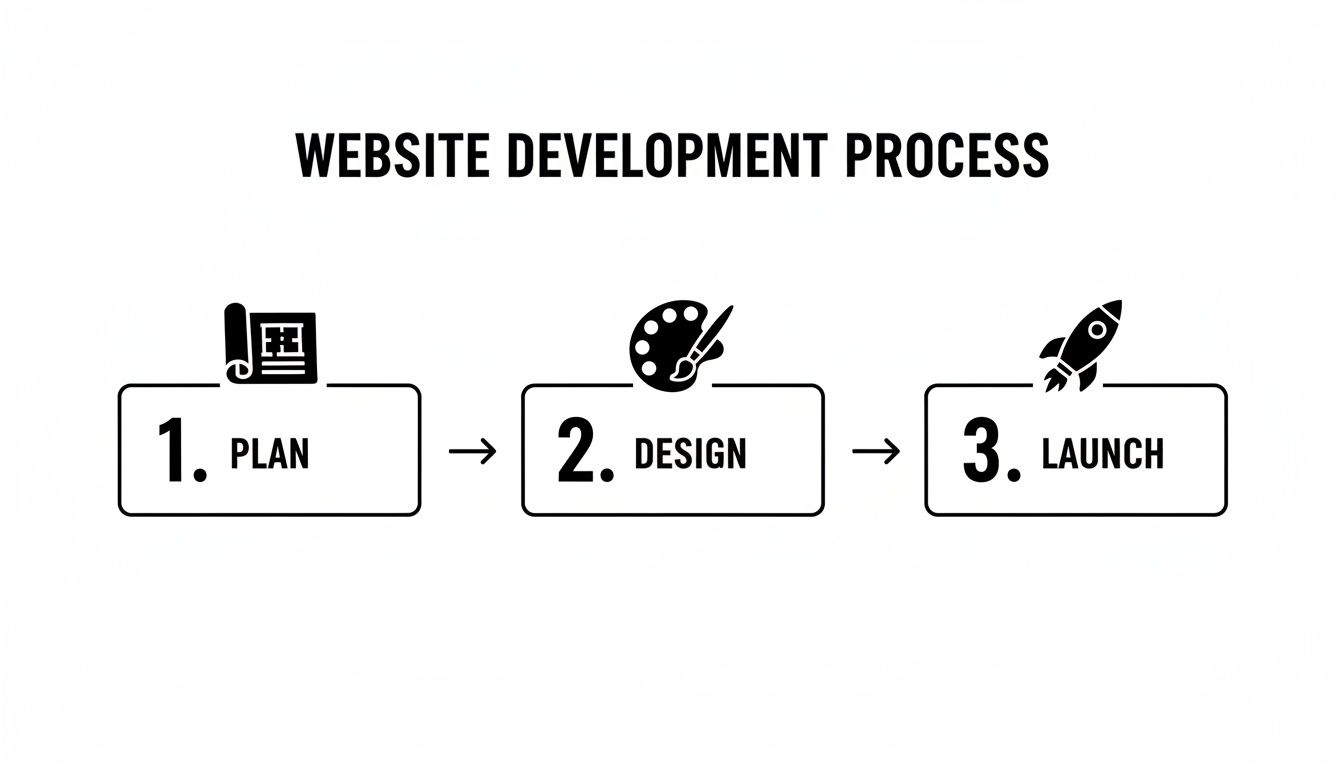
Each stage logically builds on the one before it. This step-by-step approach is what guarantees the final product isn't just a pretty picture, but a strategically sound and technically solid asset for your business.
The 7 Stages of Website Development At a Glance
Here’s a bird's-eye view of what each stage is designed to accomplish. We'll dive deep into each one.
| Stage | Primary Goal | Key Business Outcome |
|---|---|---|
| 1. Discovery & Strategy | Understand business goals and define the project scope. | A clear, actionable blueprint for a website that delivers a measurable ROI. |
| 2. Design | Create the visual identity and user experience. | An intuitive, professional-looking site that builds trust and guides users. |
| 3. Content Creation | Develop the messaging, text, and media for the site. | Compelling copy and visuals that connect with your audience and drive action. |
| 4. Development | Write the code and build the functional website. | A fast, secure, and mobile-friendly website built on a solid technical foundation. |
| 5. Testing & QA | Find and fix bugs across all devices and browsers. | A flawless user experience and the confidence that everything works perfectly. |
| 6. Launch | Deploy the website to the live server. | Your new business asset is online, visible, and ready to perform. |
| 7. Post-Launch | Maintain, update, and improve the website over time. | Long-term growth, security, and a consistently high-performing website. |
This structured approach removes guesswork and ensures we're aligned on the mission from day one.
Now, let's break down each stage so you know what to expect, why it's important, and what the key deliverables are. If you want to keep exploring, you can read more web development articles to deepen your understanding.
Let's start with the most critical phase of all: Discovery.
Stage 1: Building the Strategic Foundation
Before we write a single line of code or pick a color palette, we have to build the blueprint. This is, without a doubt, the most critical step. Skipping it is the number one reason websites fail. Would a contractor start building a house without architectural plans? Of course not. It would be an expensive mess. The same logic applies here.
This discovery phase translates your business goals into a concrete digital plan. We dig deep to understand not just what you do, but why it matters to your customers. For a local auto shop, this means recognizing their ideal customer isn't just Googling "oil change." They're searching for an "honest mechanic near me who won't upsell me." That distinction changes everything.

Defining Your Digital Game Plan
First, we get crystal clear on what success looks like for you. Is it generating 20 qualified leads per month? Increasing online sales by 30%? Or cutting down on administrative calls by automating appointment bookings? We define these goals as Key Performance Indicators (KPIs)—the specific, measurable numbers that tell us if the website is actually doing its job.
With those KPIs in mind, we map out the user journey. We put ourselves in your customer's shoes, outlining the exact path they'll take from the moment they land on your homepage to the moment they become a client. This exercise uncovers crucial questions and helps us structure the site for maximum impact.
A website built without a clear user journey is just a random collection of pages. A site built with a user journey is a guided sales process that works for you 24/7.
This first stage is where most web projects are set up for a win or doomed from the start. Industry data shows that 88.5% of visitors will leave a website if it loads too slowly—a direct result of poor planning. Another common pitfall? A confusing design, which accounts for 84.6% of mistakes that drive people away.
From Ideas to a Sitemap
The main deliverable from this stage is the sitemap. This isn't just a list of pages; it's the architectural diagram that organizes your website's content logically. It defines the navigation, sets up a clear hierarchy, and makes sure every single page has a purpose that supports your business goals.
Think of it as the floor plan for your digital storefront. The key questions we answer here are:
- What pages are absolutely essential? (e.g., Services, About Us, Contact, Testimonials)
- How should these pages be organized so visitors can find what they need instantly?
- What is the main call-to-action on each page to guide the visitor to the next step?
This structured approach ensures your investment is aimed at solving real business problems. It lays the groundwork for powerful SEO and effective lead generation long before we discuss design. For a closer look at structuring individual pages, check out our guide on effective web page strategy. Getting this foundation right ensures your website isn’t an expense, but an investment poised to deliver a real return.
Stage 2: Designing for Clarity and Conversion
With a solid strategy in place, we move to the part everyone loves: the design. But here’s the truth—great design isn’t about winning art awards. It's about function. The goal is to make your site effortlessly clear, build instant trust, and guide every visitor toward the one action you want them to take.
This is where we take the blueprint from Stage 1 and give it a visual form. The process involves two critical sides: User Experience (UX) and User Interface (UI). Think of it like a custom home. UX is the architectural plan—ensuring you can walk from the front door to the kitchen without bumping into walls. UI is the interior design—the paint, lighting, and furniture that make the space feel right.
From Wireframes to High-Fidelity Mockups
We never start by splashing color on a page. The process begins with wireframes—simple, black-and-white layouts. We keep them basic on purpose to focus entirely on structure, hierarchy, and how a user will move through the site.
Wireframing forces us to answer the tough questions first, without getting distracted by pretty pictures:
- Where does the most important information need to go?
- Is the "Get a Free Quote" button impossible to miss?
- Can someone find your phone number in three seconds or less?
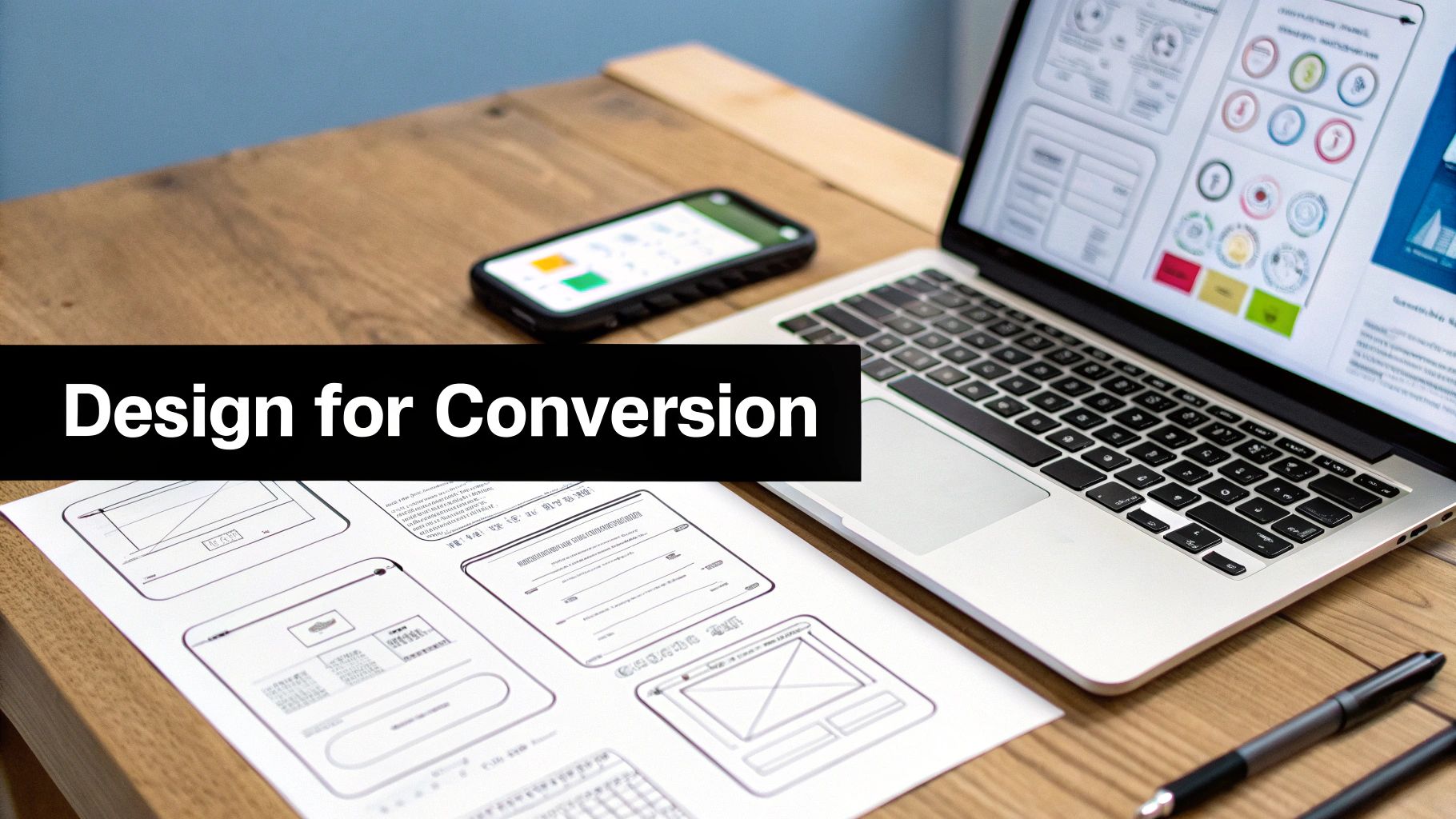
Getting the structure right ensures your website’s foundation is built to convert visitors, not just look nice.
Only after nailing the wireframes do we move to high-fidelity mockups. This is where your brand comes alive. We bring in your colors, fonts, and photos to create a pixel-perfect preview of how the final site will look and feel before we write any code.
Designing for Your Customer, Not Yourself
Every design choice has a purpose, and that purpose is to drive a specific business result. The right colors build trust, a simple navigation menu reduces frustration, and a clear visual hierarchy draws the eye to your call-to-action button.
Good design is invisible. It’s when a customer lands on your site, finds what they need, trusts what they see, and takes action without a second thought. That’s the magic we’re after.
Imagine a dental practice. A new resident is in pain and frantically searching for an emergency dentist. The website design must instantly communicate professionalism and compassion. They need to see "Emergency Services" immediately, find patient reviews that build confidence, and click a "Book Now" button without hassle. The design makes that journey smooth and stress-free. That's why our process is built on proven landing page design best practices that put clarity and action first.
And here’s a critical point: every design we create is built with a mobile-first approach. With over 60% of website visitors using their phones, your site must work perfectly on a small screen. This isn’t a nice-to-have feature; it’s a non-negotiable for any business that wants to compete.
Stage 3: Crafting Content That Connects and Sells
With the strategic blueprint and design direction locked in, it's time to breathe life into the website. A beautiful website without compelling content is like a stunning storefront with empty shelves. This stage is where we craft the words that turn a curious visitor into a loyal customer.
Your website’s content is your best salesperson, working 24/7. It must anticipate your customer's biggest questions, calm their anxieties, and show them exactly why your business is the perfect solution. It’s never about listing what you do; it's about selling a better outcome.
We focus on creating story-driven copy that gets inside the head of your ideal client. For an HVAC contractor, that means writing about the misery of a broken AC unit during a summer heatwave, then positioning their emergency service as the fastest, most reliable relief.
Writing for People and for Google
Great content has to please two different audiences: your human readers and the Google search bots. Many agencies bolt on Search Engine Optimization (SEO) as an afterthought. That’s a mistake and a recipe for getting buried on page ten.
We build SEO into the content creation process from the beginning.
- Strategic Keyword Research: First, we identify the exact phrases your best customers are typing into Google. Then we build our content around those core terms.
- Human-First Copywriting: We write for people, not algorithms. The copy is conversational and genuinely helpful, which is what both people and search engines want.
- Optimized Structure: We use headings (like the H1s and H2s in this article) and smart formatting so Google can easily understand what each page is about. This is critical for ranking well.
This integrated approach means your website doesn't just look great—it gets found by the right people from the moment it goes live.
Building Authority and Driving Action
Every word on your website needs a job. We don't write to fill space; we write to move a potential customer closer to a business goal. Whether it’s a service page, a case study, or a blog post, every piece of content is engineered to guide the reader.
Your website copy should do more than just describe what you do. It should make your ideal customer feel seen, understood, and confident that you are the only logical choice.
This is how you build authority. By creating content that genuinely helps your audience, you establish your business as the go-to expert. For a local financial advisor, that might be a blog post that breaks down complex retirement planning into simple, actionable steps. That builds trust long before they pick up the phone.
The final piece is the call-to-action (CTA). Every page needs to tell the visitor what to do next. Simple, direct prompts like "Request a Quote," "Schedule a Consultation," or "Download Our Free Guide" are the nudge that turns a passive visitor into an active lead. By weaving persuasive copy with clear direction, we transform your website from an online brochure into a lead-generation machine.
Stage 4: Turning the Vision Into a Functional Website
This is where the magic happens. We have our strategy, the design is approved, and the content is ready. Now, we roll up our sleeves for the most technical part of the journey: development. This is the stage where we transform all those static designs and documents into a living, breathing website.
Think of it as building a house. The architect (designer) has given us the blueprints and the interior designer (content creator) has picked out the finishes. Now, the construction crew—the developers—comes in to frame the house, run the electrical, and install the plumbing. This is where your vision takes shape.
For many clients, this phase can feel like a "black box." But it really just comes down to two sides of the same coin, and both are critical to your success.
Front-End: The Part Your Customers See
Front-end development is everything your visitors see and touch. It’s the visual side of the code. When someone clicks a button, scrolls through a photo gallery, or fills out your contact form, they’re interacting with the front-end. Our developers take the beautiful, pixel-perfect mockups and meticulously translate them into clean code that looks and works perfectly on every device, from a huge desktop monitor to the phone in their pocket.
The mission here is simple: create an experience that is fast, intuitive, and seamless. Animations should feel fluid, not clunky. Buttons should respond instantly. This isn't just about looking good; a frustrating user experience is a direct line to lost sales.
Back-End: The Engine Under the Hood
If the front-end is the car's slick paint job and plush seats, back-end development is the high-performance engine. It's the powerful machinery your visitors never see, but it makes everything work. This includes the server, the database, and the logic that powers your website's features.
For instance, when a customer submits a contact form, the back-end code securely grabs their information, saves it to a database, and pings your email so you can follow up. It’s the behind-the-scenes workhorse doing all the heavy lifting.
A great website needs both form and function. The front-end creates the first impression and builds trust, while the back-end ensures the entire system is reliable, secure, and ready to handle business. One without the other is a recipe for failure.
This is why we build our sites on a rock-solid foundation. For the vast majority of our clients—from local service businesses to growing online stores—we rely on WordPress. It gives us the perfect blend of power, flexibility, and user-friendliness. Forget the clunky WordPress of a decade ago; today, it’s a professional-grade platform that powers over 43% of all websites.
Using WordPress as our foundation lets us:
- Build for the future: We create a scalable site that can easily grow with you, whether you want to add a blog, an e-commerce store, or a client portal.
- Prioritize security: We implement best practices to protect your business and your customers' data from the ground up.
- Optimize for speed: We build a fast-loading website from the start, creating an experience that keeps both your visitors and Google happy.
By the end of this stage, you don't just have a design. You have a technically sound, secure, and fast website that's just a few final checks away from its debut.
Stage 5: Rigorous Testing for a Flawless Launch
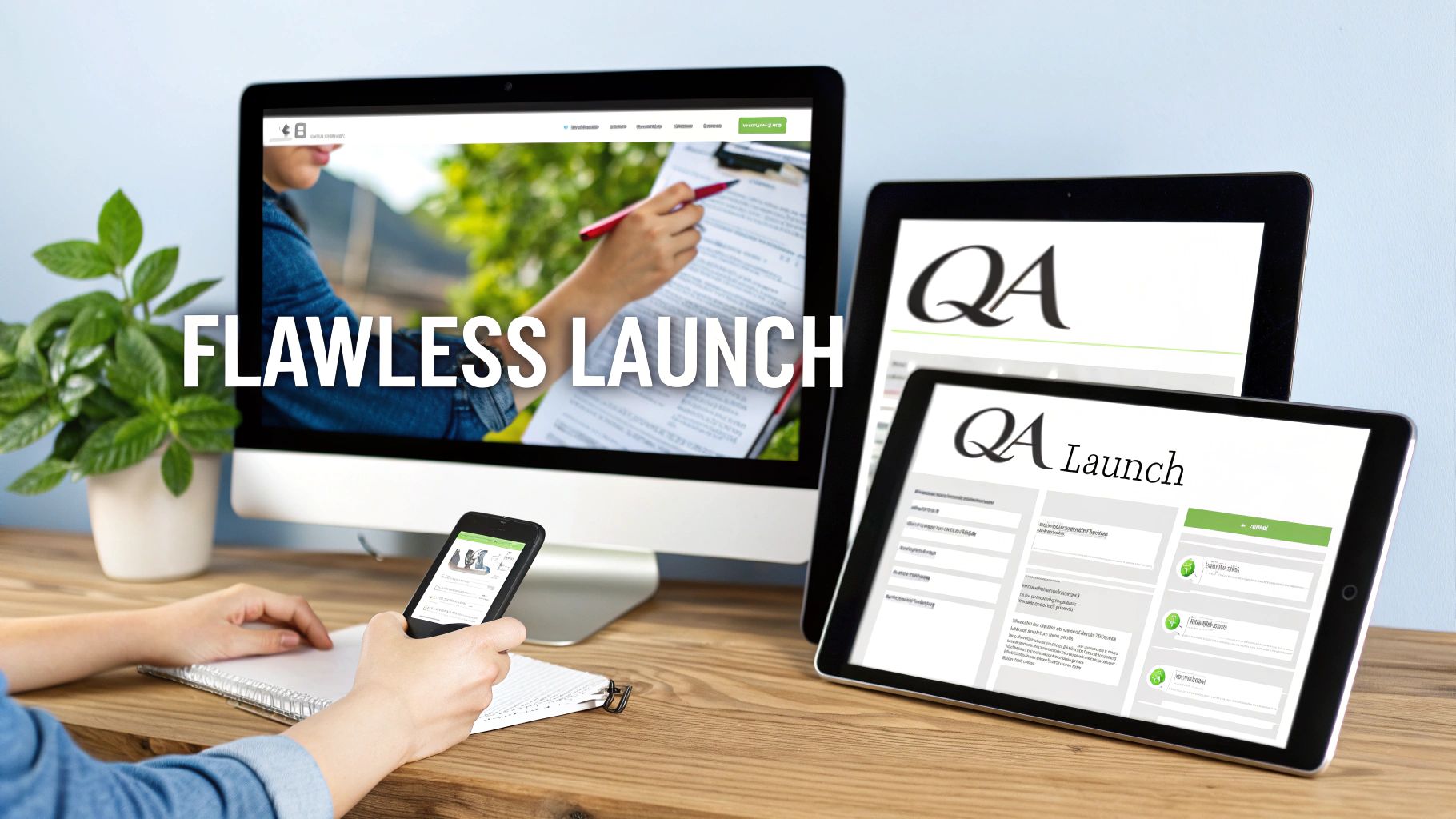
Before a single customer sees your new website, it goes through boot camp. This is the Quality Assurance (QA) stage, and frankly, it's where we get obsessive. A broken link, a contact form that goes nowhere, or a checkout button that just spins can kill a sale instantly. That’s a risk we’re not willing to take with your business.
This isn't just a quick glance. Our testing is a meticulous, top-to-bottom inspection of every page, button, and form. We become your most nitpicky customer, trying to break things so that your real customers never have to. It’s the final insurance policy for your digital storefront.
Cross-Browser and Multi-Device Validation
Your customers aren't all using the same device. One might be on a new iPhone, another on an older Android tablet, and plenty are still on desktops using Chrome, Safari, or Firefox. Your website has to look and work perfectly for every single one of them.
Our QA process covers a matrix of different devices and browsers, guaranteeing a consistent, reliable experience.
- Functionality Testing: We click everything. Does the contact form actually send you an email? Does the search bar work? We check it all.
- Responsiveness Checks: We manually resize browser windows and load the site on real phones and tablets to make sure the layout adapts flawlessly. No overlapping text or buttons that disappear off-screen.
- Performance Audits: We analyze how quickly your pages load. A slow website is a deal-breaker—even a 1-second delay can drop conversions by 7%.
Think of this as the final dress rehearsal before opening night. We find and fix all the tiny glitches now so your audience only ever sees a polished, professional, and seamless performance.
Security and Final Polish
Beyond making sure everything works, we ensure the site is secure. This means a final, comprehensive check of all security protocols built in during development. A big part of this is patching common vulnerabilities. Understanding critical web security risks like the OWASP Top 10 is fundamental to this process.
Finally, we do one last review of the content and design. We proofread for typos, double-check that all images are crisp, and ensure every visual detail matches the approved design. By the time we’re finished, your website isn’t just working—it’s a true reflection of your brand's commitment to quality.
Stage 6 & 7: Launch and Post-Launch Maintenance
The big day is here. But launching your website isn't the finish line; it's the starting line. The launch itself is a quick technical step—we point your domain name to the new server. The moment it's live, however, our focus shifts from building to protecting and growing.
A great website is a living part of your business, not a "set it and forget it" brochure. It needs consistent care to stay fast, secure, and effective. Neglect it, and that powerful asset slowly turns into a liability.
Why Ongoing Care Isn't Optional
Think of your new website like a high-performance car. You wouldn't skip oil changes and just hope for the best, right? The same logic applies here. Managed website care is the essential, ongoing maintenance that keeps your digital engine running smoothly and prevents catastrophic breakdowns.
This isn't just "keeping the lights on." Proper maintenance involves several critical tasks:
- Performance Monitoring: We constantly check your site’s loading speed to make sure it stays blazing fast.
- Security Scans: We proactively hunt for and block malicious attacks, keeping your business and your customers' data safe. You can learn more in our article on website security best practices.
- Regular Backups: We take a full snapshot of your site daily. If the worst happens, we can have you back online in minutes, not days.
- Software Updates: We are constantly updating your website's core software, theme, and plugins to patch security holes and ensure everything works together.
This proactive approach takes the technical worry off your plate, freeing you up to run your business.
Your website is your hardest-working employee, on the clock 24/7. Ongoing maintenance isn't just another bill; it's the health insurance plan that ensures your best employee is always performing at its peak.
The numbers back this up. A one-second delay in page load time can slash conversions by 7%. When you consider that 75% of your business's credibility is judged by your website's design and performance, you can see why diligent maintenance is vital for your long-term return on investment. If you're curious, you can discover more about the latest web development trends and see how this all connects.
At Uncommon Web Design, we don’t just hand over the keys and wish you luck. We build long-term assets designed for growth. Our managed hosting and maintenance plans protect your investment, keeping your site fast, secure, and always ready to turn visitors into customers. Ready to build a website that works as hard as you do? Book a no-obligation consultation today.