
If your website feels more like a digital brochure than a 24/7 salesperson, you're not alone. The problem isn't the quality of your work; it's that potential customers can't find you at the exact moment they need you most. This is where a smart SEO for service businesses strategy comes in. It’s the system that makes your business the first and best answer when someone searches "plumber near me" or "landscaper in San Diego."
Why Your Website Isn't Generating Leads
For most service business owners, a website is a significant investment. You paid for a professional design, wrote the content, and hit "launch," expecting the phone to start ringing. When it doesn’t, it’s frustrating.
Here's the hard truth: just having a website isn't enough. Without a clear plan to attract the right people, it's like putting up a billboard in the desert. Your ideal customers are on Google every single day, actively searching for what you do. They aren't just browsing—they have an urgent problem and need an expert now. SEO is the bridge connecting their search directly to your phone.
Moving Beyond a Digital Business Card
A website that actually grows your business does more than list your services and phone number. It needs to be your hardest-working salesperson, operating 24/7 to attract, educate, and convert visitors into booked jobs. This requires shifting your mindset from seeing your site as a static online pamphlet to a dynamic, lead-generating asset.
This transformation happens when your site is built to:
- Attract Qualified Traffic: You need to appear for the specific service and location keywords your ideal customers are actually typing into Google.
- Build Instant Trust: A professional design, clear messaging, and social proof like customer reviews are non-negotiable.
- Drive Action: Make it ridiculously easy for visitors to call you, fill out a form, or book an appointment on the spot.
The financial upside is huge. Recent data from First Page Sage shows that SEO delivers a massive return for service businesses. HVAC companies, for instance, see an average ROI of 678%, while construction businesses can hit 681% in just five months.
Think of it this way: traditional ads are like renting an audience—the leads stop the second you stop paying. SEO is like buying the land and building the store. It’s a business asset that grows in value, continuously generating leads at a much lower long-term cost.
But getting people to your site is only half the battle. To truly grow, you need to turn that traffic into tangible business. We cover exactly how to do that in our guide on how to improve website conversion rates. This guide will show you how to build a powerful, automated system for long-term growth.
Winning the Local Search Game
For any service business, the real action is local. When a homeowner's pipe bursts, they aren't looking for a plumber three states away—they're searching for an expert in their own city. This is your playbook for getting in front of those urgent, high-intent 'near me' searches that turn into real, paying jobs.
Forget about chasing complicated SEO tricks. Winning at local search is about methodically building a powerful, trustworthy digital footprint that Google simply can't ignore. This is especially true when it comes to generating new local leads for service businesses, where proximity and trust are everything.
Your Most Powerful Local SEO Tool
Let's get straight to it: your Google Business Profile (GBP) is the single most important tool in your local marketing kit. Think of it as your digital storefront right on the Google search page. For many potential customers, it's the very first impression they'll have of your business. A neglected profile is a massive missed opportunity.
An optimized GBP works for you 24/7. It's a salesperson that answers questions, shows off your best work, and funnels leads directly to your phone. It’s not just another listing; it's a dynamic channel for acquiring customers, and it needs consistent attention to perform.
To turn your profile into a lead machine, get these essentials right:
- Complete Every Section: Don't skip a thing. Fill out every single field you can—services, service areas, hours, photos, and all the rest. The more details you give Google, the better it understands exactly what you do and who you serve.
- Choose the Right Categories: Be specific. Your primary category should be your core service (e.g., "Plumber," not the broader "Home Services"). Then, add secondary categories to cover every other relevant service you provide.
- Upload High-Quality Photos and Videos: People want to see who they're hiring. Regularly add fresh photos of your team in action, your branded vehicles, and finished projects (always with the client's permission). This builds immediate trust and showcases the quality of your work.
This flowchart illustrates the difference between short-term spending on ads versus the long-term value you build with a solid SEO strategy.
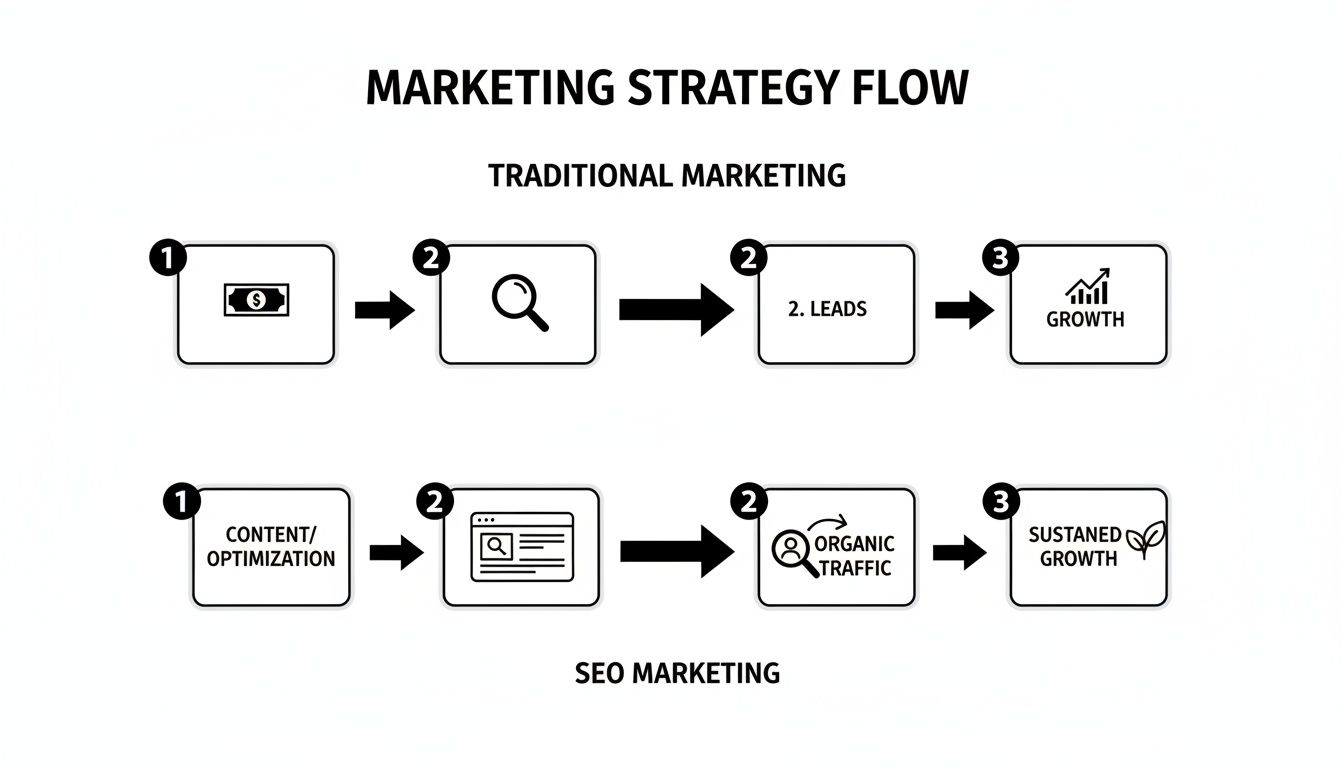
The takeaway is simple. Ads can get you leads today, but they stop the second you stop paying. A well-executed local SEO plan, on the other hand, builds a sustainable growth engine that keeps working for your business long-term.
The Foundation of Local Trust: NAP Consistency
Beyond your Google profile, search engines are constantly scanning the web for signals that your business is legitimate and reliable. The absolute cornerstone of this digital trust is your NAP data: your Name, Address, and Phone Number.
If you're listed as "Mike's Plumbing" on one directory and "M. Plumbing LLC" on another, it creates confusion for both Google and potential customers. These seemingly small mistakes can erode trust and actively hurt your local rankings.
Your business name, address, and phone number must be 100% identical everywhere they appear online. This means your website, all social media profiles, and every single online directory—no exceptions.
This consistency is a powerful signal to Google that you are a stable, real-world local business. It's a foundational piece of the puzzle you can't afford to get wrong.
Building Local Authority With Citations
With a consistent NAP locked in, the next step is building citations. A citation is simply any online mention of your business's name, address, and phone number, usually found in online directories. Think of major players like Yelp, Angi, and the Better Business Bureau, as well as smaller, industry-specific sites.
Every high-quality citation is like a vote of confidence that reinforces your connection to a specific service area. It’s a critical factor in how Google decides which business is the most prominent and relevant for a local search. The goal isn't just to get as many as possible; it’s about getting listed in reputable, relevant directories.
The numbers don't lie. A staggering 46% of all Google searches are for local information, and research shows 76% of people who search for something 'near me' on their phone visit a related business within 24 hours. This is traffic you want.
Below is a quick-start checklist to help you tackle the most important local SEO tasks first.
Your Local SEO Priority Checklist
This prioritized list of actions will help you improve your local search visibility and start attracting more nearby customers right away.
| Priority | Action Item | Why It Matters for Your Business |
|---|---|---|
| High | Fully optimize your Google Business Profile (GBP) | This is your digital storefront. A complete profile with services, photos, and posts is often the first interaction customers have with you. |
| High | Ensure perfect NAP (Name, Address, Phone) consistency | Inconsistent information across the web confuses Google and hurts your rankings. It must be identical everywhere. |
| Medium | Build citations on core directories like Yelp, Angi, etc. | These listings act as trusted third-party verification that your business is legitimate and serves a specific local area. |
| Medium | Actively solicit and respond to customer reviews | Reviews are a huge trust signal for both customers and Google. More positive reviews directly impact your local pack ranking. |
| Low | Build citations on niche or industry-specific directories | While not as powerful as the core directories, these further solidify your expertise and relevance within your specific field. |
By systematically optimizing your Google Business Profile and locking down your business information across the web, you lay the groundwork for dominating local search.
Building Service Pages That Actually Sell

One of the most common mistakes service businesses make is lumping everything they do onto a single, generic "Services" page. It feels efficient, but it's a massive missed opportunity for both SEO and for converting visitors into customers.
Put yourself in your customer’s shoes. Someone frantically searching for "emergency AC repair in Temecula" has a very specific, urgent problem. A vague page that also mentions furnace installation and commercial refrigeration doesn't speak to their immediate need. This is a moment where clarity converts.
Creating dedicated pages for each of your core services is one of the most powerful moves you can make in your SEO for service businesses strategy. It lets you fine-tune your message, target precise keywords, and demonstrate expertise in a way a single page never could.
The Anatomy of a High-Converting Service Page
An effective service page does more than just list features. It convinces a visitor that you are, without a doubt, the best solution to their problem. It needs to be part sales pitch, part educational resource, and 100% focused on the customer.
Each service page should follow a clear blueprint designed to answer questions, build trust, and guide the visitor toward taking action. Think of it as your roadmap for turning a curious browser into a confident lead.
Here’s the basic framework we start with:
- A Problem-Focused Headline: Don't just say "HVAC Services." Get specific with something like "Fast & Reliable Air Conditioning Repair for Murrieta Homeowners." It immediately tells the visitor they’re in the right place.
- Empathy and Agitation: Start by describing the problem they’re facing. Acknowledge their frustration—"A broken AC on a hot summer day is more than an inconvenience; it's an emergency." This shows you understand.
- The Solution (Your Service): Now, introduce your service as the clear solution. Explain the process, what's included, and what makes your approach better than the competition's.
- Social Proof: This is non-negotiable. Include testimonials from happy clients, short case study examples, or even logos of local businesses you’ve helped. This builds instant credibility.
- A Clear Call to Action (CTA): End by telling them exactly what to do next. "Call Now for a Free Estimate" or "Schedule Your Service Online" are direct and leave no room for confusion.
Your website content is your digital salesperson. Each service page is an opportunity to have a focused conversation with a potential customer about a specific problem they need solved. Make that conversation count.
Weaving in Local Keywords Naturally
These dedicated service pages are the perfect place for targeting those high-intent local search terms. This is how you show up for people who are actively looking to hire someone in their immediate area, right now.
The trick is to make it feel natural, not like you're just stuffing keywords in for Google's sake. The goal is to signal to search engines—and, more importantly, to your readers—exactly where you operate.
Best Practices for Localized Content
Your writing needs to sound like a real person talking, not a robot. Writing copy that connects with an audience while also checking all the SEO boxes is a skill. If you want to dive deeper, we have a complete guide that breaks down how to write website content that gets results.
Here are a few simple ways to bake local signals into your service pages:
- In Headings and Subheadings: A subheading like "Your Trusted Plumber in the Temecula Valley" is both helpful for users and great for SEO.
- Throughout the Body Copy: Casually mention specific neighborhoods, landmarks, or parts of town you serve. For instance, "We've been helping families in the French Valley and Redhawk communities for over 15 years."
- Within Testimonials: When you post a customer review, add their city. Seeing "John D. from Murrieta, CA" is a powerful trust signal for other Murrieta residents.
By creating these hyper-focused, locally-optimized pages, you're doing more than just trying to rank on Google. You are building a powerful digital asset that speaks directly to your ideal customer’s needs and positions your business as the obvious, trusted local expert.
Getting Your Website's Foundation Right
Think of your website as the engine of your business. You can have the best-looking truck wrap and the friendliest receptionist, but if the engine is broken, you aren't going anywhere. It’s the same with your website—if its technical foundation is shaky, even the most persuasive service pages won't bring in new customers.
This is where technical SEO comes in. It’s not as scary as it sounds. It’s simply the work we do ‘under the hood’ to ensure search engines like Google can easily find, crawl, and understand what your site is all about. For any local service business, getting this right is non-negotiable.
The Make-or-Break Technical Elements
Picture your ideal customer. Chances are, they’re on their phone, maybe even in their car, looking for someone to solve a problem right now. If your website isn’t ready for that moment, they’ll hit the back button and call your competitor without a second thought.
You don't need to be a coding whiz, but you absolutely need to nail these three pillars for a technically healthy website:
- Mobile-Friendliness: Your website has to look and feel great on a smartphone. Is the text readable without pinching and zooming? Are the buttons easy to tap? Can someone click your phone number to call you instantly? With over 60% of all searches happening on mobile, this isn't a feature; it's a requirement.
- Site Speed: How quickly does your page pop up? If a potential customer has to wait more than three seconds, they're gone. We all expect things to load instantly, and a sluggish website is a surefire way to lose a hot lead.
- Clear Navigation: When someone lands on your site, can they immediately figure out what you do, where you do it, and how to contact you? A clean, logical site structure is just as important for Google as it is for a real person trying to give you their money.
A technically sound website doesn't just appease Google's algorithm. It creates a smooth, frustration-free experience for your visitors, which directly translates into more phone calls and contact form submissions. It's a direct investment in your bottom line.
Speaking Google’s Native Language with Schema Markup
Once your site is fast, mobile-ready, and easy to navigate, it's time to add a powerful, yet often overlooked, layer: schema markup.
Imagine it as adding little cheat sheet notes directly into your website's code. These notes are invisible to your human visitors, but they speak directly to search engines, spoon-feeding them critical details about your business. It removes the guesswork for Google.
For instance, you can use schema to explicitly tell Google:
- Your business type (e.g., you’re a
LocalBusinessand, more specifically, aPlumber) - Your exact service area (the specific cities and zip codes you cover)
- Your business hours
- Your customer ratings
By adding this structured data, you’re basically handing Google a perfectly organized dossier on your business. This helps it understand you’re not just some blog that mentions plumbing, but a real-deal plumbing company serving a specific community. This single step can be a game-changer, often resulting in "rich snippets" in the search results—like star ratings appearing right below your listing.
Earning Trust with Reviews and Backlinks

In the service business, your reputation is your currency. Online, that reputation is built on two things: what your customers say about you (reviews) and what other local businesses say about you (backlinks). These aren't just feel-good metrics. They are direct signals to both Google and your potential customers that you're a legitimate, high-quality business.
Think about it from a customer's perspective. When looking for a plumber, who do they call? The one with 45 recent, glowing reviews, or the one with two reviews from last year? It's a no-brainer. In fact, a staggering 95% of people trust online reviews just as much as a recommendation from a friend. They are the new word-of-mouth.
Turning Happy Customers into a Marketing Asset
Your job isn't done when you send the final invoice. That moment—right after you've solved a customer's problem—is the perfect time to turn their positive experience into a powerful review. Building a simple system for asking for reviews is one of the highest-ROI activities you can do for your local SEO.
The trick is to make it dead simple for them. Any friction will tank your success rate.
Here’s a simple, proven process:
- Time it Right: Ask for the review immediately after the job is done. The positive feeling is fresh and they're most likely to act.
- Make it Personal: A quick, personal text or email from you or the technician feels genuine and gets much better results than a generic, automated email.
- Provide a Direct Link: Never just say, "Please review us on Google." That's asking them to do work. Send them a direct link that opens the review box instantly.
Your goal isn't just to get a few reviews; it's to create a steady stream of them. Google loves to see fresh, consistent feedback. It shows you're actively making customers happy right now, not just a year ago.
And don't forget to reply to every single review, good or bad. Thanking customers for positive feedback shows you appreciate them. Responding professionally to criticism shows you're accountable and committed to quality service. That active management is a huge trust signal on its own.
Building Local Authority with Quality Backlinks
If reviews are your customers vouching for you, backlinks are other websites vouching for you. A backlink is simply a link from another site to yours. To Google, a link from a respected, relevant website is a powerful vote of confidence.
You can forget about complicated, spammy link-building schemes. For a local service business, the name of the game is quality over quantity. Your focus should be on earning high-quality, geographically relevant links that cement your place in the local community. A single link from the local Chamber of Commerce website is worth more than a hundred links from random online directories.
Here are a few practical places to start earning these valuable local links:
- Local Organizations: Sponsor a local kid's sports team, join the Chamber of Commerce, or get involved with a community nonprofit. These groups almost always list their sponsors and members on their websites, complete with a link.
- Niche Industry Associations: Are you part of a regional trade association for HVAC techs or electricians? Your membership probably includes a listing in their online directory.
- Supplier and Partner Websites: Think about the suppliers you buy from or other businesses you work with. If a roofer regularly refers you for gutter jobs, ask them to add you to their "trusted partners" page with a link.
Every quality backlink you earn tells Google that you're a real, trusted player in your local business community. This is a non-negotiable part of a solid SEO for service businesses strategy, helping you build a digital presence that truly stands out.
Tracking the Metrics That Matter for Growth
If you're not measuring, you're guessing. This is especially true for SEO. It’s easy to get distracted by "vanity metrics"—like a big spike in website traffic—that look impressive but don't actually lead to paying customers.
Real, sustainable growth comes from focusing on the numbers that directly impact your revenue. It's about knowing precisely what's working so you can double down on it, and what's not so you can fix it or stop wasting your time.
Moving Beyond Traffic to Conversions
Let's be blunt: a surge in website visitors is great, but if your phone isn't ringing any more than usual, what's the point? The single most important mental shift you can make is to stop obsessing over how many people visit your site and start tracking how many of them actually become qualified leads.
For any service business, success comes down to a few critical actions:
- Phone Calls from the Website: How many people tapped the "call now" button on your site? These are often your hottest leads.
- Form Submissions: How many potential clients filled out your "Request an Estimate" or "Contact Us" form?
- Google Business Profile Actions: Don't forget the leads that happen before someone even clicks to your site. This includes calls and requests for directions right from your Google listing.
These aren't just data points. Each one represents a real person who needs your services. When you focus on these conversions, you start measuring the true return on your SEO investment.
Tracking conversions is the only way to know if your website is just an online brochure or if it's acting as your best 24/7 salesperson. The goal isn’t more clicks—it’s more customers.
The Essential Toolkit for Measuring What Works
You don't need a massive budget or complicated software to get started. In fact, two incredibly powerful and completely free tools from Google will give you everything you need to connect your SEO efforts to real business results.
Google Search Console
Think of Google Search Console (GSC) as your direct line of communication with Google. It tells you exactly which search terms people are using to find you, where you're ranking for those keywords, and how many clicks you’re getting from the search results. This is ground zero for monitoring your visibility for money-making keywords like "emergency plumber in Murrieta."
Google Analytics
While GSC tells you how people find you, Google Analytics (GA4) tells you what they do after they land on your website. This is where the magic happens. By setting up conversion goals, you can precisely track how many of those visitors turn into phone calls or form fills. It’s the key to proving your SEO is actually generating leads.
To get a complete picture of your performance, it helps to bring all this data together. For a deeper dive, check out the top local SEO reporting tools for service businesses that can help you visualize what's driving real growth.
To keep things simple, here are the core KPIs you should be watching.
Essential SEO KPIs for Service Businesses
Focus on these key metrics to understand the real impact of your SEO efforts on business growth.
| KPI (Key Performance Indicator) | What It Tells You | Tool to Use |
|---|---|---|
| Organic Lead Volume | The total number of phone calls and form submissions from organic search. This is your most important metric. | Google Analytics (GA4) |
| Keyword Rankings | Your visibility in search results for your most important service and location-based keywords. | Google Search Console (GSC) |
| Google Business Profile Actions | The number of calls, website clicks, and direction requests originating from your GBP listing. | GBP Insights |
| Conversion Rate | The percentage of website visitors who become a lead. This shows how effective your site is at selling. | Google Analytics (GA4) |
| Organic Traffic | The total number of visitors who found you through a search engine (not ads). Tracks overall brand visibility. | Google Analytics (GA4) |
By keeping a close eye on these specific numbers, you'll always have a clear, honest assessment of how your SEO is performing. You'll know what to celebrate and what needs attention.
Frequently Asked Questions
As you start putting these SEO strategies into practice for your service business, you're bound to have some questions. Let's tackle some of the most common ones we hear from business owners who are right where you are now.
How Long Does SEO Take to Work for a Service Business?
Everyone wants to know the timeline, and the honest answer is: it's a process. You can often see encouraging early movement in the first 1-3 months, especially after optimizing your Google Business Profile.
But for the kind of results that really move the needle—think consistent leads and a strong local presence—you’re typically looking at 4-6 months to build serious momentum. Think of it like planting a tree, not flipping a switch. The effort you invest now in building authority pays off for years, creating a business asset that keeps generating leads long after you've done the work. It's the polar opposite of paid ads, where the leads dry up the second you turn off the spend.
Can I Do SEO Myself or Should I Hire Someone?
You can definitely get the ball rolling on your own. There are foundational tasks that are perfect for a DIY approach. Things like claiming and optimizing your Google Business Profile, ensuring your business name and address are consistent everywhere online, and setting up a simple process to ask every happy customer for a review are fantastic first steps.
The challenge comes with scaling up. A full-blown strategy involves a lot of moving parts—technical site audits, consistent content creation, and strategic local link building. These aren't just one-and-done tasks; they require ongoing effort and expertise. A seasoned professional can speed things up and help you sidestep common pitfalls. For most busy owners, it comes down to bandwidth.
What Is More Important: Local SEO or General SEO?
For a service business with a defined geographic footprint—plumbers, roofers, dentists, you name it—the answer is clear: local SEO is your bread and butter. It’s all about getting in front of potential customers in your immediate area who are searching right now for the services you provide.
The fundamentals of general SEO, like having a fast website and creating helpful content, are still the foundation. But your strategy needs to be laser-focused on local signals. That means your Google Business Profile, local directory listings (citations), and service pages tailored to specific towns or neighborhoods are what will ultimately make your phone ring.
Ready to stop guessing and start turning your website into a predictable source of new customers? At Uncommon Web Design, we build SEO systems designed specifically for service businesses that need measurable growth. If you're ready for a clear, actionable plan, let's talk. Schedule a free consultation with us today.