When you need customers now, Pay-Per-Click (PPC) advertising is the most direct way to make it happen. It puts your business in front of people actively searching for what you do. While other marketing strategies take time to build, a well-managed PPC campaign can have your phone ringing almost overnight.
This guide isn't about marketing jargon; it's a straightforward look at how smart PPC management drives real business growth.
Why Smart PPC Management is a Growth Engine, Not an Expense
As a business owner, you can't afford to throw money at marketing that feels like a shot in the dark. Professional PPC isn't another line item on your budget—it's a calculated investment designed to connect you with customers who are ready to buy.
Think of it this way: PPC is like putting up a billboard on the busiest digital highway in your city. Except this billboard only appears for your perfect customer at the exact moment they need you. It’s a direct line to motivated buyers, and that immediacy is what makes it one of the most powerful tools for driving rapid growth.
The Fastest Path to Qualified Leads
Building your organic search presence (SEO) is vital, but that's a marathon. PPC management for small business is the sprint that gets you results today. For a local contractor, it means your ad shows up the instant a homeowner searches "emergency plumbing repair near me." You aren't just hoping they find you—you're making sure of it.
This strategic approach delivers real, measurable results, fast. Here’s why it’s so effective:
- Immediate Visibility: Your ads can be live within hours, placing you at the top of Google’s search results.
- Hyper-Targeting: You can zero in on customers based on their location, the words they type into Google, and even the time of day they’re searching.
- Total Budget Control: You decide exactly what you want to spend each day or month. No surprise bills.
It's no wonder that 65% of small businesses now use PPC campaigns. This isn't a fringe tactic; it's a fundamental strategy for winning customers. If you're running an e-commerce site, learning how to promote your Shopify store effectively is key, and PPC is a huge piece of that puzzle. For a deeper dive into how paid ads differ from SEO, compare organic and paid traffic in our comprehensive guide.
The Anatomy of a High-Performing PPC Campaign
Let’s pull back the curtain on what makes a PPC campaign work. Think of it like a high-performance engine—every part has a job, and they all have to work together perfectly. A winning campaign isn't about some secret formula; it's about methodically aligning a few key pieces.
For a small business, getting this right is the difference between burning cash and generating a steady stream of customers. Before building any campaign, a thorough understanding your competitive landscape is crucial for spotting opportunities.
This mind map shows how we structure a PPC strategy to drive real growth by focusing on speed, laser-focused targeting, and a relentless commitment to return on investment.
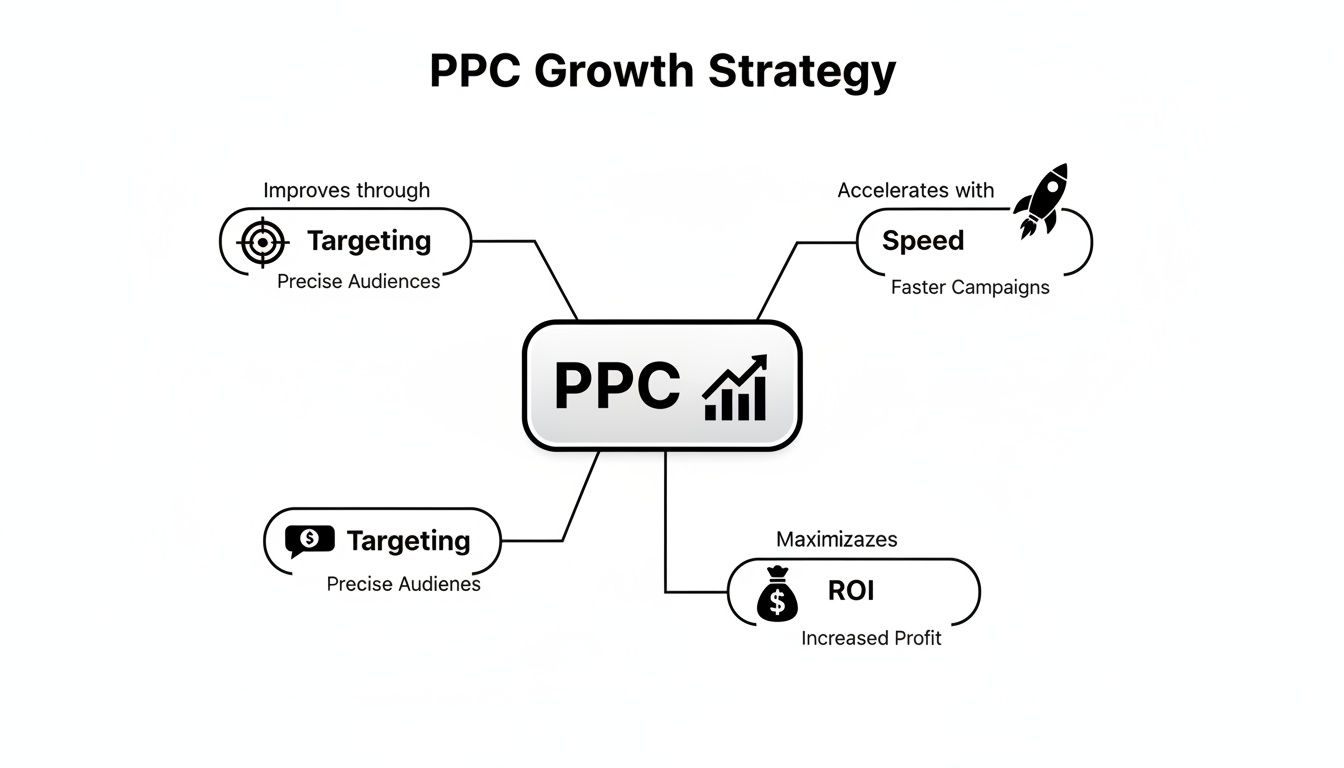
Each branch highlights a core piece of the puzzle. When managed correctly, these pieces turn your ad spend into actual, measurable profit.
Finding Your Customers with Keyword Research
Everything begins with keywords. These are the exact phrases your ideal customers are typing into Google when they need you. Smart PPC management for a small business is about digging deep to find "high-intent" keywords.
For instance, an auto shop bidding on the generic term "car repair" will pay a fortune to attract casual browsers. But a high-intent keyword like "transmission repair Murrieta CA" targets someone with a specific, urgent problem—and they’re ready to pay for a real solution. We focus on finding those golden nuggets that signal someone is ready to buy.
Crafting Ads That Get Clicked
Once you know what people are searching for, you need an ad that speaks directly to their needs. Great ad copy isn't about being clever; it's about being clear, compelling, and offering an immediate answer.
Your ad is a promise. It tells a potential customer, "I understand what you need, and I have the answer right here." A powerful ad starts building trust before they even click.
An ad for a local contractor shouldn't just say, "General Contractor." It needs to connect. "Fast & Reliable Kitchen Remodels. Get a Free Estimate Today!" is far more effective. It’s specific, it creates urgency, and it gives a clear next step, which dramatically boosts the chances of getting a truly qualified click.
The Final Step: Turning Clicks into Customers
Getting the click is only half the battle. Where you send that visitor after they click is the most important part of the equation. We see it all the time: businesses waste thousands in ad spend by sending highly motivated traffic to their generic homepage.
This is a massive mistake. Every ad campaign needs to point to a dedicated landing page built for one purpose: getting that person to take action. This page must perfectly match the promise made in your ad and make it incredibly easy for the visitor to take the next step, whether that's calling your office or filling out a form. To see what makes a great one, check out our guide on landing page design best practices.
How to Set a Realistic PPC Budget for Real Results
"So, how much is this going to cost me?"
It’s always one of the first questions we hear, and for good reason. The answer isn't a simple number—it's about strategy. Your budget isn't just an expense; think of it as the fuel for your campaign's engine, powering it to gather crucial data.
In the beginning, view your budget as an investment in market intelligence. You're paying to discover exactly what it costs to acquire a new customer online. This isn't about guessing. It's about a calculated process to find the sweet spot where your ad spend generates a predictable, profitable return.

What Determines Your Ad Spend
There's no magic "one-size-fits-all" budget because every business operates in its own competitive space. Several key factors directly shape what you should expect to invest.
Here are the main variables:
- Industry Competitiveness: Are you a plumber in a crowded city? You'll pay more for a click on "emergency plumbing" than a niche B2B company will for its specialized terms. High-value services naturally have higher click costs because the potential payoff is bigger.
- Geographic Targeting: Targeting a single small town is much cheaper than covering an entire metropolitan area. The more focused your service area, the more efficiently your budget will be spent.
- Business Goals: What do you want to achieve? Making the phone ring, driving foot traffic, or selling products online? Each objective requires a different approach. For instance, our work with PPC for e-commerce is laser-focused on direct sales, which carries different budget considerations than a local lead generation campaign.
Getting a handle on these factors is the first step toward setting a budget that actually works for your business.
Budget Tiers and What to Expect
To make this more concrete, let's break down what different budget levels can realistically accomplish. One of the most common missteps we see is starting too small. When you do that, you starve the campaign of the very data it needs to become profitable. You have to spend enough to learn what works.
A PPC budget isn't a number you set and forget. It's a dynamic tool for gathering intelligence, testing assumptions, and ultimately building a machine that turns dollars into customers.
The table below gives you a framework for understanding what different monthly ad spend levels can achieve, from the initial testing phase to scalable growth.
Sample Monthly PPC Budgets and Expected Outcomes
This table breaks down what small businesses can generally expect at different monthly ad spend levels, focusing on initial data gathering versus scalable lead generation.
| Monthly Ad Spend | Primary Goal | Typical Focus | Expected Outcome |
|---|---|---|---|
| $500 – $1,500 | Data Gathering & Testing | Proving the concept. Identifying which keywords, ads, and audiences convert at the best price. | Learning your true cost per lead (CPL). Expect a trickle of leads, not a flood. Essential for building a foundation. |
| $1,500 – $3,000 | Consistent Lead Flow | Optimizing winning campaigns. Expanding on what works and cutting what doesn't based on initial data. | A predictable number of leads or sales each month. You can start forecasting growth based on your ad spend. |
| $3,000+ | Scaling & Dominance | Aggressively capturing market share. Expanding to new services or locations and outbidding competitors on top keywords. | Significant and scalable business growth. Your PPC campaign becomes a reliable, primary source of new customers. |
The key takeaway is simple: start smart, gather good data, and scale your investment once you've proven the return. Even a modest, well-managed budget delivers powerful insights that pave the way for real growth.
Choosing Your Path: DIY vs. Professional Management
So, should you run your own PPC campaigns or hire someone? On the surface, the DIY route seems like an obvious way to save money, especially when you’re watching every penny. But this is a classic "penny wise, pound foolish" situation.
As a busy business owner, trying to become a digital marketing expert overnight is a recipe for frustration. You're already juggling sales, customers, and a thousand other things. PPC isn't a "set it and forget it" machine; it's a complex system that needs constant tuning, a deep understanding of bidding strategies, and the technical know-how to keep up with platforms that are always changing.
The real question isn't about the management fee—it's about the value of your time and the cost of mistakes.
The True Cost of a DIY Approach
When you go it alone, you’re on the hook for everything: keyword research, ad copywriting, landing page design, conversion tracking… it all falls on you. You’re not just learning a new skill; you’re competing against seasoned professionals who live and breathe this stuff every day.
The learning curve is steep, and mistakes can be brutal on your budget. A simple error, like forgetting to set a geographic target, can vaporize your entire monthly ad spend in a single afternoon with zero leads to show for it.
The most expensive PPC campaign is the one that doesn't work. Wasted ad spend from simple mistakes often costs a business far more than a professional management fee ever would.
And don't forget how fast the technology is moving. PPC management for small business is now driven by sophisticated AI. Properly managed smart bidding strategies can slash your cost-per-acquisition by as much as 30%—a massive efficiency gain that's tough to unlock without real expertise.
When you weigh that against the potential for wasted spend, a professional management fee—typically between $500 to $3,000 a month—starts to look more like a smart investment. You can find out more about how smarter ads are delivering bigger ROI at CausalFunnel.com.
An Honest Head-to-Head Comparison
To make the right call, you have to look past the monthly invoice. Think about the hours you'll spend, the growth you might miss, and the expertise you're either gaining or buying. A good agency doesn't just run ads; they bring a proven process and years of data-driven insights to the table.
We’ve put together a simple table to show you what this choice really looks like.
DIY PPC vs. Professional Management: A Head-to-Head Comparison
This table compares the real-world implications of managing PPC in-house versus hiring a specialized agency, focusing on cost, time, expertise, and potential outcomes for a small business.
| Aspect | DIY PPC Management | Professional Agency Management |
|---|---|---|
| True Cost | Low upfront fee, but high risk of wasted ad spend from costly errors and missed optimizations. | A predictable monthly management fee that is an investment in efficiency and expertise. |
| Time Investment | Significant and ongoing. Requires hours each week for learning, monitoring, and adjusting campaigns. | Minimal. Frees you up to focus on running your business while experts handle the complexities. |
| Expertise & Tools | Limited to your own research. Access to basic platform tools only. | Deep industry knowledge, access to premium analytics tools, and cross-campaign insights. |
| Potential Outcome | Slow, often frustrating results with a high chance of campaign failure and budget waste. | Faster, more predictable results. Campaigns are optimized for ROI from day one, leading to scalable growth. |
Ultimately, choosing an agency isn't an expense—it's a strategic decision to buy back your time and invest in expertise that drives predictable growth.
The Only PPC Metrics That Actually Matter
It’s easy to open your Google Ads account and immediately feel like you’re drowning in data. You have charts for impressions, click-through rates, and a dozen other numbers that look important but don’t actually tell you if you’re making money.
For a small business owner, most of that is just noise.
Impressions and clicks are what we call vanity metrics. They show activity, but they don't pay the bills. A thousand clicks that don’t lead to a single phone call are worthless. Smart PPC management for a small business means cutting through the fluff and focusing only on the numbers that directly impact your bottom line.
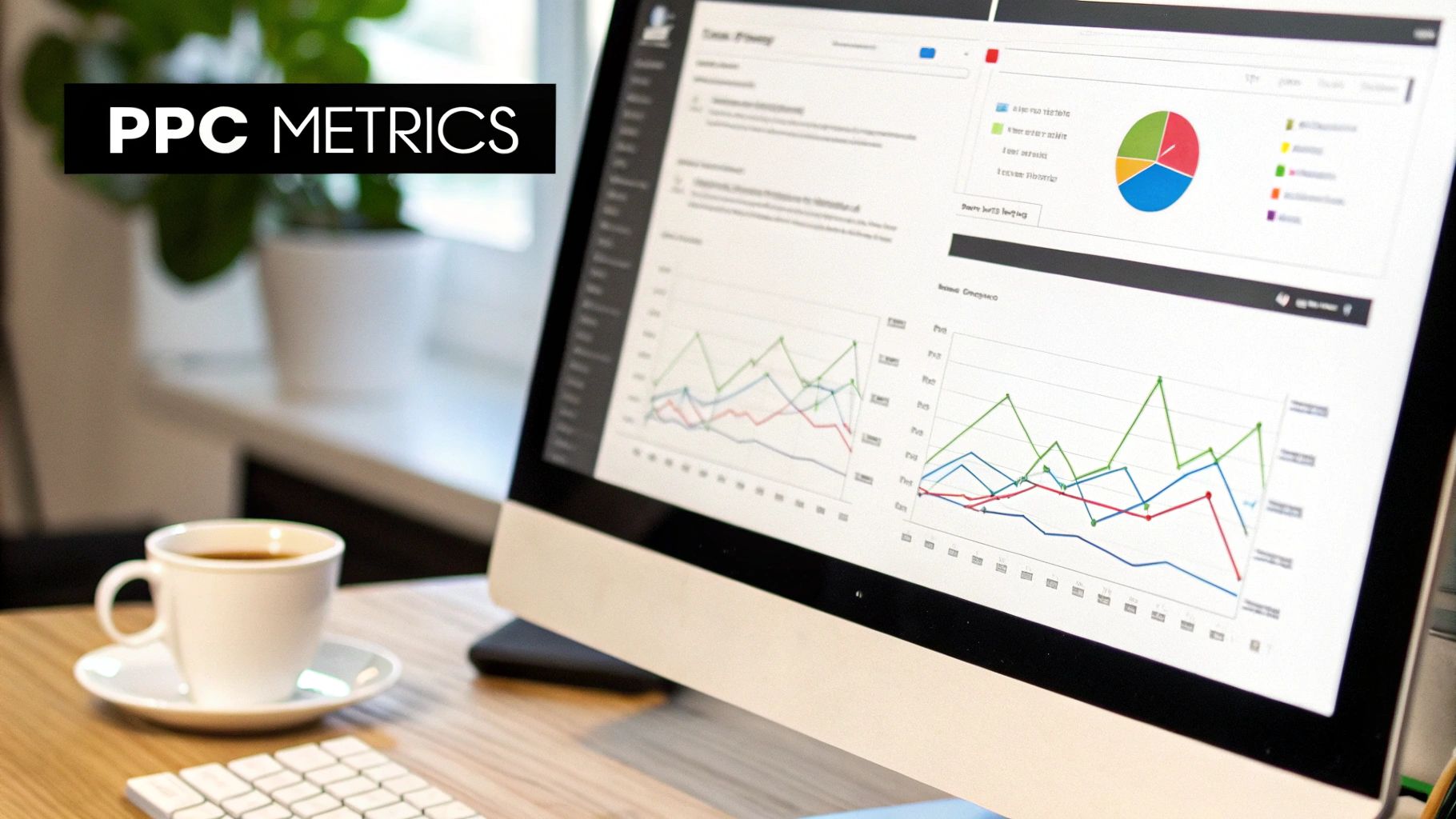
The Numbers That Drive Your Business
To hold any marketing partner accountable—or to understand your own campaigns—you only need to master three key metrics. These tell the real story of your investment.
-
Conversion Rate: The percentage of people who click your ad and then take the action you want, like calling your office or filling out a contact form. A high conversion rate means your ad and landing page are working together perfectly.
-
Cost Per Acquisition (CPA): This is your true cost for getting a new lead or customer. If you spend $500 on ads and get 10 qualified leads, your CPA is $50. This number tells you exactly what you’re paying to make the phone ring.
-
Return On Ad Spend (ROAS): This is the ultimate measure of profitability. It answers the crucial question: "For every dollar I put into ads, how many dollars do I get back?" A 4:1 ROAS means you’re generating $4 in revenue for every $1 you spend.
When you zero in on these three metrics, you get absolute clarity. The conversation instantly shifts from "How many clicks did we get?" to "How much profitable business did our ads generate?"
Putting Metrics Into Action
Let's make this real. Imagine you run a local dental practice. You know from your books that a new patient is worth, on average, $1,200 in their first year.
If your PPC campaign has a CPA of $100, you’re spending $100 to acquire a $1,200 customer. That's a fantastic return.
By tracking these core numbers, you stop guessing and start making calculated business decisions. You can confidently increase your ad budget, knowing that every extra dollar isn't just creating more chart activity—it's fueling predictable growth. This disciplined focus is what turns PPC from a marketing expense into a reliable growth engine.
Common Questions We Hear About Small Business PPC
If you’re busy running your business, jumping into digital advertising can feel overwhelming. That’s completely normal. Here are some of the most common questions we get, broken down into simple, practical answers.
The goal is to cut through the jargon and give you the clarity you need to make a smart decision.
How Long Does It Take to See Results from PPC?
This is one of the best parts about PPC. Unlike SEO, which can take months to kick in, a well-built PPC campaign can start sending people to your website almost immediately—often within hours of going live.
But let's be clear about what "results" means. Traffic is one thing; predictable leads are another. The first 30 to 90 days are an essential learning phase. During this time, we’re not just spending money; we’re buying data. We’re figuring out which keywords lead to phone calls, what ad copy gets people to click, and when your ideal customers are searching.
After that initial discovery period, you should start seeing a much more consistent flow of qualified leads. This is the point where PPC shifts from an experiment to a reliable engine for growing your business.
Can PPC Work for My Local Service Business?
Absolutely. In fact, PPC is one of the most powerful tools for local service businesses. Whether you’re a plumber, a roofer, or a dentist, PPC offers a level of precision that you can't get from old-school advertising.
The secret is in the targeting. With local PPC management, we can essentially draw a digital border around your specific service area. This means your ads are only shown to potential customers in the towns, neighborhoods, or even zip codes you actually work in.
For any local business, an ad shown to someone outside your service area is a wasted dollar. Geographic targeting cuts out that waste, ensuring your budget is spent only on people who can realistically hire you.
This focus allows a local auto shop to appear at the top of Google the exact moment someone a few miles away searches for "brake repair near me." It’s direct, efficient, and perfectly built for Main Street businesses.
What Is a Good Return on Ad Spend (ROAS)?
Return on Ad Spend (ROAS) is the metric that really matters. It answers the big question: "For every dollar I put into ads, how much money do I get back?"
While it can vary based on your industry and profit margins, a common benchmark for a healthy campaign is a 4:1 ratio. That means bringing in $4 in revenue for every $1 you spend on ads.
But the "right" ROAS is unique to your business. It all comes down to your numbers.
- High-Margin Services: If you’re a custom home builder or run a specialized law firm, your profit margins are high. In that case, even a 2:1 or 3:1 ROAS could be incredibly profitable.
- Lower-Margin Products: An online store with tighter margins might need to shoot for a 5:1 ROAS or higher to be profitable after factoring in the cost of goods sold.
The key is to stop chasing an industry-wide number and figure out your own break-even point. Once you know what a new customer is truly worth, you can set a clear ROAS goal. This ensures your advertising isn't just an expense—it's a profit center. Proper ppc management for your small business is about tracking this relentlessly to make sure every dollar works for you.
Ready to stop guessing and start getting predictable results from your advertising? The team at Uncommon Web Design builds strategic PPC campaigns that turn clicks into customers. Book a no-obligation consultation today and let's create a clear roadmap for your growth.