
The difference between Magento and Shopify comes down to one question: do you want a streamlined, all-in-one solution that gets you selling fast, or a powerful, open-source framework built for deep customization? Your choice hinges on whether your business values speed-to-market or total control.
Choosing Your E-commerce Platform

It’s time to stop asking which e-commerce platform is "best." The right question is, which one is right for your business? For a growing company, the choice between Magento (now Adobe Commerce) and Shopify can feel paralyzing. This isn't just a technical decision; it's a strategic investment that will shape your growth for years.
Your platform dictates everything—your ability to scale, how you integrate with critical business systems like inventory or accounting software, and the control you have over the customer experience. Let's cut through the noise and connect these platform differences directly to your revenue, operations, and long-term vision.
At a Glance: Which Platform Fits Your Business?
This quick decision matrix is a great starting point to see which platform aligns with your business profile. It's designed to give you a gut check before you dive deeper.
| Business Profile | Shopify Is Likely Your Best Fit If… | Magento (Adobe Commerce) Is Likely Your Best Fit If… |
|---|---|---|
| Startups & D2C Brands | You need to launch quickly and focus on marketing, not technical maintenance. | You have a complex, unique business model from day one requiring custom code. |
| B2B & Wholesale | Your wholesale needs are simple and can be handled with apps. | You require complex pricing tiers, customer-specific catalogs, and deep ERP integration. |
| Established Retailers | You want predictable costs and an easy-to-manage system for your team. | You have an in-house development team or agency partner to manage a custom-built site. |
| International Sales | You need straightforward multi-currency and language features that work out of the box. | You need granular control over multiple storefronts for different regions and legal entities. |
While this table offers a solid overview, market trends can also influence the decision.
Shopify has cemented itself as the go-to platform in the United States, capturing roughly 29-30% of the market as of 2025. This incredible domestic strength makes it a default choice for many American businesses looking for a proven, well-supported solution.
Of course, the e-commerce world is bigger than just these two giants. To get a better sense of the entire landscape, you can read a general overview of e-commerce platforms. We also break down more options in our guide on the best ecommerce platforms for small business.
The Core Difference: Ease of Use vs. Total Control

The entire Magento vs. Shopify debate boils down to one simple question: What matters more to your business right now? Is it getting your store online fast with predictable costs, or is it having the power to build absolutely anything you can imagine? The path you choose will shape your budget, your team's day-to-day work, and your ability to pivot in the future.
Shopify is a software-as-a-service (SaaS) platform. Think of it like leasing a high-end retail space in a managed mall. The mall owner—Shopify—handles security, maintenance, and keeping the lights on. You focus on what you do best: designing your storefront, stocking products, and bringing in customers. It’s designed for merchants who want to concentrate on sales and marketing, not server configurations.
On the other hand, Magento (now Adobe Commerce) is open-source. This is like buying the land and hiring an architect to build your store from the ground up. You own the blueprints and can knock down walls, add a new wing, or even dig a basement whenever you want. This level of control is incredible for deep customization and weaving the platform into your existing business systems.
But that kind of freedom comes with a hefty dose of responsibility.
Shopify: The Path of Least Resistance
Imagine a local auto shop that wants to start selling performance parts online. For them, speed and simplicity are everything, and that's where Shopify truly shines. The time it takes to go from a great idea to a customer checkout is remarkably short.
- Managed Environment: Shopify handles all the technical headaches. Hosting, security updates, and performance tweaks happen behind the scenes. You’ll never have to worry about a server going down in the middle of a big sale.
- User-Friendly Interface: The dashboard is clean and intuitive, making it easy for anyone on your team—not just developers—to add products, create discount codes, and pull sales reports.
- Predictable Costs: You pay a clear monthly subscription. This makes financial planning straightforward, with any extra costs coming from apps you choose to add from the Shopify App Store.
This turn-key approach frees up your most valuable resources—time and money—so you can pour them into growing your business.
Magento: The Power of Total Ownership
Now, let's picture a B2B contractor supply business. They have complex pricing tiers for different customer groups, custom shipping rules based on pallet size, and a non-negotiable integration with their legacy inventory system. This is a scenario where Shopify would struggle.
Magento is engineered for precisely this kind of complexity. When your business processes can't be forced to fit a platform's rigid structure, the platform needs to bend to fit your business. This is the heart of Magento’s power.
With Magento, you can develop proprietary features that become your competitive advantage, not just pick from a list of pre-made apps. Of course, this requires a skilled in-house development team or a reliable agency partner like us. You are in the driver's seat for everything:
- Hosting and Security: It’s on you to find, set up, and lock down your own hosting environment.
- Maintenance and Updates: Your team is responsible for applying all platform updates and critical security patches.
- Performance Optimization: As traffic grows, you'll need to actively manage server resources to keep your site fast and responsive.
Ultimately, the choice isn't just about a list of features. It’s about your business model and operational reality. Do you need a dependable car that gets you on the road today, or are you building a highly specialized machine that requires a custom-built engine?
Comparing The True Costs and Capabilities

When you're trying to figure out the real cost of an e-commerce platform, the monthly subscription fee is just the tip of the iceberg. The true cost of ownership also includes transaction fees, app subscriptions, hosting bills, developer hours, and all the little maintenance tasks that pop up.
Getting a handle on these numbers from the start helps you budget accurately and avoid nasty surprises six months down the road. Let's break down where the money really goes for both Shopify and Magento.
Total Cost Of Ownership: A Head-to-Head Look
Shopify's pricing looks simple on the surface, with plans starting at just $29/month. But once you add transaction fees and a few essential app subscriptions, that number can climb quickly.
On the other hand, Magento (Adobe Commerce) licensing is a serious investment, kicking off at around $22,000 per year. That's before you even think about custom hosting, which can be thousands per month, and the developer costs to build and maintain it. For a serious enterprise store on Magento, factoring in hosting, SSL, performance tuning, and patching can easily push your first-year costs into six figures.
Here’s a more detailed look at how these costs stack up. This table isn't just about the numbers; it’s about what those numbers mean for your team's time and resources.
Detailed Feature and Cost Breakdown
| Criteria | Shopify | Magento (Adobe Commerce) |
|---|---|---|
| Base Subscription | $29–$299/month. Straightforward monthly fees. | Custom pricing starting around $22,000/year. |
| Transaction Fees | 0.5%–2% on top of your plan, unless you use Shopify Payments. | No built-in fees, but your chosen payment gateway will have its own rates. |
| Hosting | Included in your plan. You never have to think about it. | Self-managed. Expect to pay $100–$2,000+/month for reliable hosting. |
| App/Extension Costs | $0–$200+/app/month. Mostly a recurring subscription model. | $0–$500+ per extension, often a one-time fee plus optional annual support. |
| Development Hours | Minimal for a basic setup (10–20 hours). | Significant. Customization easily requires 100+ hours upfront. |
| Maintenance & Updates | Handled entirely by Shopify. You focus on your business. | Your responsibility. Budget 5–15 hours/month for an in-house or agency team. |
As you can see, Shopify’s costs are predictable and manageable, making it a great fit for teams that need to keep a close eye on their monthly burn rate. Magento’s model, in contrast, demands a much larger upfront and ongoing financial commitment.
App Ecosystems and Extension Fees
Shopify's App Store is famous for its plug-and-play add-ons, most of which operate on a monthly subscription. This makes it easy to add functionality without a developer.
Magento Marketplace extensions, however, typically involve a one-time license fee. The catch is that you might have to pay extra for installation, support, or future updates, which can add up.
- A few essential Shopify apps might run you $20–$50/month each.
- A comparable set of Magento extensions could cost $300–$2,000+ upfront.
- The key is to be realistic about what you'll actually use. Don't pay for features that don't directly contribute to sales or efficiency.
Scalability and Performance Costs
When a flash sale hits, the last thing you want is for your site to go down. With Shopify, scaling is hands-off; their infrastructure is built to handle massive traffic spikes, and a global CDN is part of the deal.
With Magento, you're the one in the driver's seat. You'll need a solid server management plan, a robust caching strategy, and likely a CDN to keep things running smoothly. This gives you total control but also adds complexity and cost. Check out our guide on how to improve page load speed to understand why this is so critical.
A platform that can’t handle your peak traffic means lost sales. This is often the deal-breaker between plug-n-play simplicity and total control.
Security and Maintenance Overhead
Shopify includes security and PCI compliance in its monthly fee. Their team is on watch 24/7, applying patches and monitoring for threats so you don’t have to.
On a Magento store, all of that responsibility falls on you or your agency. You have to stay on top of security patches, and proving PCI compliance is your job. This usually means hiring security auditors or paying for a premium managed hosting partner who specializes in Magento.
For a Magento store owner, the security to-do list includes:
- Applying and testing security patches every quarter.
- Managing and renewing SSL certificates.
- Conducting and reporting on PCI compliance audits.
- Hardening servers and monitoring for intrusions.
- Running ongoing performance and security audits.
Each of these tasks adds billable hours and potential subscription costs to your total cost of ownership.
SEO Potential and Long-Term ROI
Out of the box, Shopify gives you the basic SEO tools you need to get started, and its app store has plenty of options to fill the gaps. It’s effective and easy to use, but you might hit a ceiling if you need highly advanced customizations.
Magento, on the other hand, is an SEO powerhouse from the get-go. It offers granular control over URLs, advanced layered navigation, and other features built for serious organic growth. The trade-off? You’ll need a developer who knows what they're doing to implement it all correctly.
Enterprise demand for Magento's deep customization remains strong, with reports showing 25% year-over-year growth in Q2 2024.
To calculate your long-term ROI, you need to look beyond the first year. A small direct-to-consumer brand might spend $10,000 on Shopify apps and minor customizations over five years. In that same timeframe, an enterprise business could easily spend $200,000 on Magento development, licensing, and hosting.
Practical Takeaways For Business Owners
Laying these costs out side-by-side should give you a much clearer picture for your budget planning.
- If you value predictable monthly costs and want to minimize technical headaches, Shopify is almost certainly the more cost-effective choice.
- If your business model depends on complex, custom workflows and you have access to development resources, Magento's higher TCO can deliver far greater long-term value.
Ultimately, you need to weigh the initial and ongoing costs against your growth plans and your team's capabilities. That’s how you’ll find the right platform for your unique business.
Which Platform Wins for Your Business Model?
Theory is one thing; how a platform performs under the pressure of your daily operations is another. A feature list can't tell you the whole story. The choice between Magento and Shopify becomes much clearer when you look at it through the lens of real-world business scenarios.
Let’s walk through a few common business models. Seeing how each platform's unique strengths solve specific problems will help you picture your own business in these examples. This makes the decision less abstract and more about tangible results.
The Direct-to-Consumer Brand Launch
Imagine a small team launching a new line of artisanal coffee beans. Their focus is 100% on marketing and building the brand. They need a beautiful, functional website up and running yesterday, not next quarter. Their main goal is to create a dead-simple path from an Instagram ad to a completed purchase.
For this D2C brand, Shopify is the undisputed winner.
- Speed-to-Market: They can pick a professional theme, upload their product shots, connect Shopify Payments, and be live in just a few days. No need to interview developers or get quotes for hosting.
- Ease of Use: The marketing manager can build landing pages, run flash sales, and manage inventory without touching a single line of code. This frees up the founder to focus on sourcing beans and building partnerships.
- Predictable Costs: A flat monthly subscription makes budgeting a breeze. They know exactly what their core platform will cost, allowing them to pour more money into ad campaigns and influencer marketing.
For a new D2C business, choosing Magento would be like buying a commercial shipping truck to make a grocery run. The overhead and complexity would drain resources that should be spent on actually acquiring customers. Shopify delivers the speed and simplicity they need to get that crucial early traction.
The B2B Wholesaler with Complex Pricing
Now, let's picture an established B2B supplier of industrial parts. They sell to hundreds of contractors, and every single one has a different, negotiated pricing tier. Some get a 15% discount on bulk orders, others have special pricing on specific product lines, and a handful are tax-exempt.
In this complex B2B world, Magento (Adobe Commerce) is the superior choice.
You can handle some B2B functions on Shopify with apps, but it often feels bolted on. Magento was built for this kind of operational depth from the ground up.
- Customer-Specific Pricing: Magento lets you create incredibly detailed customer groups, each with its own product catalog and pricing rules. This isn't an add-on; it's a core, native feature.
- Deep ERP Integration: This wholesaler's entire business runs on a central ERP system that manages inventory, customer data, and accounting. Magento’s open architecture is specifically designed for deep, two-way integrations with these kinds of mission-critical systems.
- Custom Quoting and Ordering: Many B2B sales don't start with "add to cart." They start with a quote. Magento allows for custom quoting workflows, purchase order systems, and approval processes that mirror how the business already operates.
For businesses where pricing is a key competitive advantage, integrating competitor price monitoring software is a smart move—a task far better suited to Magento's flexible architecture.
The Established Retailer with Omnichannel Needs
Finally, think about a regional retailer with five physical stores and a growing online presence. Their biggest headache is unifying inventory. They need a system where an online purchase can pull from any store's stock, and customers can buy online and pick up in-store (BOPIS).
This one is a closer race, but Magento often pulls ahead for true omnichannel retail.
While Shopify has made huge strides with its POS system, Magento’s power as a central commerce hub for multiple, distinct sales channels gives it an undeniable edge.
- Multi-Source Inventory (MSI): Magento’s native MSI feature allows merchants to manage stock across multiple physical locations seamlessly. You can set rules to decide which warehouse or store fulfills an order based on shipping proximity or current stock levels.
- Headless Commerce Potential: This retailer might want to power in-store kiosks, a mobile app, and their website from a single product database. Magento’s robust APIs and headless capabilities make this possible without juggling multiple disconnected systems.
- Total Brand Control: An established retailer has a brand identity to protect. Magento offers complete control over the user experience, ensuring the look, feel, and function of the website perfectly align with the in-store experience.
Looking at the Magento vs. Shopify decision through these real-world scenarios really highlights the core trade-off. Shopify is built for simplicity and speed, perfect for straightforward sales models. Magento, on the other hand, provides the powerful, customizable foundation required for complex business operations. Your business model should be your ultimate guide.
Evaluating the Platform Ecosystem and Support
An e-commerce platform is much more than just software. It’s the entire network of developers, agencies, and support channels built around it. The strength of that community directly affects how quickly you can solve problems, add new features, and ultimately grow your business without hitting a technical dead end.
When your site goes down or a critical feature breaks, who do you call? The answer to that question reveals one of the biggest differences between Magento and Shopify. This isn't just about a quick fix; it's about the entire support structure designed to help your store succeed.
Shopify: The Walled Garden of Support
Shopify’s ecosystem feels like a massive, user-friendly "walled garden." Everything is built to be accessible, safe, and easy for business owners who aren't developers. For teams without dedicated technical staff, this is a huge advantage.
Their support model is all about immediate access and simplicity:
- 24/7 Direct Support: Shopify offers round-the-clock help through chat, email, and phone. When a payment gateway suddenly fails at 2 a.m., that direct line to a real person is a lifesaver.
- Vast App Store: With over 8,000 apps, the Shopify App Store is one of its greatest strengths. Need a loyalty program or advanced analytics? There's an app for that, and most install with a single click.
- Large Freelancer Pool: Shopify's popularity has created a massive community of freelancers and small agencies ready to help with theme tweaks and minor customizations at very competitive rates.
This entire ecosystem is designed to remove friction. The goal is to keep you focused on marketing and sales, knowing a reliable support system is always there when you need it.
Magento: A Community for Experts
Magento’s ecosystem is a completely different world. It’s an open-source community geared toward certified development agencies and highly skilled, specialized developers. Here, power and flexibility are prioritized over ease of access.
Choosing Magento means you are not just selecting a platform; you are committing to a relationship with a technical partner. The quality of that partner will define your experience.
This approach brings its own set of powerful advantages, especially for more complex businesses:
- Certified Agency Partners: The official Adobe Commerce partner network is made up of vetted agencies with proven expertise in building and maintaining enterprise-level stores.
- Deep Technical Knowledge: The developer community is smaller but incredibly specialized. These are the experts who can build custom modules from the ground up, integrate with complex ERP systems, and fine-tune server performance—tasks far beyond what a typical Shopify freelancer can handle.
- Powerful Extension Marketplace: The Adobe Commerce Marketplace is loaded with robust extensions for complex B2B functions, multi-source inventory, and advanced SEO. Just keep in mind that installing and configuring them almost always requires a developer.
Making the Right Choice for Your Business
So, which ecosystem is the right fit for you? The answer really comes down to your team's structure and what your business actually needs to operate.
Shopify’s walled garden is perfect for businesses that value speed, predictability, and being able to handle things themselves. It's for the founder who wants to install a marketing automation app on a Tuesday morning and see results by the afternoon. In fact, our guide on marketing automation for ecommerce is a great place to start understanding what’s possible.
On the other hand, Magento's open community is built for businesses whose needs simply can't be met with off-the-shelf solutions. It's for the B2B distributor who needs a custom-coded pricing engine and has an agency on retainer to manage it. This path offers nearly limitless potential, but it comes with the responsibility—and cost—of managing your own technical team.
Making Your Final Decision: A Strategic Framework
We’ve dug into the tech, crunched the numbers, and looked at how these platforms perform in the wild. Now comes the hard part: making the final call. This isn't just about picking software; it's about laying the groundwork for where your business will be in the next five years.
At its core, the Magento vs. Shopify debate boils down to a classic trade-off. We typically point businesses toward Shopify when their priorities are speed-to-market, operational simplicity, and predictable costs. It's the go-to for most D2C brands, startups, and growing retailers who need to pour their resources into marketing and sales, not platform maintenance.
On the other hand, we recommend Magento (now Adobe Commerce) for established businesses with complex product catalogs, specific B2B needs, or an absolute requirement for total control over their brand and technology. If your business runs on unique processes that give you an edge, you need a platform that conforms to your operations, not the other way around.
This decision tree breaks down the choice based on your team’s internal support and technical know-how.
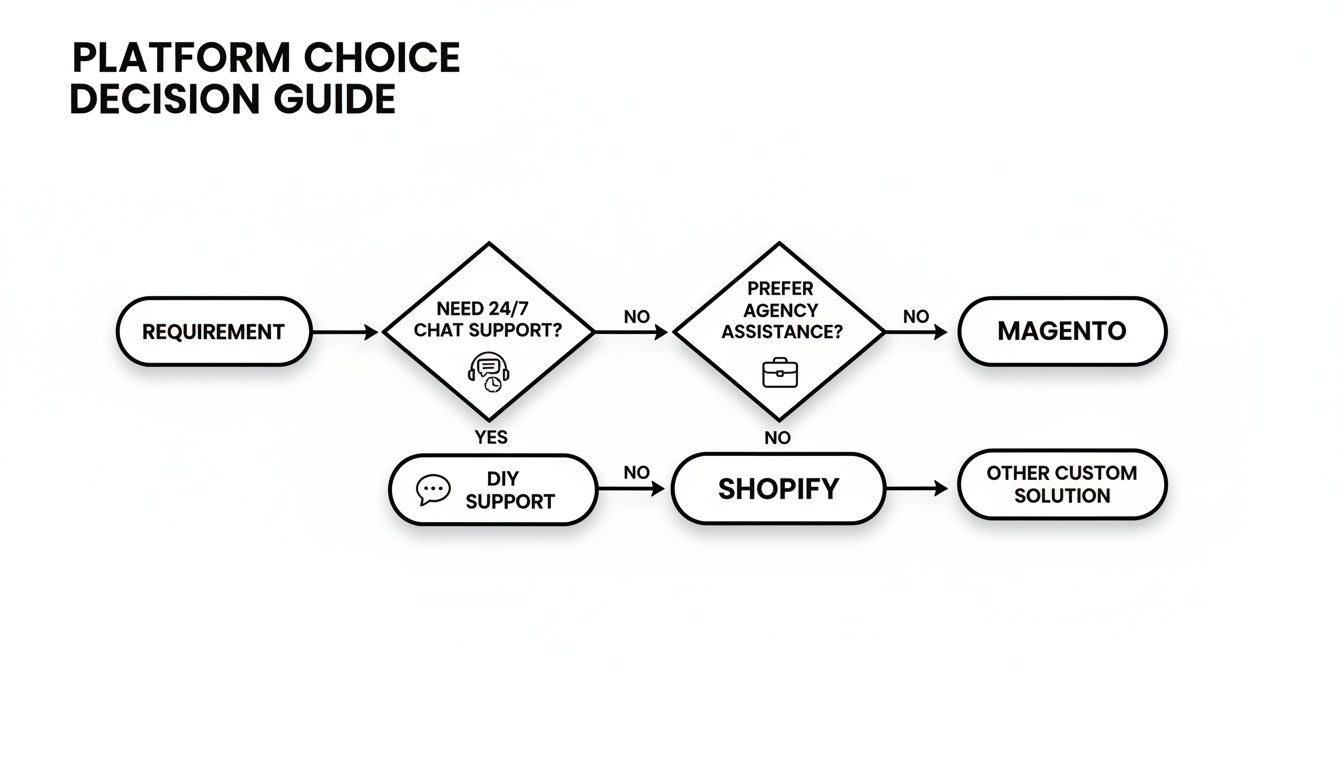
The flowchart gets right to the point: companies that work best with self-service tools and round-the-clock support will feel right at home with Shopify. Those who rely on deep, specialized technical partners to build and maintain their systems will find Magento a much better fit.
A Framework For A Confident Choice
To feel truly confident in your choice, you need to look past the feature lists and think about your five-year vision. Where is your business headed, and which of these platforms will actually help you get there?
-
Go with Shopify if: Your growth plan is all about aggressive marketing and getting new products to market quickly. Your main objective is to win customers and scale your sales channels without getting bogged down by technical hurdles. You need a platform that just works, so your team can focus on what they do best—driving growth.
-
Go with Magento if: Your success depends on operational excellence, complex system integrations, and a highly tailored customer journey. You have the budget and team (whether in-house or an agency) to build and manage a custom system that becomes a core part of your competitive advantage.
The right platform should feel like a foundation for growth, not a ceiling that limits it. Your choice should remove operational friction and free up your team to focus on high-value activities that drive revenue.
Ultimately, your e-commerce platform should be your best salesperson, working 24/7, not another headache for your team to solve. It needs to automate processes, clarify your brand message, and turn casual visitors into loyal customers.
The Path Forward
The last step is to map out your total cost of ownership over the next three years for both platforms. Be sure to include subscription fees, app costs, hosting, and—most importantly—the budget for development and maintenance hours. Seeing the numbers laid out this clearly often makes the decision for you.
If you’re still weighing the pros and cons of Magento vs. Shopify, remember that the "best" platform is simply the one that aligns with your real-world operations and long-term goals. Choose the one that empowers your team, supports your vision, and gives you the clearest path to profitable growth.
At Uncommon Web Design, we help you turn your website into a 24/7 salesperson. If you’re ready to build an online presence that drives measurable business outcomes, let’s talk. Schedule a no-obligation consultation with us today at https://uncommonwebdesign.com.