
Using email marketing to generate leads is the most reliable way to close the gap between website traffic and actual sales conversations. Think of it as an automated system that captures a visitor's interest and systematically builds trust. It's your best salesperson—and it never sleeps.
Why Email Is Your Most Valuable Lead Generation Tool
You’re spending good money on Google Ads or investing serious time in SEO to get people to your website. Great. But what happens once they arrive?
The hard truth is that over 97% of visitors aren't ready to call you or fill out a contact form on their first visit. If they leave, that traffic you paid for is gone, probably for good. This is the expensive "leaky bucket" where most marketing strategies fall apart.
Email marketing is the bridge that connects your traffic-generating efforts (like SEO and ads) to your sales process. It gives you a way to stay in touch with prospects who are interested but not ready to buy today, letting you nurture them until they are.
The Simple Math Behind Email ROI
Business owners are right to be skeptical of anything that doesn't produce a clear return. The numbers behind email marketing are precisely why we make it central to our clients' growth strategies. This isn't about sending fluffy newsletters; it's about building a predictable lead-generation machine with a fantastic ROI.
Industry data consistently shows that email marketing delivers an average return of around 36:1. For every $1 you put in, you can expect about $36 back. For a small or mid-sized business where every dollar has to work hard, that's a game-changer.
To put it in perspective, the average cost per lead via email can be as low as $53. Compare that to search engine marketing at $110 or trade shows, which can skyrocket to $811 per lead. You can dig into more email marketing statistics to see how these figures stack up across different industries.
Think of it this way: for a local contractor, capturing an email with a helpful "Home Renovation Budget Calculator" is far more effective than just hoping a visitor remembers their name three months later when they're finally ready to get a quote.
Owning Your Audience vs. Renting It
Here's another critical reason to double down on email: ownership. When you rely entirely on social media or search engines, you're building your business on rented land. A simple algorithm change from Google or Facebook can slash your visibility overnight, cutting you off from the audience you worked so hard to build.
Your email list, on the other hand, is a direct line of communication that you own. It's a real business asset that grows more valuable over time. Every subscriber is a potential customer who has given you explicit permission to contact them.
This direct connection lets you:
- Build genuine trust by consistently sharing helpful advice.
- Stay top-of-mind, so when a prospect needs what you offer, you're the first one they think of.
- Segment your audience to send highly relevant messages, not generic promotions.
- Automate your follow-up, ensuring no interested lead ever slips through the cracks.
Ultimately, a smart email strategy transforms your website from a passive digital brochure into an active, 24/7 salesperson. It's what turns casual interest into qualified, sales-ready conversations.
Creating A Lead Magnet Prospects Actually Want

Let's be honest. That generic "Subscribe to our newsletter" box collecting digital dust on your website isn’t working. It asks for something valuable—a person's email and their future attention—but offers almost nothing in return. To successfully use email marketing to generate leads, you have to make a much better offer.
You need a compelling reason for them to say yes. This is the job of a lead magnet: a specific, high-value resource you trade for an email address. The secret is to solve a small, immediate problem for your ideal customer.
When you solve a real problem, you're not just getting an email; you're starting a relationship built on value. The right offer also acts as a filter, attracting qualified prospects who are already thinking about the exact problems your business solves.
Moving Beyond Generic Ebooks
For a busy professional or homeowner, a 50-page ebook often feels like homework. They don't have time for it. The best lead magnets are practical, easily digestible, and provide a quick win.
Instead of tackling broad topics, get specific and actionable. Think about the most common questions your best customers ask before they're ready to buy. What small piece of information would make their lives easier right now?
Here are a few real-world examples:
- For an auto shop: Forget "The Ultimate Guide to Car Care." A much better offer is a "DIY Pre-Road Trip Vehicle Inspection Checklist." It's practical and positions them as the trusted expert.
- For a custom home builder: Instead of a generic portfolio, provide an interactive "New Home Construction Budget Calculator" spreadsheet that helps them figure out what's possible.
- For a dental office: Offer a downloadable "Guide to Choosing the Right Cosmetic Dentistry Option" that clearly compares veneers, bonding, and whitening.
These tools are incredibly useful on their own, positioning you as a helpful expert long before you ever ask for the sale. This is a fundamental part of building an email list that turns passive website visitors into genuinely engaged leads.
How to Brainstorm Your Perfect Lead Magnet
Your ideal lead magnet sits at the intersection of your customer's biggest pain points and your unique expertise. It should be something they would seriously consider paying for if it weren't free.
Start by mapping out your customer's journey. What are their biggest uncertainties early on? What phrases are they typing into Google before they feel ready to contact a professional? Your lead magnet should answer one of those questions decisively.
The goal isn't just to get any email address; it's to get the right one. A well-designed lead magnet pre-qualifies your leads, ensuring your list is filled with potential customers, not just freebie seekers.
Creating valuable lead magnets is one piece of the puzzle; you also need to understand the broader strategies for acquiring email addresses for marketing to ensure your efforts reach the right audience.
Lead Magnet Ideas That Convert For Your Business
Finding the right concept can be tough, so here are a few ideas tailored to different business models. The key is to match the offer to the specific problem your ideal customer is trying to solve.
| Business Type | High-Value Lead Magnet Idea | Why It Works |
|---|---|---|
| Local Service Provider (e.g., Plumber, Electrician) | A "Home Emergency Prevention Kit" checklist. | Solves an immediate fear (a burst pipe) and positions the business as a proactive, trustworthy expert. |
| E-commerce Store (e.g., selling coffee beans) | An interactive "Find Your Perfect Brew" quiz. | Offers a personalized recommendation, guides the user toward a purchase, and makes the shopping experience engaging. |
| B2B Consultant (e.g., Financial Advisor) | A "5-Point Retirement Readiness Scorecard." | Provides a self-assessment tool that highlights gaps in the prospect's planning, creating a natural opening for a consultation. |
Each of these ideas provides instant value and naturally leads the prospect toward your core service or product. That's the mark of a truly effective lead magnet.
Designing Signup Forms That Convert Visitors
A killer lead magnet is a great start, but you have to present it in a way that makes saying "yes" a no-brainer. If your signup process is clunky, hidden, or confusing, you’ll lose people—no matter how great your offer is. This is where the rubber meets the road with email marketing to generate leads.
Think of your signup form as more than a box for collecting data. It's the digital handshake that kicks off your relationship with a potential customer. It has to be seamless, trustworthy, and placed where your ideal customer can't miss it.
Placement Is Everything
Where you ask for an email is just as important as how you ask. Burying your signup form on some forgotten page is like trying to make a sale by whispering in a crowded room. You need to put your offers in high-traffic, high-intent spots.
Put yourself in your visitor's shoes:
- Embedded in a Blog Post: If you wrote an article on "signs you need a new roof," embedding a signup form for a "Roofing Inspection Checklist" right in that post is perfect timing. It’s relevant and immediately useful.
- The Exit-Intent Pop-up: This is one of our go-to tactics. It only appears when someone's mouse heads for the exit. It’s your last chance to make a valuable offer—like a discount or a helpful guide—before they vanish.
- The Website Footer: Sure, the conversion rate here is lower, but the footer is a predictable spot for a signup form. It's great for catching highly engaged visitors who've scrolled all the way to the bottom.
The trick is matching the offer to the context. A generic "sign up" in the footer is fine, but a targeted offer inside a specific service page or blog post will always bring in more qualified leads.
Keep It Simple and Clear
The moment someone decides they want your lead magnet, your job is to make the process disappear. Every extra field you add creates friction and gives them a reason to bail. For most lead-gen efforts, a name and an email address is all you need.
Resist the temptation to ask for their phone number or company size upfront. You can always gather more details later. Right now, the only goal is to capture the email.
This "keep it simple" rule applies to your copy, too. Ditch the clever marketing jargon and just be clear.
Your headline should scream the benefit, and your button should tell them exactly what to do.
-
Weak Headline: "Our Newsletter"
-
Strong Headline: "Get a Free Home Staging Checklist to Sell Your House Faster."
-
Weak Button: "Submit"
-
Strong Button: "Send Me the Checklist!"
See the difference? This small tweak reframes the exchange around what they get, not what you're asking them to do. It’s a subtle shift with a huge impact on conversions. For a deeper look, check out our guide on landing page design best practices—it pairs perfectly with these form strategies.
Designing for Trust and Action
Finally, don't overlook the visual design. Your form needs to look professional, match your brand, and feel secure. Use your brand’s colors and fonts to keep the experience consistent. A simple sentence below the form reassuring people you won’t spam them can also do wonders to ease any last-second doubts.
When you combine smart placement, minimalist design, and clear, benefit-focused copy, your signup forms will transform from a passive website element into a powerful lead-generating machine.
Building An Automated Email Nurture Sequence
Getting an email address is a great start, but it's just that—a start. The real power of using email marketing to generate leads isn't in capturing an email; it's in the conversation that happens next. If you just dump new subscribers onto a generic newsletter list, you're leaving a massive opportunity on the table.
This is where an automated email nurture sequence changes the game. It’s a series of pre-written emails that go out automatically to new subscribers over a set period. Think of it as your virtual salesperson, working 24/7 to build trust, answer questions, and gently guide prospects toward a real conversation—all without you lifting a finger after the initial setup.
The goal isn't to blast them with sales pitches. It’s about systematically warming them up, transforming a curious stranger into a qualified lead who sees you as the only person who can solve their problem.
The Anatomy of an Effective Nurture Sequence
You don’t need a complicated, 20-email flowchart to get this working. For most service businesses, a simple 3- to 5-part sequence is incredibly effective. Each email in the series has a specific job, moving the relationship forward one step at a time.
This diagram breaks down the essential flow, from signup to connection, focusing on the core elements that drive conversions.
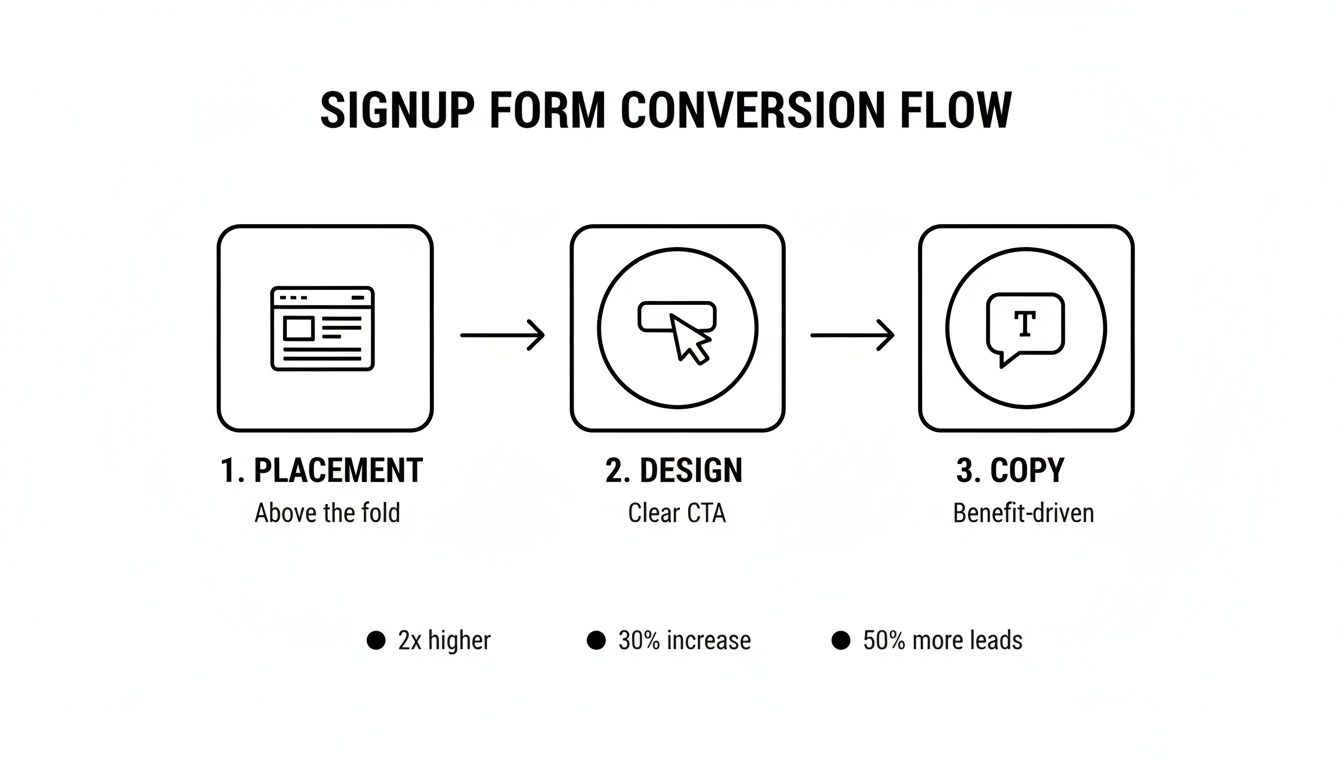
As you can see, a seamless user experience—from where you place the form to the clarity of your copy—is what convinces a visitor to become a lead in the first place.
Here’s a simple, proven framework for your first automated sequence:
-
Email 1: The Welcome & Delivery (Send Immediately)
This is purely functional. Its main job is to deliver the lead magnet. Keep it short, thank them, and give them a clear link to their download. That immediate delivery builds instant trust. -
Email 2: Hit Their Biggest Pain Point (Send 1-2 Days Later)
You've delivered the goods, now connect on a deeper level. Write an email that speaks directly to the core frustration your ideal customer feels. For a custom cabinet maker, this might be about the chaos of a disorganized kitchen. Show them you understand their problem. -
Email 3: Showcase Expertise with a Case Study or Tip (Send 2-3 Days Later)
This is where you start positioning yourself as the solution. Share a quick story about a client you helped who had the exact same problem you mentioned in the last email. A short "before and after" narrative is incredibly powerful here. -
Email 4: Overcome a Common Objection (Send 2-3 Days Later)
What’s the biggest hesitation people have before hiring you? Cost? Time commitment? Complexity? Address that objection head-on with an email that provides clarity and reassurance. -
Email 5: The Soft Call-to-Action (Send 2-3 Days Later)
You've built trust, demonstrated value, and eased their concerns. Now, and only now, is it time to invite them to take the next step. Don't be pushy. A simple, "If you're ready to see how we can do this for you, you can book a no-pressure 15-minute call here" is perfect.
Your nurture sequence should feel less like a marketing campaign and more like a helpful conversation. Each email should provide value on its own, even if the reader never buys from you. That's how you build a reputation and a pipeline of future customers.
Connecting Your Systems for Seamless Follow-Up
An automated email sequence is powerful on its own, but it becomes a true engine for growth when it "talks" to your other business systems. Syncing your email platform with your customer relationship management (CRM) software is a critical step. This ensures that when a lead shows buying signals—like clicking a link to your services page multiple times—that information is automatically logged.
This connection allows you to see the full picture of a prospect's journey and follow up at the perfect moment. We wrote a detailed guide on the benefits of integrating your CRM with your website that walks you through this process.
After setting up your initial automation, you can continuously refine it using proven lead nurturing best practices to improve your results over time. The goal is to create a closed-loop system where marketing and sales work together, fueled by intelligent automation.
How To Measure Your Email Marketing ROI
Alright, let's talk about what really matters: results. Setting up an email system is one thing, but if you can't prove it’s making you money, it’s just another chore. The good news is that measuring your return on investment (ROI) doesn't require a Ph.D. in data science.
You just need to track a few key numbers that connect your email efforts directly to your bottom line. This isn't about chasing vanity metrics like "total subscribers." It’s about tracking how well your system turns strangers into paying customers.
The Metrics That Actually Matter
Most email marketing dashboards can be overwhelming. As a busy business owner, you only need to obsess over three of them to know if your lead generation is working.
- Signup Conversion Rate: This tells you how well your lead magnet and signup forms are performing. It's the percentage of website visitors who see your offer and give you their email. If this number is low, your offer isn't hitting the mark or your forms are buried.
- Email Click-Through Rate (CTR): This measures engagement. How many subscribers are actually clicking the links in your emails? A healthy CTR is a direct signal of interest and tells you if your content is compelling enough to get people to take action.
- Subscriber-to-Customer Conversion Rate: This is the big one. It answers the most important question: How many people on my email list actually become paying customers? This metric is the ultimate test of your entire funnel.
By keeping a close eye on these three metrics, you get a clear, actionable picture of what’s working and what isn't. You’ll know right away if the problem is at the top (not enough signups), in the middle (boring emails), or at the bottom (leads aren't closing).
A Simple Formula for Calculating Email ROI
Once you’re tracking the right things, figuring out your actual return is surprisingly simple.
Here’s the back-of-the-napkin formula we use with clients to show them the real value:
(Revenue from Email Leads – Cost of Email Marketing) / Cost of Email Marketing = ROI
Let’s run a quick, real-world example for a local HVAC contractor.
- Figure Out Your Costs: Add up your email software (like Mailchimp for, say, $50/month) and any money spent creating your lead magnet. Let's say your total cost for the year is $600.
- Track Your Revenue: Over that same year, you track that 10 subscribers hired you for a new AC installation, and the average job value was $5,000. That's $50,000 in new revenue.
- Do the Math: ($50,000 – $600) / $600 = 82.3.
Multiply by 100 to get the percentage. That’s an 8,233% ROI. When you see a number like that, the $50 monthly software fee suddenly looks like the smartest investment you’ve ever made.
Why Email Consistently Outperforms Other Channels
Returns like this aren't a fluke; it's why email marketing is a powerhouse for businesses that need to generate leads without breaking the bank. The cost-effectiveness shines when you stack it against other channels.
It's no surprise that nearly 48% of marketers see email as their single most effective tactic for getting new leads. It consistently beats paid search and generic online ads. The average cost per lead for Google Ads can easily shoot past $70, while email and SEO are often cited as the most affordable ways to bring in new business.
Even better, email campaigns have seen their click-to-conversion rates jump by about 27.6% year-over-year. That means the people who click are highly motivated to buy. You can dig into more of the data behind lead generation effectiveness to get the full picture.
For service businesses and local shops, the game plan is clear. Use things like SEO and ads to draw in targeted traffic, but lean on a well-built email system to capture that interest and nurture it into profitable relationships—all at a fraction of the cost. Your email list isn't just a marketing tool; it's one of your company's most valuable financial assets.
Got Questions About Lead Gen? We've Got Answers.
Over the years, we've helped countless business owners get their lead generation systems humming. And along the way, we've noticed the same smart questions pop up time and again.
Our goal here is to give you clear, no-nonsense answers based on what we've seen work in the real world. This isn't about theory; it's about practical advice to help you avoid common potholes and move forward with confidence.
Let's dive in.
What’s the Best Email Marketing Software for My Business?
It's easy to get paralyzed by the sheer number of email marketing tools out there. Our advice? Focus on what you need right now, not what you might need five years from now. For most service businesses, a platform that nails the fundamentals is far more valuable than one with a million features you’ll never touch.
We usually point our clients toward one of these three, depending on their situation:
- Mailchimp: Still the king of user-friendliness. It's a fantastic starting point for anyone new to email marketing. Their drag-and-drop builder makes creating professional-looking emails a breeze.
- ConvertKit: Originally built for creators, its powerful automation and tagging features are perfect for service businesses that need to segment an audience based on interest or behavior. It’s incredibly intuitive for setting up nurture sequences.
- ActiveCampaign: This is the next level up, combining email marketing with a full CRM. It's a great choice if you have a sales team and want to track a lead’s entire journey, from their first click all the way to a closed deal.
The best choice is the one that helps you grow without overwhelming you. Start simple and master the basics. You can always migrate to a more advanced platform later if your needs change.
How Often Should I Email My List?
This is the classic "it depends" question, but here’s a rule of thumb we stand by: consistency and value matter far more than frequency. Sending one genuinely helpful email every week is infinitely better than sending three mediocre ones just to stay "top of mind."
Once your automated welcome sequence wraps up, a weekly or bi-weekly email is a great rhythm for most local businesses. It keeps you on their radar without becoming inbox noise.
The real key is to watch your engagement metrics. Pay close attention to your open rates and, more importantly, your unsubscribe rates. If you see a spike in people unsubscribing after a certain email, that’s your audience giving you direct feedback that you missed the mark. Let their behavior be your guide.
Is It a Good Idea to Buy an Email List?
Let us be crystal clear: absolutely not. Buying an email list is the single fastest way to obliterate your sender reputation, get your domain blacklisted by providers like Gmail, and land in hot water over spam laws like the CAN-SPAM Act.
Just think about it from a human perspective. These people never asked to hear from you. The odds they'll care about your offer are practically zero, and the odds they'll smash that "mark as spam" button are incredibly high.
The only sustainable way to succeed with email marketing to generate leads is to build your own permission-based list. You want every subscriber to be someone who willingly raised their hand and said, "Yes, I want to hear from you." It takes more work upfront, but the quality of those leads is a thousand times better.
What Can I Do to Improve Low Email Open Rates?
When open rates are in the gutter, it almost always points back to one of two things: your subject lines are boring, or your sender reputation is taking a hit.
First, your subject lines. They need to spark curiosity or promise a clear benefit. A subject line like "A quick question about your roofing project" is far more compelling than "June Newsletter." Personalization and a little intrigue go a long way.
Second, you have to practice good list hygiene. This means regularly clearing out inactive subscribers—people who haven't opened any of your emails in the last 6-12 months. Continuously sending emails to a disengaged audience signals to email providers that your content isn't valuable, which hurts your deliverability for everyone on your list.
At Uncommon Web Design, we don't just build websites; we build integrated marketing systems that turn your digital presence into a 24/7 lead generation engine. If you're ready to stop guessing and start building a predictable pipeline of customers, let's talk.
Schedule your free, no-obligation strategy consultation today.