
If your website isn’t bringing in leads or sales, it’s not a business asset—it’s an expensive digital brochure. For a business owner, that’s a tough pill to swallow. Every visitor is a potential sale you can't afford to lose, and customer journey optimization is how you stop them from slipping through the cracks.
It's a straightforward process of finding and plugging the "leaks" where potential customers get confused, frustrated, and ultimately leave your site for a competitor.
Why Your Website Is Quietly Losing Customers
Think of your website like a physical store. Are the signs clear? Is the path to the checkout easy to find? Or are people wandering in, getting lost in messy aisles, and leaving empty-handed? A common mistake is pouring money into ads to get people to the site, then completely ignoring their experience once they arrive.
A disorganized or slow website creates friction. That friction is a deal-breaker. Modern customers don't hesitate—they just hit the "back" button and find someone else. This isn't about adding fancy features; it’s about creating a smooth, intuitive path from their first click to becoming a customer.
Pinpointing the Leaks in Your Sales Funnel
Every action a user takes on your site is a "touchpoint." Each one is a chance to either build their confidence or create doubt. Most leaks happen when there's a disconnect between what a visitor expects and what your website delivers.
Here’s a real-world example: A homeowner clicks your ad for "emergency plumbing services" but lands on your generic homepage instead of a page specifically about emergency repairs. They're gone in seconds. That’s a leak.
These small friction points add up, silently killing your marketing ROI. A high bounce rate isn't just a vanity metric; it's a clear signal that your first impression is failing. You can dig deeper into this problem by reading our guide on how to reduce website bounce rate.
The journey from initial awareness to final conversion is where most businesses unknowingly bleed revenue.
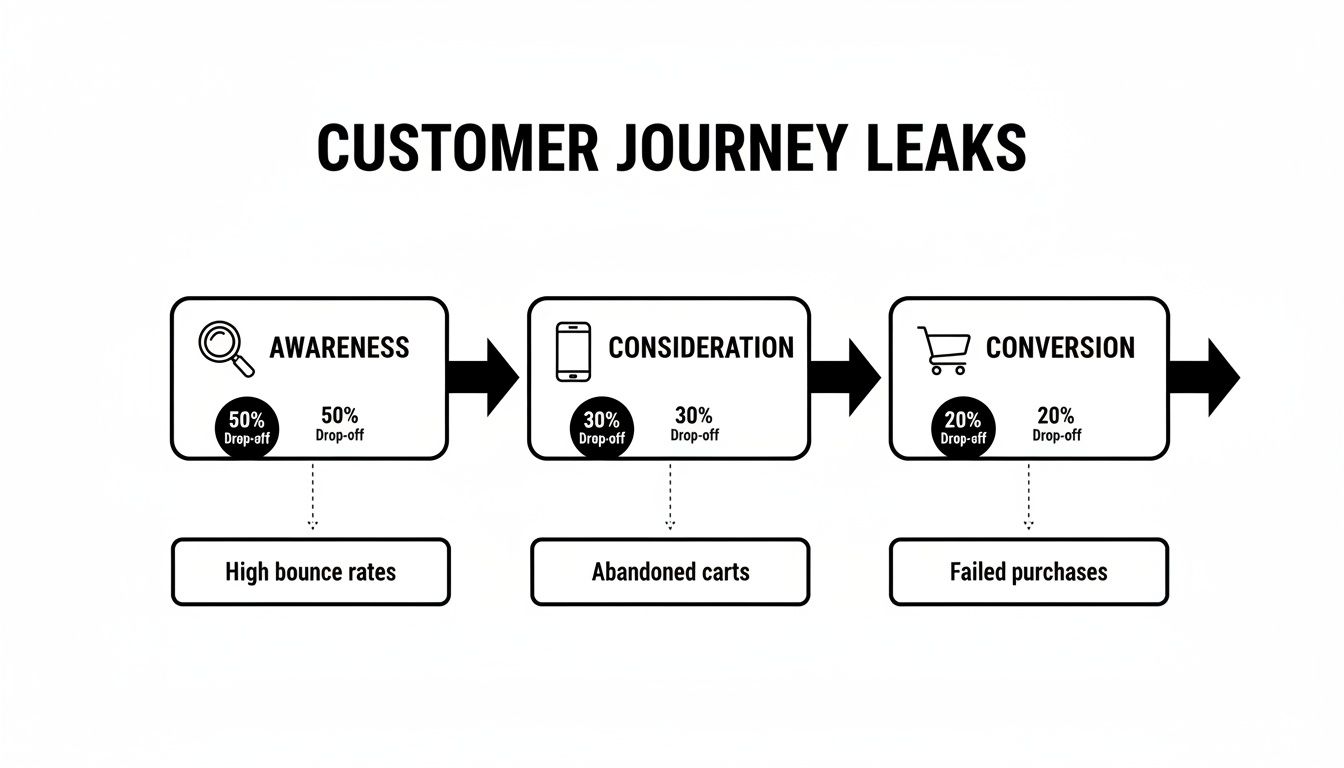
This diagram shows you exactly where those drop-offs happen. You can see how even small leaks at the awareness and consideration stages turn into a huge loss by the time someone is ready to buy. When you map this digital path, you finally get clarity on what your customers actually need from you.
To get you started, we've put together a table outlining the most frequent problems we see at each stage of the journey, along with direct, actionable solutions.
Common Customer Journey Leaks and How to Fix Them
| Journey Stage | Common Leak (The Problem) | How to Fix It (The Solution) |
|---|---|---|
| Awareness | Vague Messaging: Your headline doesn't immediately confirm the visitor is in the right place. | Write benefit-driven headlines. Instead of "Our Services," use "Roof Repair That Lasts a Lifetime." Solve their immediate problem. |
| Consideration | Lack of Social Proof: No reviews, testimonials, or case studies to build trust and prove your claims. | Display testimonials prominently. Add a case study portfolio. Embed a feed of your Google or Yelp reviews directly on service pages. |
| Conversion | Confusing Call-to-Action (CTA): The "next step" is unclear. Buttons are hidden or use weak language like "Submit." | Use strong, action-oriented CTAs. Make buttons a contrasting color. Use text like "Get Your Free Quote Now" or "Schedule Your Consultation." |
| Retention | No Follow-Up: Once a sale is made, the communication stops, leaving future revenue on the table. | Implement a simple email follow-up sequence. Send a thank-you note, ask for a review, and offer a discount on their next service. |
This table isn't exhaustive, but it covers the 80/20 of what usually goes wrong. Fixing even one of these common leaks can have a noticeable impact on your bottom line.
By focusing on customer journey optimization, you turn your website from a passive flyer into an automated salesperson that works for you 24/7. This isn’t abstract marketing theory; it's a direct way to increase the return on every dollar you spend on ads, content, and SEO.
When you optimize this journey, you stop guessing and start guiding. You build a system that anticipates what your customers need and gives them clear answers, making it easy for them to choose you over the competition.
Using Analytics to Uncover Hidden Sticking Points
You can't fix what you can't measure. A customer journey map is a great start, but on its own, it's just a hypothesis. It's your best guess at how people interact with your business. To actually improve the customer journey, you need to see what’s really happening. That’s where analytics comes in.
Think of a tool like Google Analytics 4 as the security camera for your digital storefront. It shows you where visitors go, where they get stuck, and where they give up. This isn't about becoming a data scientist. It’s about finding the one or two major friction points that are costing you the most business.
The data reveals the unfiltered truth about user behavior. It replaces guesswork with evidence, letting you focus your efforts where they'll make a real financial impact.
Moving From Guesswork to Data-Driven Decisions
As a business owner, your time is limited. You don't need to track dozens of obscure metrics. You just need to identify the key actions that signal a visitor is moving closer to becoming a customer.
We always recommend starting with simple event tracking to monitor these make-or-break actions. This could be things like:
- Clicks on your phone number: This is a high-intent action, especially on mobile. If you get tons of traffic but the phone isn't ringing, you have a problem.
- Contact form submissions: Tracking how many people start filling out your form versus how many actually hit "submit" can reveal if your form is too long, confusing, or broken.
- Clicks for driving directions: For a local business like an auto shop or a dental office, this is a clear sign someone is planning to visit.
- Downloads of a brochure or guide: This tells you a visitor is deep in the research phase and sees you as a credible source.
Setting up tracking for these events gives you a clear dashboard of what’s working and what’s not. Without this data, you're flying blind, throwing money at ads that send people straight to a broken part of your customer journey. You can dig deeper into finding these problems with our comprehensive web audit checklist.
Identifying High-Exit Pages and Drop-Off Points
One of the most powerful reports in Google Analytics shows you exactly where people leave your site. These high-exit pages are the digital equivalent of a customer walking out of your store in frustration. You have to figure out why.
For instance, we once worked with a local contractor who saw that tons of visitors from a paid ad campaign were landing on their 'Services' page but almost none were clicking through to the 'Contact Us' page. That's a huge red flag. It told us the page wasn't answering their key questions or giving them a compelling reason to take the next step.
Visual reports in analytics make it immediately obvious where the biggest leaks are. Is the drop-off happening between the homepage and a service page? Or between the service page and the quote request form?
Here's the takeaway: Find the single biggest drop-off point in your customer's journey. Fixing that one page will almost always deliver a better return on your time and money than making ten small tweaks elsewhere.
Flying blind on these friction points comes at a steep cost. And when you consider that nearly 60% of customers are willing to jump to a competitor after just one or two bad experiences, the stakes couldn't be higher.
Crafting a Personalized Path That Builds Trust
Personalization isn't just a buzzword for giants like Amazon. For small businesses, it's a powerful tool to make every visitor feel seen and understood. It’s about closing the gap between what someone expects when they land on your site and what you actually deliver.
Think about it practically. Someone searches for "emergency roof repair in Temecula," clicks your ad, and lands on a page that just says, "Welcome to Our Roofing Company." That’s an immediate disconnect. That friction is often all it takes for them to hit the back button.
This isn't about complex technology; it's about being relevant. Creating that instant connection shows you understand their problem right now, and that’s the first step to building trust.
Simple Personalization That Drives Results
You don't need a massive budget to personalize the customer journey. The goal is simply to create a more direct, relevant path for your visitors based on what you already know about them.
Here are a few practical, low-cost ways to make this happen:
- Dedicated Service Pages: Instead of one generic "Services" page, create a unique page for each core offering—think "Water Heater Installation," "Drain Cleaning," or "Sewer Line Repair." This lets you match your headlines and content directly to specific searches.
- Ad-to-Landing Page Consistency: This is critical. Make sure the headline and offer on your landing page perfectly mirror the ad that brought the visitor there. It’s a simple reassurance that they’re in the right place.
- Geographically Targeted Content: If you serve multiple towns, build out pages for those locations. A page titled "HVAC Repair in Murrieta" will connect with a local resident far more effectively than a generic page ever could.
These small adjustments in your customer journey optimization strategy make a huge difference. They don’t just get you more leads—they get you better-qualified leads who already feel like you're the right choice.
Why Personalization Is No Longer Optional
In a crowded market, personalization is how you stand out. It’s about showing you care enough to pay attention. When done right, it doesn't even feel like marketing; it just feels helpful. And the data backs this up.
Organizations that get personalization right are 48% more likely to smash their revenue goals. This is critical because while 80% of consumers say they want personalized experiences, only about half feel businesses are delivering. That gap is a massive opportunity for you to pull ahead of the competition. For more on this, check out this CSGI report on customer experience trends.
The bottom line is this: a personalized journey converts better because it feels less like a sales pitch and more like a conversation. It builds the kind of trust that turns a one-time visitor into a long-term customer.
Connecting the Dots with Your CRM
Real personalization doesn't stop at your website. It extends to how you follow up with leads and nurture customers. This is where integrating your website with a Customer Relationship Management (CRM) system becomes a game-changer.
When someone fills out a form on your site, that info shouldn't just die in an email inbox. It should flow straight into your CRM, automatically tagging the lead with the service they were interested in. This simple automation opens up powerful ways to follow up.
For example:
- A lead from your "Water Heater Installation" page could get an automated email with a case study about a recent water heater project.
- Someone who downloaded a "Roof Maintenance Checklist" could be added to a sequence that sends them helpful roofing tips over the next few weeks.
This targeted communication shows you're organized, professional, and paying attention. You can dive deeper into the nuts and bolts of integrating a CRM with your website in our detailed guide. Ultimately, the goal is to improve customer experience and build loyalty, and these are the proven strategies that get it done.
Optimizing Key Touchpoints for Measurable Results
Let's move from theory to action. Real customer journey optimization happens when you improve the specific interactions—the "touchpoints"—where you can win or lose a customer for good. This is about making focused, practical changes where they'll impact your bottom line.
For any business, a few key moments in the customer's journey carry most of the weight. Nailing these isn’t just "nice-to-have"; it’s what separates a visitor who bounces from one who becomes a paying customer.
Your Homepage Is Your Digital Handshake
Your homepage has one job: convince your ideal customer they’ve landed in the right spot within three seconds. That's it. It’s not a brochure for your business; it’s a direct answer to their most pressing problem. If someone has to hunt for what you do, you've already lost.
The most important element here is your value proposition, delivered through a clear, powerful headline. It has to speak directly to the pain point that brought them to you.
- Weak Headline: "Welcome to Johnson's Auto Repair"
- Strong Headline: "Honest Car Repair That Gets You Back on the Road, Fast"
See the difference? The first is a statement of fact. The second is a promise. It acknowledges their need for speed and taps into their fear of being ripped off. Right away, you're building trust and giving them a reason to stick around.
A great homepage doesn't try to sell everything. It sells the next click. Its sole function is to filter visitors, reassuring the right ones that you have the solution and guiding them to the page that proves it.
This clarity is foundational. To improve how people move through your funnel, you have to implement solid conversion rate optimization best practices. That process starts with your first impression.
Service and Product Pages Are Your Salespeople
Once a visitor clicks deeper into your site, their mindset shifts from "browsing" to "evaluating." Your service and product pages are your digital sales team, working 24/7. Their purpose is to build confidence that you are the absolute best choice.
This is where you must overcome skepticism with proof. A list of features is forgettable. Results and proof from real people are what stick.
Here’s how to turn a basic page into a conversion machine:
- Weave in Social Proof: Don't dump testimonials on a separate page no one visits. Scatter customer reviews throughout the page, right next to the service or feature they’re about.
- Be Radically Clear on Pricing: If you can, show your prices. If not, provide a transparent pricing model (e.g., "packages start at…"). Hiding prices creates friction. For a custom service, simply explaining how you price the work goes a long way.
- Use a Compelling Call-to-Action (CTA): Your CTA button should never be a passive suggestion like "Learn More." It needs to be a benefit-driven command, like "Get My Free Estimate Now" or "Schedule My Consultation." Make that button impossible to miss with a bold, contrasting color.
Every element on these pages should answer questions, build trust, and make the next step feel like the most obvious, easy choice they could make.
The Last Mile: The Contact Form and Checkout
You've done the hard work. They got to your site, they liked what they saw, and now they're ready to take action. This is the final and most critical touchpoint. Any friction here is deadly for your conversion rates.
Your only goal at this stage is to make it as easy as humanly possible for them to finish.
Think about a grocery store. You wouldn't make someone fill out a three-page survey just to buy milk. Yet, many businesses have contact forms with a dozen fields when all they need is a name, email, and a message.
Strip away every unnecessary field. Do you really need their fax number in 2024? Reducing the number of form fields dramatically increases submission rates.
For an e-commerce store, a guest checkout option is non-negotiable. A shocking 24% of users will abandon a cart if forced to create an account. That's nearly one in four potential customers walking away at the last second.
Make the process frictionless, and you'll see an immediate lift in leads and sales without spending another dime on advertising.
Connecting Your Systems for a Seamless Experience
A customer's journey rarely starts and ends neatly on your website. It's a path that winds across emails, phone calls, and social media. When these touchpoints are siloed, the experience feels clunky and unprofessional. It’s the classic case of the left hand not knowing what the right is doing, and it kills deals.
System integration is your weapon against this chaos. The core idea is simple: make your tools talk to each other. This isn't about buying expensive software; it’s about creating a smooth, automated workflow with the tools you probably already use.

From Manual Entry to an Automated Engine
Let’s walk through a common scenario. A potential customer fills out your contact form for a quote. What happens next? Too often, that submission just sits in an email inbox, waiting for someone to manually copy it into a spreadsheet. That delay is a conversion killer.
The expectation for a quick response is high. Research shows that 72% of customers now demand immediate service, and 64% will spend more just for a better experience. Yet, with data scattered everywhere, it's no wonder that only a quarter of people feel "very satisfied" with their last brand interaction. You can dig into more customer experience statistics to understand the stakes.
This is where a simple integration changes everything. By connecting your website form directly to your CRM or even a basic Google Sheet, you can:
- Eliminate manual data entry: This saves time and prevents human errors that can cost you a lead.
- Ensure immediate follow-up: The lead is instantly in your system, ready for action while they're still hot.
- Preserve crucial context: You know exactly which page or ad prompted their inquiry, allowing for a much more relevant conversation.
The goal is to build a marketing engine that doesn’t just generate leads, but effectively captures and nurtures them without you lifting a finger. Automation here isn't about being lazy; it's about being professional and responsive at scale.
Practical Connections for Small Businesses
Connecting your systems is the backbone of effective customer journey optimization. It allows you to build a single, unified view of each customer, ensuring every interaction is consistent and informed.
Here are a few high-impact integrations every small business should consider:
1. Website Forms to Your CRM or Email List
When someone requests a quote, that action should trigger a workflow. At a minimum, their info should be zapped to your contact list. Ideally, it also tags them based on their interest (e.g., "interested in roof repair") so you can send targeted follow-ups.
2. Ad Campaigns to Your Analytics
Connecting your Google Ads account to Google Analytics is non-negotiable. This is how you see not just which ads get clicks, but which ads lead to actual conversions. Without this connection, you're gambling with your marketing dollars.
3. E-commerce Platform to Your Email Marketing Software
For any online store, this is essential. An integration can automatically send a follow-up email to customers who abandon their shopping carts, recovering a huge chunk of otherwise lost revenue. It also lets you segment customers to send relevant product recommendations.
The Real-World Impact of a Connected System
Imagine a local HVAC company. A homeowner clicks a Facebook ad for "AC tune-up specials," lands on a dedicated page, and fills out the form.
Instantly, the integration fires. The lead appears in the company’s CRM, assigned to a technician. At the same time, the customer gets an automated email confirming their request and letting them know when to expect a call.
That entire process is seamless, professional, and requires zero manual work. The customer feels heard, and the business has a qualified lead in its pipeline within seconds. That’s the power of a connected customer journey. It transforms your marketing from disconnected tactics into a cohesive, automated system that drives predictable growth.
Common Questions About Customer Journey Optimization
Diving into your customer journey can feel like a massive project when you're busy running your business. We get it. Let’s cut through the noise and tackle some of the most common questions business owners ask us.
How Do I Start Optimizing on a Small Budget?
You don't need a huge budget or complex software to make a real difference. Start with the powerful, free tools you probably already have, like Google Analytics and Google's PageSpeed Insights.
From there, focus on the "low-hanging fruit"—the simple fixes that are likely costing you business right now. For instance, is your phone number clearly visible on every page of your website? Is your contact form asking ten questions when you only need a name, email, and message?
Fixing these foundational issues costs next to nothing, but they can make a huge impact on your conversion rates. Concentrate your energy on one high-impact area at a time—like your main service page—instead of trying to fix everything at once.
What Are the Most Important Metrics to Track?
It’s easy to get lost in a sea of data. For most businesses, just a handful of metrics tell you most of the story.
Don't overcomplicate it. Keep a close eye on these four:
- Conversion Rate: This is the big one. It’s the percentage of visitors who do what you want them to do (fill out a form, call you, buy something). If this number is climbing, you're on the right track.
- Bounce Rate (on key pages): A high bounce rate on a critical landing page is a red flag. It’s a clear signal there's a disconnect between what the visitor expected and what your page delivered.
- User Flow Report: This report in Google Analytics shows the paths people take through your site. You can spot exactly where they get stuck or give up. Those drop-off points are your top priorities.
- Cart Abandonment Rate: If you run an e-commerce store, this is non-negotiable. It tells you how many people add items to their cart but bail before checking out. It’s a goldmine for finding friction in your sales process.
These four metrics alone will give you 80% of the insight you need to make smart, profitable decisions without becoming a data scientist.
How Often Should I Review My Customer Journey?
A customer journey map is a living document, not a "set it and forget it" project. Your customers change, new competitors emerge, and your market shifts.
As a general rule, we recommend a full review of your map and analytics at least quarterly. This gives you enough time to gather meaningful data from any changes you’ve made, so you’re not just reacting to random weekly blips.
The exception: If you launch a major marketing campaign or redesign a critical part of your website (like the checkout), watch it more closely. Check in weekly for the first month to catch any problems early.
The goal is steady, continuous improvement—not one massive project each year. Small, consistent adjustments over time build a truly powerful marketing engine.
At Uncommon Web Design, we don't just build websites; we build automated growth systems that turn your digital presence into your most effective salesperson. If you're ready to stop guessing and start getting measurable results, let's talk. Schedule your free, no-obligation strategy session today.