Your website copy is the craft of writing words that get visitors to do something specific—like book a call, request a quote, or buy a product. It’s the difference between a website that’s a static digital brochure and one that’s a tireless salesperson working for you 24/7.
Why Your Website Copy Is Silently Losing You Money
Your website might look fantastic, but if the words aren't doing their job, it's just a slick-looking billboard on a deserted highway. We've seen it countless times: a business owner sinks thousands into a stunning design, then fills it with generic, jargon-filled text that says absolutely nothing to their ideal customer. This is exactly where the quiet revenue leak starts.

The Hidden Costs of Bad Copy
Weak copy doesn't just sit there being ineffective; it actively hurts your bottom line. Every dollar you pour into Google Ads, social media, or SEO is wasted if the landing page can't convert the traffic you worked so hard to get.
Think about a local HVAC company. They’re getting clicks on their ads, but the phone stays silent. Why? Their website copy is full of fluff like "quality services" and "years of experience." It never speaks to the homeowner's real panic—a broken AC on a 100-degree day or the dread of a massive, unexpected bill. Because the copy fails to build trust and solve a problem, potential customers leave and call a competitor.
This isn't an isolated problem. Poor copywriting for websites causes real, measurable losses:
- Wasted Ad Spend: You're paying for people to visit your site, but they bounce immediately because your message is confusing or unconvincing.
- Low Lead Generation: Your contact forms are collecting digital dust because you haven't given anyone a compelling reason to fill them out.
- Poor SEO Performance: Google prioritizes websites that give clear answers. Vague, generic copy won't rank for the valuable keywords your customers are searching for.
Your website copy has one core mission: clearly explain the value you offer to the right person and persuade them to take the next step. If it can't do that, your entire marketing effort falls apart.
There's a reason the global copywriting market is expected to jump from $27.96 billion in 2025 to $42.83 billion by 2030. This rapid growth, spurred on by AI tools, underscores a fundamental truth: machines can generate words, but it takes human insight to create a message that connects, persuades, and sells. You can read the full research about copywriting market trends for more details.
Powerful website copy isn't just another business expense—it's the engine that drives your digital growth. It’s what turns casual visitors into eager leads and makes your website your most valuable employee.
Master Your Message Before You Write A Single Word
We see it all the time. Business owners, eager to get their site live, jump straight into writing. It feels productive, but it's a recipe for generic, uninspired copy that sounds like every other competitor and convinces no one.
Before you even think about your homepage headline, you need to get crystal clear on your core message. Doing this foundational work first makes the actual writing ten times easier and a hundred times more effective.
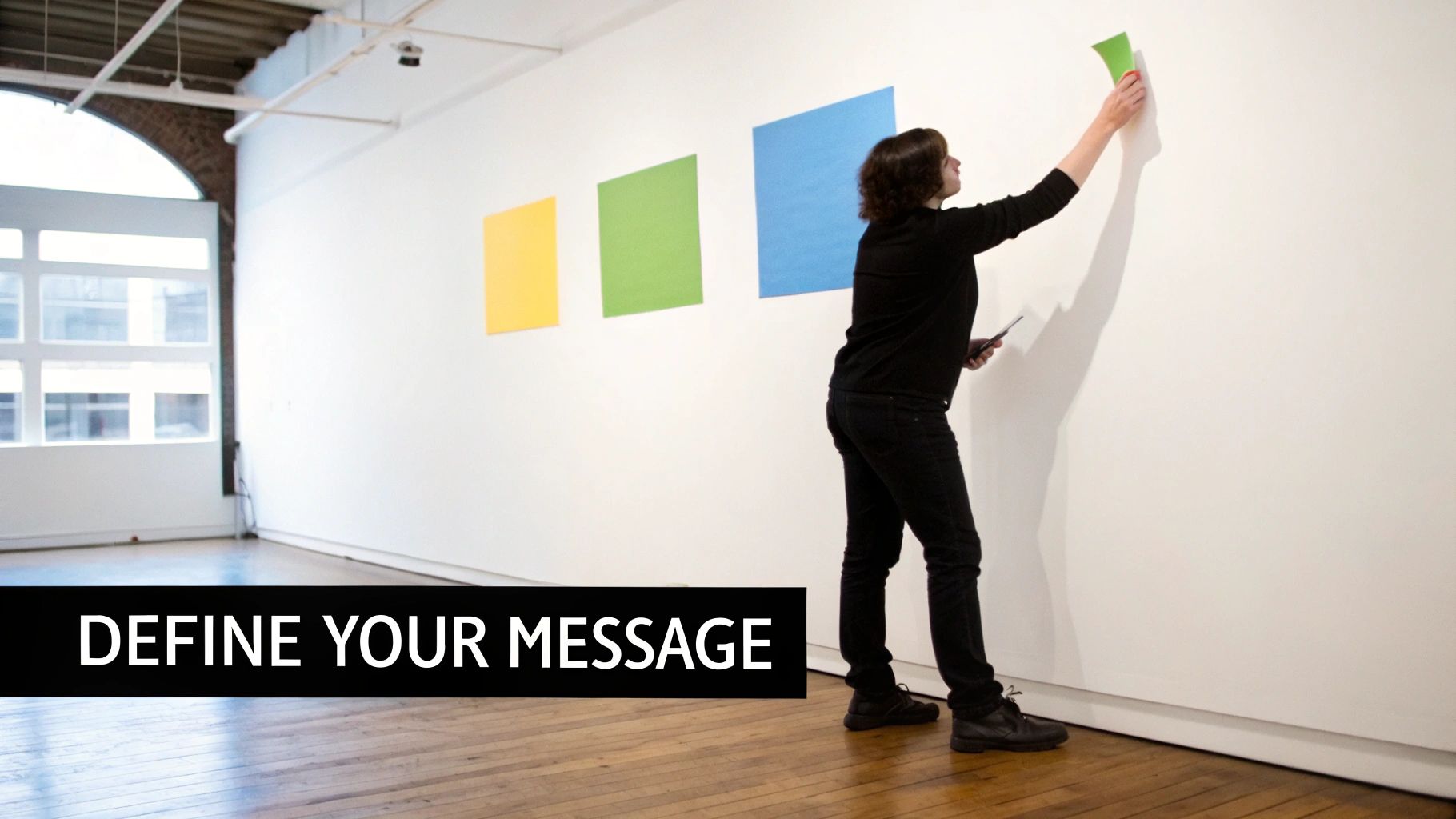
This isn't about brainstorming clever taglines. It's about building a strategic framework that will guide every word on your site. Once you have this down, you stop selling stuff and start solving real problems for real people.
Pinpoint Your Customer’s Real Problem
Here's the truth: your customers don't buy your services; they buy an escape from a problem they have. The trick is to dig past the obvious, surface-level issue to find the real, emotional pain point that drives their decisions.
A roofing contractor isn't just selling shingles; they're selling peace of mind when a nasty storm rolls through.
Instead of guessing, you have to understand their world. That means getting into their heads. Learning how to conduct user research effectively is a fantastic starting point for gathering these crucial insights.
Think about the real-life anxieties behind a simple search:
- A business owner looking for an accountant isn't just looking for tax prep. They're up at night worried about a surprise IRS audit or missing a chance to save for their kid's college fund.
- Someone searching for a local mechanic doesn't just need an oil change. They're stressed about being overcharged or having their car break down on the way to a big meeting.
Your copy has to speak directly to those feelings.
The most powerful website copy doesn't describe what you do. It describes the customer's problem so perfectly that they feel understood and automatically assume you have the solution.
Articulate What Makes You Different
"We offer quality service" is the most forgettable sentence in business. It says nothing because every single one of your competitors is saying the exact same thing. You have to define what makes you the only logical choice for your ideal customer.
This is your unique selling proposition (USP). It’s not a vague promise; it’s a specific, concrete reason to choose you.
- Bad Example: "We’re the best plumbers in town."
- Good Example: "We’re the only plumbers in Murrieta that offer a 2-hour appointment window so you don't waste your whole day waiting."
See the difference? The first is a bland claim. The second is a specific promise that solves a common, deeply annoying frustration. To get to the heart of your message, you need to define these key elements. A clear web page strategy connects your business goals with your customer’s needs, ensuring every page serves a real purpose.
To help you get started, we've put together a simple framework. Think through these questions to nail down your core message before you start writing.
Core Messaging Framework
| Component | Guiding Question | Example (Local HVAC Contractor) |
|---|---|---|
| Problem | What is the customer's real frustration, beyond the obvious? | My house is unbearably hot, my old AC unit is costing a fortune to run, and I'm worried it will die during a heatwave, leaving my family miserable. |
| Solution | How does your service directly solve that specific problem? | We install high-efficiency AC systems that lower your energy bills by 30% and provide reliable cooling you can count on, all summer long. |
| USP | What's the one thing you do better or differently than anyone else? | We offer same-day emergency installation, so you'll never be stuck without AC for more than a few hours. No one else in the county can promise that. |
| Brand Voice | What is the personality of your brand? How do you want to sound? | The friendly, reliable neighbor. Trustworthy, no-nonsense, and reassuring. We're here to help, not to upsell you. |
With these answers in hand, you have the building blocks for every headline, service description, and call to action on your website.
Define Your Brand Voice
Finally, let's talk about how you want to sound. Are you the reassuring expert? The friendly, down-to-earth guide? Or the straight-shooting, no-nonsense pro?
Your brand voice is the personality that comes through in your writing. It needs to be consistent across every single page, from your homepage headline to the tiny text on your contact form button.
A consistent voice builds trust and makes your brand memorable. If you're a high-end financial advisor, your tone should be authoritative and sophisticated. But if you're a dog groomer, it should be warm, friendly, and maybe a little playful. The key is to decide on this voice before you write a word, and then stick to it.
Writing Key Website Pages That Actually Convert
Alright, you've done the hard work and built a solid messaging foundation. Now comes the fun part: putting it all into action on your website.
Every page on your site has a job to do. If a page isn’t strategically guiding a visitor toward a goal, it's digital dead space. Let's dig into the most important pages—your Homepage, About page, and Service pages—and give you a practical, conversion-focused playbook for each.
This isn’t about blindly following a template. It's about getting inside your customer's head and understanding what makes them trust you enough to take that next step.
Your Homepage: The 5-Second Test
Your homepage is your digital front door, and you’ve got about five seconds—tops—to convince someone they’re in the right place. If a new visitor can't immediately figure out these three things, they're clicking the back button.
- What do you offer?
- Who is it for?
- Why should they stick around?
That first chunk of content they see, the hero section, has to nail your value proposition. It needs to speak directly to your visitor's problem and promise a clear, desirable outcome.
For example, a dental office homepage that just says "Family Dentistry in Menifee" is a missed opportunity. A much stronger version would be: "Gentle Dental Care for Anxious Patients in Menifee. Get a Healthy Smile, Without the Fear." See how that immediately connects with a specific audience (anxious patients), states the service, and highlights a powerful benefit (overcoming fear)?
Your homepage's primary job isn't to sell everything you offer. Its job is to earn you another 30 seconds of attention by proving you understand what your visitor is going through.
Your About Page: Building Real Trust
Here’s a classic mistake we see all the time: the About page is treated like a boring company timeline. Honestly, nobody cares that you were founded in 1998. What they do care about is why you do what you do and whether they can trust you to solve their problem.
Your About page is your best shot at telling a story and forging a human connection. Don't just list facts. Share your origin story, talk about your core values, and introduce the real people behind the logo.
A local contractor could share a story about growing up in a family of builders and learning the value of honest work from their grandfather. That's infinitely more compelling than just stating "25 years of experience." It transforms a faceless company into a trusted expert with a genuine passion—a critical piece of the copywriting for websites puzzle.
Your Service Pages: Turning Features Into Benefits
This is where the rubber meets the road. Your service pages are where you connect what you do directly to your customer's pain points and close the deal. The most powerful way to do this is by translating features into tangible benefits.
A feature is what your service is or has. A benefit is what that feature does for the customer. People don’t buy features; they buy the better version of themselves those features help create.
Let's break it down with a local auto shop:
- Feature: We use synthetic oil.
- Benefit: Your engine runs smoother, and you can go an extra 2,000 miles between oil changes, saving you time and money.
See the difference? The benefit paints a vivid picture of value. A good service page usually follows a simple, effective flow:
- Acknowledge Their Pain: Start by showing you understand the problem they're facing.
- Introduce Your Solution: Clearly present your service as the answer.
- Explain the Benefits: Detail exactly how your service makes their life better.
- Address Objections: Proactively answer the common questions or doubts you know they have.
- Provide a Clear Call-to-Action: Tell them exactly what to do next.
By structuring your key pages this way, you create a logical path that guides visitors from being casual browsers to becoming confident, qualified leads ready to do business with you.
Optimizing Your Copy For Google And For Humans
It’s a classic trap business owners fall into: they create incredible, persuasive copy, but their ideal customers never find it. They think they have to choose between writing for Google and writing for people.
The good news? You don't have to. In fact, Google’s entire mission is to reward content that real humans find genuinely useful.
Think of SEO copywriting less as a technical task and more as a way of aligning your message with what people are already searching for. It all comes down to understanding user intent—the real problem or question behind their search—and crafting copy that delivers the perfect answer.
Weaving In Keywords Without Sounding Like A Robot
Let’s get one thing straight: the old-school tactic of cramming keywords into every sentence is dead. Thank goodness.
Today, the smart approach is to use them naturally in a few key places where both Google and your readers expect to find them. This gives search engines clear signals about your page's topic while ensuring your copy stays smooth and convincing.
As a rule of thumb, place your main keyword (or a close variation) in these spots:
- Your Main Page Title (H1): This is the big, bold headline at the top. It needs to be clear, compelling, and should include your primary keyword.
- Subheadings (H2s and H3s): These are your signposts. They break up content, make it easy to scan, and help Google understand the page's structure.
- The First Paragraph: Introduce your core topic right away. This instantly confirms for both visitors and search engines that they’ve landed in the right spot.
- Image Alt Text: This descriptive text helps search engines "see" your images. It’s a perfect, natural place for a relevant keyword.
The key here is balance. Don't force it. People often ask about keyword density, but modern SEO is far more about relevance and context. If you're wondering how to strike that balance, we've put together a guide that explains how many keywords to focus on for SEO without getting bogged down in the weeds.
Writing Headlines And Descriptions That Demand A Click
When your page shows up in Google's search results, your title tag and meta description are your first—and sometimes only—chance to make an impression. Think of them as the sales copy for your content. They have one job: get the click.
Your headline needs to grab attention and promise a solution. The meta description then acts as a short, punchy summary of what the user will find, reinforcing the value you're offering. Honing this skill is crucial, so learning how to write effective meta descriptions is a massive step toward boosting your click-through rates.
Don’t treat SEO and great copy as separate tasks. Think of SEO as the signposts that guide the right people to your door, and your copy as the compelling conversation that happens once they’re inside.
By focusing on clear, helpful language that naturally uses the phrases your customers use, you create a website that works for everyone. You satisfy the search engines and the people who actually buy from you. That's the real foundation of copywriting for websites that grows a business.
Fine-Tuning Your Copy to Maximize Conversions
You can nail the big-picture message and have stellar SEO, but if the final step—the action you want people to take—is unclear or uninspiring, you’ll lose them at the finish line. This is where the smallest details in your website copy often make the biggest difference.

It’s time to zoom in on the little things that produce big results. We're talking about the specific words that turn a passive visitor into a paying customer, and it all starts with rethinking the most important buttons on your site.
Crafting Calls-to-Action That Actually Work
Your Call-to-Action (CTA) is arguably the most important instruction on any given page. And yet, so many websites fall back on the same tired, generic words: "Submit," "Learn More," or "Contact Us."
These phrases are weak because they don't tell the visitor what they'll get. A strong CTA needs to be specific, action-oriented, and focused on user value. It creates clarity and crushes hesitation by telling them exactly what happens next.
- Instead of "Submit," try "Get Your Free Estimate Now."
- Instead of "Learn More," try "Explore Our Fencing Styles."
- Instead of "Contact Us," try "Schedule a 15-Minute Consultation."
See the difference? Each revised example promises a specific, tangible outcome. The visitor isn’t just submitting a form; they’re taking a clear step toward solving their problem. This simple switch is one of the fastest ways to see a lift in engagement.
The Hidden Power of Microcopy
Beyond your main CTAs, dozens of tiny bits of text are scattered across your site that quietly build confidence or create friction. This is microcopy, and it includes everything from form field labels and error messages to confirmation pop-ups and helper text.
Good microcopy reassures users and guides them smoothly. For instance, right below the email field on your contact form, you could add: "We'll reply within 24 hours and never share your email." This tiny sentence proactively answers two huge anxieties: "Will anyone get back to me?" and "Am I about to get spammed?"
A visitor who feels confused or uncertain will almost always leave. Excellent microcopy works like a helpful guide, anticipating questions and removing every possible roadblock between the visitor and the goal.
By sweating these small details, you build trust at every touchpoint. It’s a core part of turning clicks into conversions, something we explore in-depth in our guide to conversion rate optimization best practices. More importantly, it shows you’ve thought through the entire customer experience, which makes your business feel professional, trustworthy, and reliable.
Common Questions About Website Copywriting
Even with the best roadmap, you’re bound to hit a few bumps when you start writing your website copy. We get it. Over the years, we've heard just about every question you can imagine from business owners trying to get their messaging right.
Let's clear up some of the most common ones.
How Do I Know If My Copy Is Actually Working?
This is the big one, isn't it? Good copy isn't just about sounding clever—it’s about getting results. You can't just guess or go with a "gut feeling."
You need to look at the data. Specifically, these three metrics will tell you a lot:
- Conversion Rate: This is your bottom line. Are more people buying your product, booking a call, or filling out your contact form? If that number is going up, you're on the right track.
- Time on Page: Are people sticking around to read what you've written? If a crucial service page has an average time on page of 10 seconds, that's a red flag that your message isn't grabbing them.
- Bounce Rate: This tells you how many people land on a page and leave immediately without clicking anything else. A high bounce rate often means your headline doesn't match what the visitor was expecting.
Together, these numbers paint a picture. They show you if your words are connecting with people and pushing them to take that next step.
Can I Just Write The Website Copy Myself?
Of course. You know your business, your customers, and your industry better than anyone. If you've got the time and a solid grasp of your core message, writing your own copy can be a fantastic move.
The trick is to stick to the fundamentals we've covered. Nail down your messaging strategy before you write a single word, always lead with customer benefits (not just your features), and write for them, not at them.
But it’s also important to be realistic. If writing feels like pulling teeth or you're constantly staring at a blinking cursor, it can stall your entire website project. Be honest about where your time and energy are best spent.
When Should I Hire A Professional Copywriter?
Bringing in a professional copywriter isn't an expense; it's an investment in getting your messaging right from the start. It’s probably time to call in an expert when:
- You're too close to your own business. It happens to all of us. We're so deep in the day-to-day that it's hard to explain what we do in a way an outsider instantly understands. A copywriter provides that crucial fresh perspective.
- You're launching a big new site or a major marketing campaign. When the stakes are high, you don't want to leave your messaging to chance. Professional copywriting for websites makes sure your investment in design and ads actually delivers.
- You just don't have the time. Your focus should be on running your business. A good writer can get the job done much faster and more effectively, letting your website start working for you sooner.
Think of a copywriter as a messaging strategist. They don't just fill pages with words; they dig deep to translate your unique value into a clear, persuasive story that your ideal customers are waiting to hear.
In the end, you need a website that pulls its weight and works as hard as you do. Whether you tackle the copy yourself or bring in a pro, focusing on clarity, the customer, and a clear call-to-action is what will transform your site into a genuine growth engine for your business.
Ready to turn your website into your most effective salesperson? At Uncommon Web Design, we build strategic websites with copy that connects and converts. Let's talk about a plan for your business.