
If you run a service business, SEO is how you get your website in front of people at the exact moment they’re searching for what you do. It’s not about getting more clicks; it’s about turning your website into a machine that generates qualified phone calls, quote requests, and real, measurable growth.
Why Your Website Should Be Your Best Salesperson
Take a hard look at your website. Is it actively bringing in business, or is it just an expensive digital brochure? For contractors, consultants, and auto shops, a website that performs is the most critical asset you have. This isn't about flashy design. It's about a smart, strategic system built to answer your ideal customer's questions the second they type them into Google.

When you nail SEO for your service-based business, you stop seeing your site as a necessary expense. It becomes your best employee—one that works 24/7 without ever needing a coffee break.
The Problem with a "Brochure" Website
So many business owners we talk to have a website that’s just their offline flyer forced onto a screen. It lists services, maybe has a phone number, but it does none of the heavy lifting required to actually sell.
A typical brochure website:
- Sits passively, hoping someone stumbles upon it.
- Fails to answer the specific questions your customers are asking.
- Doesn't build trust or showcase your real-world expertise.
- Lacks clear calls-to-action, leaving potential customers wondering what to do next.
This kind of site puts all the pressure on you to hustle for referrals or outbound sales. A "salesperson" website, on the other hand, actively finds and persuades prospects for you.
A strategically optimized website doesn’t just get found—it convinces. It anticipates a customer's needs, answers their objections, and makes it incredibly easy for them to take the next step.
This guide breaks down how to build an SEO strategy that connects every action—from local search to service pages—directly to your bottom line. After all, getting traffic is only half the battle; knowing the conversion rate optimization best practices is what turns those visitors into paying customers.
Let's skip the fluff and get straight to building your best salesperson.
Dominate Local Search With Your Google Business Profile
For a service business, your entire online world often shrinks down to the local map.
Think about it. When a homeowner’s AC gives out in a July heatwave, they aren't leisurely browsing websites. They’re grabbing their phone and searching “emergency AC repair near me.” They will call the first trustworthy name that pops up. This is where your Google Business Profile (GBP) becomes the most powerful tool in your arsenal.
It's more than a digital business card. It’s your storefront, your first impression, and a direct line to motivated customers who need you now. The problem is, most businesses claim their profile, fill out the basics, and then forget it exists, leaving a huge opportunity on the table for competitors.
Your GBP Is Your New Homepage
Let's be real: a huge portion of your potential customers will decide whether to hire you based on your GBP alone. They might never even click through to your website.
Why? Because everything they need is right there: your reviews, photos of your work, your service area, and your hours—all in one glance.
The numbers don't lie. A staggering 46% of all Google searches have local intent. These are people looking for local services. These searches drive an incredible 1.5 billion visits to physical business locations every single month. For a service pro, this isn't just "traffic"—it's a direct pipeline to new clients. You can discover more insights about these local search statistics on Backlinko.
Given this reality, optimizing your GBP isn't just another task. It’s fundamental to being seen by people who are ready to open their wallets.
Moving Beyond the Basics
Just having a complete profile isn’t enough. Your competitors have one, too. The real goal is to transform your profile from a static listing into an active, lead-generating machine that builds trust before a prospect even calls.
This means getting strategic with every single part of your profile.
-
Your Business Description: Don’t just state what you do; speak to your customer's problems. An HVAC company shouldn't just say, "We fix air conditioners." A better approach: "We provide fast, reliable emergency AC repair for homeowners in Menifee, ensuring your family stays cool when you need it most." See the difference?
-
Primary & Secondary Categories: Your primary category is critical (e.g., "Plumber," "Electrician"). But the magic happens in the secondary categories. This is where you snag more specific, high-intent searches. A plumber, for instance, should add "Water Heater Installation & Repair" and "Drain Cleaning Service" to attract customers looking for those exact solutions.
-
Your Services List: Get granular. Detail every single service you offer. Instead of a generic "Landscaping," break it down into "Lawn Mowing," "Tree Trimming," "Irrigation System Installation," and "Sod Installation." This directly aligns your profile with the specific phrases customers are typing into Google.
Think of your Google Business Profile as a mini-website that Google gives top priority. Every photo you upload, every review you respond to, and every question you answer is a powerful signal to both Google and your future customers that you are an active, engaged, and trustworthy expert.
A Tactical Checklist for an Optimized GBP
Turning your profile into a client magnet requires consistent effort, not a one-time setup. Here’s a prioritized checklist of actions that make a real difference.
Google Business Profile Optimization Checklist
This isn't just about filling out fields; it's about strategically turning your profile into a powerful tool that brings in leads day after day.
| Action Item | Why It Matters for Your Business | Difficulty Level |
|---|---|---|
| Complete Every Single Profile Section | An incomplete profile looks unprofessional and signals to Google that you aren't fully engaged. Fill out everything: service areas, hours, accessibility info, etc. | Easy |
| Geotag Your Photos | Adding location data to your images (before/after shots, team photos) reinforces your service area to Google, boosting your local ranking signals. | Medium |
| Publish Weekly Google Posts | Use Posts to share updates, promotions, or highlight recent projects. This shows Google your business is active and gives customers a reason to choose you. | Easy |
| Actively Solicit Reviews | A steady stream of new, positive reviews is the single most powerful trust signal for local customers. Create a simple system to ask every happy client for one. | Medium |
| Answer the Q&A Proactively | Don't wait for questions. Go in and ask your own FAQs, then answer them yourself. This controls the narrative and positions you as a helpful authority. | Easy |
By treating your Google Business Profile with the same strategic focus as your main website, you stop waiting for customers to find you. You put your business right in front of them, ready to win their business.
Create Service Pages That Actually Convert Leads
Your service pages are where the money is made—or lost. We see it all the time: business owners treat these pages like an afterthought. They throw up a generic title like "Our Services," add a stock photo, and list a few bullet points. This is a huge mistake.
Think about it from your customer's perspective. When they land on a vague page, they have no reason to believe you understand their specific problem, let alone that you're the right person to solve it.
For any service business, good SEO is about getting the right people to the right page. A generic "Electrical Services" page doesn't cut it. It won't convince a homeowner with flickering lights to call you, especially when a competitor’s page is titled "Fast & Reliable Circuit Breaker Repair for Menifee Homes." Specificity sells because it mirrors the exact thought going through your customer's head.
The Anatomy of a High-Converting Service Page
You need to think of each service page as a dedicated salesperson for one specific offer. Its only job is to walk a visitor from having a problem to confidently booking your service. That means it needs to be structured to build trust, answer questions, and make taking the next step incredibly easy.
A great service page isn't a wall of text; it's a strategic conversation. Here’s what it must include:
- A Pain-Point Driven Headline: Speak directly to their problem. "Emergency HVAC Repair for Phoenix Summers" is far more effective than "HVAC Services."
- Clear Social Proof: Don't just say you're great. Show it. Weave real client testimonials and photos of your work right into the page.
- A Simple Explanation of Your Process: What happens after they call? Briefly outline the steps. This demystifies the experience and lowers their anxiety about hiring you.
- Direct Answers to Common Questions (FAQs): Get ahead of their concerns. Address costs, timelines, and what they can expect before they even have to ask.
This structure transforms a passive, brochure-like page into an active sales tool. It anticipates what the customer needs and guides them straight to a solution, positioning you as the obvious expert. The whole process is a cycle of optimizing your pages, engaging with customers, and earning top rankings.
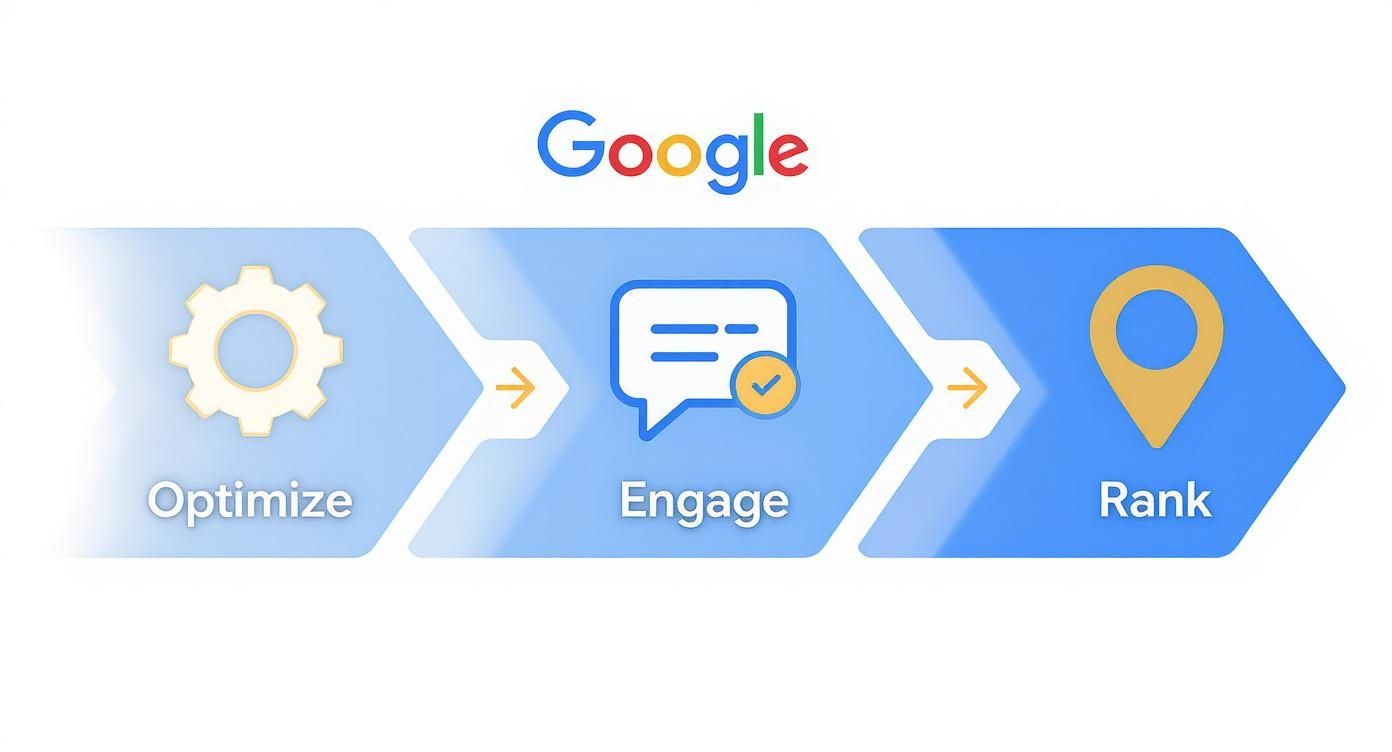
This workflow is the key. It's an ongoing cycle where technical tweaks and active customer engagement work together to drive you up the local search results.
Building Trust With Every Word
Your service pages are your chance to prove you know your stuff. A plumber could detail their modern, non-invasive leak detection process, showing they use advanced equipment instead of guesswork. An IT consultant could map out their onboarding process for new clients, demonstrating a clear, professional system from day one.
This isn't about bragging; it's about building confidence. You’re showing them you've solved this exact problem hundreds of times before. Getting this right starts with your website’s structure. If you need a refresher on the fundamentals, you might find our guide on strategic web page planning helpful.
The goal of a service page is to get the visitor to stop searching. When they feel understood and see clear proof you can solve their problem, they have no reason to go back to Google.
This stuff isn't optional. Organic search is the lifeblood for service businesses, driving 53% of all website traffic. But so many sites miss the basics. It’s shocking, but 25% of small business websites don’t even have an H1 tag, and an incredible 7.4% of pages ranking in Google's top 10 are missing a title tag altogether.
By taking the time to build robust, specific, and conversion-focused service pages, you create assets that don't just rank—they generate qualified leads and drive measurable revenue.
A Practical Content Strategy for Busy Owners
Let's be honest. When most service business owners hear "content marketing," they picture a hamster wheel. They imagine an endless grind of writing blog posts and making videos—a full-time job they don't have time for.
That's the wrong way to look at it.
For a service business, effective content isn't about churning out a ton of stuff. It’s about establishing authority and answering questions. Your job isn't to become a professional blogger. It’s to build a small library of strategic assets that work for you 24/7, attracting the right kind of leads and pre-selling them on your expertise before they even call.
The idea is simple: figure out the most important questions your customers ask before they're ready to buy, and then answer those questions better than anyone else. This is a huge piece of a solid SEO strategy for any service based business, because it connects you with people in the research phase—the folks who will become paying customers tomorrow.
Focus on Questions, Not Just Keywords
Forget getting bogged down in complicated keyword tools, at least for now. Start with what you already know. As an expert, you probably answer the same handful of questions from potential clients every single week.
Those questions are pure content gold.
For example, a roofer in Phoenix is constantly asked about the best materials for the brutal sun. An article titled "Choosing the Best Roofing Material for Arizona Heat" is infinitely more valuable than a generic "Roofing Services" post. It pulls in highly qualified local traffic and instantly frames the roofer as a knowledgeable pro.
Or imagine a financial advisor who works with entrepreneurs. They could write a guide on "Common Financial Mistakes for Small Business Owners in Their First Five Years." This doesn't just attract their ideal client; it builds immediate trust by giving away genuine value.
Building Your Content Framework
You don't need an elaborate, complex system. The goal is a repeatable process that doesn't take over your life. This is about planning ahead and putting your energy into quality, not quantity.
Here’s a simple way to approach it:
- Brainstorm Core Customer Problems: List the top 10-15 questions you get asked all the time. What are people's biggest worries, concerns, or points of confusion about your service?
- Group Them into Themes: You’ll start to see patterns in your list. These themes—like "Project Costs," "Timelines," "Material Choices," or "Our Process"—can become your main content pillars.
- Create "Pillar" Content: For each theme, create one high-value piece of content. This could be a detailed blog post, an in-depth project gallery with explanatory text, or a comprehensive FAQ page.
- Schedule It Out: Don't try to do everything at once. Commit to creating one or two of these pieces a month. Consistency beats speed every time. To keep it all manageable, we always recommend organizing your ideas; learn how to create a content calendar that actually fits your schedule.
Your content's job is to make the sales conversation easier. When a lead comes to you after reading your detailed article on your process, they're not just a lead anymore. They're a pre-qualified prospect who already trusts you.
Ideas That Work for Any Service Business
This strategy works even if you hate writing. Here are a few content formats that build serious authority and are perfect for service providers:
- Project Case Studies: Go beyond simple before-and-after photos. Tell the story. What was the client's problem? What was your specific process for solving it? What was the final outcome? This shows people how you think and solve real-world problems.
- Detailed FAQ Pages: Don't just list a few basic questions. Create dedicated, in-depth FAQ pages for each of your core services. Answer every possible question about pricing, timelines, what's included, and what clients need to do to prepare.
- "How to Choose" Guides: Help your customers make better, more informed decisions. A painting contractor could create a guide on "How to Choose the Right Paint Finish for Every Room." Content that helps people like this builds incredible trust.
By focusing on answering real customer questions with practical, valuable content, you transform your website from a simple online brochure into an authority hub. It starts attracting the right kind of traffic and ensures that when those searchers are finally ready to hire, your name is the first one they think of.
Build Authority With Reviews and Local Signals
In the service industry, trust is everything. Your skills might be the best in town, but if a potential customer doesn't trust you, they'll never pick up the phone. Online, that trust isn't just built on your website. It’s built through a web of reviews, local directory listings, and consistent brand signals that tell both Google and your customers that you're a legitimate, reliable expert.

This isn’t just about collecting five-star ratings. It’s about creating a powerful network of social proof that solidifies your authority in the local market. When you get this right, this ecosystem of trust signals becomes a core part of your SEO for a service based business, making you the obvious choice.
A System for Generating Positive Reviews
Hoping for reviews is not a strategy. You need a simple, repeatable process to ask every happy customer for their feedback. Most people are willing to leave a review; they just need a gentle nudge and an easy way to do it.
The key is to make it frictionless. Don't just say, "Leave us a review!" Send them a direct link to your Google Business Profile review page via text or email right after the job is done. This one small step can dramatically boost your review rate.
Your goal isn't just a high star rating; it's a steady stream of recent reviews. A business with 50 reviews from last week looks far more active and trustworthy to both Google and customers than a business with 100 reviews from three years ago.
Responding to those reviews is just as important. Always thank customers for positive feedback, and—this is critical—address negative reviews professionally. A thoughtful, helpful response to a bad review can often win over more new customers than a dozen glowing ones because it shows you genuinely care and are committed to making things right.
Understanding Citations and NAP Consistency
Beyond reviews, another crucial trust signal is the citation. A citation is any online mention of your business's Name, Address, and Phone number (NAP). You'll find them in local directories like Yelp, industry-specific sites like Houzz for contractors, and other online platforms.
Think of each consistent citation as another vote of confidence for your business. When Google sees these mentions across the web, it uses them to verify that your business is real, located where you say it is, and actively serving the community.
But here’s the catch: inconsistency is a killer. If one directory lists you as "Smith Plumbing Inc." on "Main St." and another has "Smith Plumbing" on "Main Street," it creates confusion for search engines. That confusion erodes the trust signals you're trying to build.
A Practical Plan for Building Local Authority
Building this web of trust doesn't have to be overwhelming. You can get started by focusing on a few high-impact actions.
- Audit Your Existing Citations: Use a tool or just search for your business to see where you're listed. Make a simple spreadsheet of all the NAP inconsistencies you find and start correcting them.
- Target Key Directories First: Don't try to get listed on hundreds of sites at once. Start with the big ones that matter for almost every local business: Google Business Profile, Yelp, and Bing Places.
- Find Niche Industry Directories: Are you a lawyer, a dentist, or a home builder? There are dozens of high-authority directories specific to your field. Getting listed on these sends a powerful relevancy signal to Google that you're an expert in your niche.
By systematically building your review profile and ensuring your business information is rock-solid consistent across the web, you create a powerful foundation of trust. This doesn't just help you rank higher; it reassures potential customers that you are the right pro for the job.
Measure The SEO Metrics That Actually Matter
SEO isn’t about collecting traffic. For a service business, it's about generating revenue, period. The biggest mistake owners make is getting hooked on vanity metrics—things like daily ranking changes or total website visitors. These numbers might feel good, but they don't pay the bills.
The whole point of SEO for a service based business is to connect every dollar and hour you invest to a tangible return. You have to know if your efforts are actually putting money in your pocket. This means shifting your focus from "How many people visited?" to "How many qualified leads did we get this month?"
This is how you prove that SEO isn't just another marketing expense. It’s a high-growth investment that systematically builds your most valuable asset: a predictable pipeline of inbound customers.
Ditching Vanity Metrics for Business KPIs
You're a business owner, not a data analyst. You don't have time to drown in charts and graphs. The secret is to zero in on the few Key Performance Indicators (KPIs) that directly tie back to business growth.
Stop obsessively checking your rankings every day. It's a waste of time. Instead, focus on these three core areas:
- Qualified Lead Volume: This is the big one. How many contact form fills, quote requests, and direct emails are coming from organic search? This is the clearest sign that your SEO is attracting the right people.
- Phone Calls from Google Business Profile: For many local service businesses, this is the most valuable metric of all. Your Google Business Profile tracks how many people click to call you straight from the search results. These are often your hottest, most ready-to-buy leads.
- Conversion Rate on Key Service Pages: Driving traffic to a page is only half the battle. Tracking the percentage of people who contact you after landing on a specific page (like "Emergency Plumbing Repair") tells you whether your message is actually working.
Your SEO report shouldn't be a complex, jargon-filled document. It should be a simple, clear answer to one question: "Is this working?" If a metric doesn't tie directly back to leads and revenue, it’s just noise.
What Does a Healthy SEO ROI Look Like?
Understanding the potential return is critical before you invest. While every business is different, the data consistently shows that a well-executed SEO strategy delivers a powerful ROI for service providers.
The numbers are particularly compelling in the service sector. For instance, looking at three-year average data, Financial Services saw an incredible 1,031% ROI with a 9-month break-even period. HVAC services weren't far behind, showing a 678% ROI and an even faster break-even time of just 6 months. You can read more about these ROI benchmarks to see what's possible.
This kind of return doesn't just happen. It's the result of a focused strategy that aligns every SEO action—from the keywords you choose to the blog posts you write—with the ultimate goal of generating a qualified lead.
When you start tracking the right things, you gain incredible clarity. You can see exactly which strategies are driving real-world results, allowing you to double down on what works and cut what doesn't. This is how you stop guessing and start building a predictable system for growing your business.
Frequently Asked Questions
How Long Does SEO Take To Show Results?
That's the million-dollar question. While you can see some quick wins from tuning up your Google Business Profile—sometimes in just a few weeks—real, lasting SEO is a marathon, not a sprint. We're building a valuable business asset, not just chasing a short-term traffic bump.
Generally, you should start to see a meaningful increase in qualified leads within 4-6 months. The companies that truly dominate online are the ones who treat SEO as a continuous investment in their growth, not a one-and-done project.
Can I Do SEO Myself Or Should I Hire Someone?
You can absolutely handle the fundamentals yourself. Optimizing your Google Business Profile and tightening up your main service pages are fantastic, high-impact tasks you can tackle. But when you get into more technical areas, like strategic link building or planning a content calendar that ranks, the learning curve gets steep.
The real question is about return on investment. Where is your time most valuable: in your business, delivering amazing service to your clients, or on your business, trying to master a complex marketing discipline? For most service business owners, hiring an expert is not only more effective but also more profitable in the long run.
Is Local SEO Or Website SEO More Important?
For a service business? That's like asking if your van's engine or its wheels are more important. You need both to get anywhere. They're two sides of the same coin.
Here’s a simple way to think about it:
- Local SEO is about immediacy. It’s your Google Business Profile, your reviews, and local directory listings. This is what captures the "I need a plumber now" customer in your service area. It should be your first priority.
- Website SEO builds long-term authority. It’s your in-depth service pages and your blog content. This captures customers who are still in the research phase—the ones searching "best way to fix a leaky faucet" before they even look for a plumber.
The winning playbook is to first own your local map pack. Then, use your website's content to back up that authority and expand your reach. You need both firing on all cylinders to build a lead generation machine you can count on.
Ready to turn your website into a system that consistently brings in qualified leads? The team at Uncommon Web Design has over 25 years of experience building conversion-focused websites that drive measurable growth for service businesses. Let's build a plan that works for you.