If you run an ecommerce store, you’ve probably heard about link building. Let’s cut through the jargon. It’s the process of getting other websites to link back to your product and category pages. Think of these backlinks as votes of confidence. When a respected website links to you, it tells search engines like Google that your store is a credible, valuable resource. That signal is a major factor in boosting your rankings and, ultimately, driving more organic traffic.
Why your ecommerce site needs backlinks
A beautiful online store is a great start, but if customers can’t find it, it isn’t making you money. Many business owners get trapped in the paid ad cycle. Ads deliver traffic now, which feels good, but the moment you stop paying, the traffic vanishes. Link building is different. It’s an investment in a long-term asset that works for you 24/7, without requiring a constant cash injection.
Every high-quality backlink acts as a digital referral. When an authoritative industry blog or a local business partner links to you, they’re vouching for your business. This sends valuable referral traffic your way, but more importantly, it fundamentally improves how Google sees your entire website.
Backlinks drive sustainable growth
For any business, sustainable growth is the goal. You need marketing that compounds over time, not something that eats up cash just to keep the lights on. Organic traffic, powered by a solid backlink profile, is one of the most cost-effective ways to achieve this.
We worked with a local auto shop that doubled its online bookings for custom exhaust systems with a surprisingly simple approach. They didn't sink their budget into pricey ads. Instead, they focused on getting their work featured in a few popular car enthusiast blogs. A handful of these high-quality links made a massive difference. They drove initial sales, but they also lifted the shop's search rankings for key terms like "custom exhaust fabrication."
This created a powerful snowball effect:
- Increased Authority: Google started seeing their site as a more credible source for auto services.
- Higher Rankings: Their service pages climbed higher in search results, capturing more organic traffic from people ready to buy.
- More Sales: All that new visibility translated directly into more customers finding their shop and booking appointments.
A strong backlink profile turns your website into a powerful, automated salesperson. It's the difference between renting traffic with ads and owning an asset that generates leads and sales month after month.
Building quality backlinks is how you improve your site's authority and implement proven SEO strategies to outrank competitors. Don't think of it as just another marketing task. It's a core business activity that builds a durable, competitive advantage.
Building your foundation with a backlink audit and competitor analysis
Jumping into link building without knowing where you stand is like renovating a house without checking the foundation first. You might make things look better, but you could be building on a shaky base. The smartest approach to link building for ecommerce sites doesn't start with outreach—it starts with an honest look at your current backlink profile and what your competitors are doing.
This means starting with a backlink audit. Think of it as a health check for your website’s online reputation. The goal is to figure out what’s helping you, what’s hurting you, and where your biggest opportunities lie.
Know your starting point
Before you can build anything solid, you have to clear the ground. A good backlink audit shows you two critical things: your assets and your liabilities. Your assets are the strong, relevant links signaling to Google that you're a trustworthy source. Your liabilities are the spammy, "toxic" links that could be weighing your site down.
Using a tool like Ahrefs or Semrush, you can pull a complete list of every site linking to you. You'll want to sift through that data to find:
- Toxic Links: The first step is to identify and disavow low-quality or irrelevant links. These can seriously harm your SEO.
- Strongest Referring Domains: Note which high-authority sites already link to you. These relationships are valuable and may offer future opportunities.
- Most-Linked Pages: See which of your pages attract links naturally. This is a huge clue about what type of content resonates in your industry.
This initial review is foundational. If you want to dig deeper, our comprehensive web audit checklist can walk you through a broader site analysis to make sure all your bases are covered.
Reverse-engineer your competitors
Once you have a handle on your own profile, it’s time to see what your top competitors are doing. They’ve already done a lot of the heavy lifting for you—they’ve figured out which link-building tactics work in your niche. Your job is to uncover their playbook and find opportunities you can ethically replicate.
This isn’t about copying them. It’s about strategic intelligence. By analyzing their backlink profiles, you can answer critical questions:
- What kinds of websites are linking to them? Are they blogs, news outlets, or industry directories?
- Which of their pages earn the most backlinks? Is it product pages, blog posts, or detailed buyer’s guides?
- Can you spot any patterns? Maybe they have supplier partnerships, get featured in gift guides, or do a lot of podcast interviews.
Imagine you run an online store for artisanal coffee. You might discover your biggest rival gets dozens of links from coffee bloggers reviewing their single-origin beans. That’s not a secret; it’s a roadmap. You now have a proven tactic you can adapt for your own brand. To get a clear picture of the landscape, you can use the best free competitor analysis tools available.
This simple flow shows how even a single quality backlink can make a real difference to your bottom line.
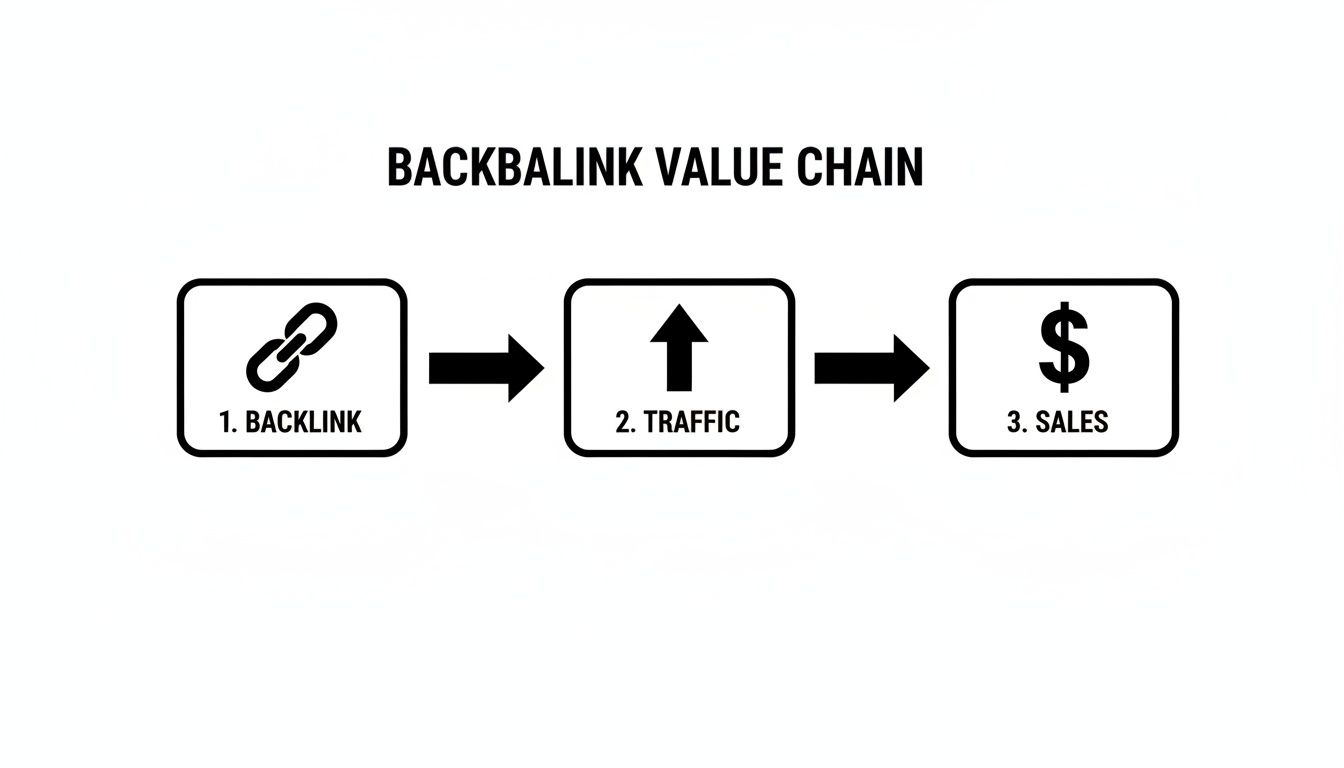
There’s a direct line from earning a quality backlink to seeing more traffic and, ultimately, making more sales. It's a powerful chain reaction.
It's no surprise that most SEO experts agree backlinks have a massive impact on search rankings, especially in the competitive world of ecommerce. The data is clear: ignoring your backlink profile is a fast way to get left behind. In fact, one of these eye-opening link building statistics found that over 90% of pages get zero organic traffic from Google, largely because they have no backlinks.
Auditing your site and analyzing the competition moves you from guesswork to a data-backed strategy. You’ll end up with a prioritized list of link targets based on what’s already working, not wishful thinking. This is how you ensure every hour you invest is aimed at opportunities with the highest possible return.
Creating linkable assets that actually attract links
Let’s be direct: your product and category pages are designed to sell, not to earn backlinks. Why would a journalist or blogger link to a standard product page unless it's for a specific gift guide? It doesn't happen often. If you want to consistently earn high-quality links, you have to give other websites a compelling reason to reference you.
This is where linkable assets come in.
A linkable asset is a piece of content created specifically to be a go-to resource for your industry. It’s a page so valuable, an answer so clear, or data so unique that other sites feel compelled to link to it. This strategy is how you stop chasing links and start attracting them organically.
The impact of this approach is huge. Data shows a direct line between backlink volume and organic traffic. According to some eye-opening link building statistics, pages ranking #1 in Google have, on average, 3.8 times more backlinks than those in positions #2-#10.
With the vast majority of online content getting zero external links, creating something truly exceptional is the only way to break through the noise.
Think beyond the standard blog post
A well-written blog post is a good start, but a true linkable asset is often more ambitious. You're aiming to create something definitive and genuinely useful—something your competitors would find difficult to replicate. This doesn’t require a massive budget, just strategic thinking.
Here are a few types of linkable assets that work wonders for ecommerce stores:
- Interactive Calculators & Tools: These are gold because they offer instant, personalized value. A contractor could build a "Deck Installation Cost Estimator." Local bloggers and community news sites love sharing practical resources like that.
- Original Data & Survey Reports: Everyone loves quoting statistics. An online pet supply store could survey its customers about annual pet care costs and publish the findings. This original data becomes a link magnet for pet bloggers and journalists who need a solid statistic to back up their articles.
- The Ultimate Buyer's Guide: Don't just write a blog post; create the most comprehensive guide on the internet for one of your core product types. If you sell power tools, create the definitive guide to "Choosing the Right Cordless Drill," complete with charts, comparisons, and videos. It becomes the resource everyone else links to.
- Industry Glossaries: Every niche has its own jargon. A well-organized glossary of terms can attract links from beginners who need definitions and even experts who want a reliable source to send their own audience to.
Pro Tip: The best linkable assets solve a real problem for your audience. They aren't just content for content's sake; they're functional resources that cement your authority and make other websites look smarter for linking to you.
Turning an idea into a link-earning machine
Having a great idea is one thing; executing it is another. Once you've brainstormed a potential asset, you need to map out its creation, publication, and—most importantly—its promotion.
A smart way to manage this is to build asset creation into your content workflow. For instance, when planning topics for the next quarter, schedule these bigger projects alongside your regular blog posts. Our guide on how to create a content calendar can help you get organized.
To help you decide where to start, here's a quick look at some common asset types and the resources they typically require.
Linkable Asset Ideas for Ecommerce Stores
| Asset Type | Description | Investment Level | Link Potential |
|---|---|---|---|
| Industry Glossary | A simple A-Z list of key terms and definitions relevant to your niche. | Low | Medium |
| Buyer's Guides | In-depth articles that help customers make a purchase decision. | Medium | High |
| Original Survey | Polling your audience or industry to produce unique data and insights. | Medium-High | Very High |
| Interactive Calculator | A custom-coded tool that solves a user's problem (e.g., cost, size, fit). | High | Very High |
The effort often correlates with the reward. A simple glossary is a great starting point, but a unique, interactive tool has the potential to become a cornerstone of your link profile for years.
Just remember, the asset itself doesn’t earn links—your promotion does. Once your new calculator or ultimate guide is live, you need a smart outreach plan to let the right people know it exists.
Scaling outreach with relationship building
You’ve created a genuinely valuable, linkable asset. Now comes the critical part: getting it in front of the right people. This is where most link building campaigns fall apart.
The common mistake is blasting out hundreds of generic emails, crossing your fingers, and hoping for a response. This approach is not only ineffective; it burns bridges and makes your brand look desperate.
Genuine link building for ecommerce sites isn't a numbers game. It's a relationship game. Your goal isn’t just to get a single link; it’s to build a network of advocates for your brand. These are the journalists, bloggers, and industry influencers who will think of you first when a relevant topic comes up in the future.

When you adopt this relationship-first mindset, outreach stops being a tedious chore and becomes a strategic business development activity. It's about finding people who will truly benefit from what you've created and approaching them with respect for their time and expertise.
Finding the right people to contact
Before you write a single email, you must know who you’re talking to. Your outreach list should be small, highly targeted, and meticulously researched. Forget scraping thousands of emails. Your time is better spent identifying a few dozen high-potential contacts who are a perfect match.
So, who are you looking for?
- Niche Bloggers: Find the influential voices in your specific vertical. If you sell high-end kitchen knives, connect with serious food bloggers and professional chefs, not generic lifestyle bloggers.
- Journalists and Editors: Look for writers who cover your industry for trade publications or local news outlets. Services like HARO (Help a Reporter Out) are great for this, giving you a direct line to journalist queries.
- Complementary Brands: Who else serves your audience without directly competing? A landscape supply company and a local pool installer, for example, are a natural fit for collaboration.
- Past Linkers: Dive back into your backlink audit. See who has linked to similar content in the past—or even better, to your competitors. These are warm leads because they've already shown interest in your topic.
The key is to think like a matchmaker. You're not hunting for any website with a decent Domain Authority; you're looking for an alignment of audience, content, and intent.
Crafting a pitch that actually gets a "yes"
Once you have your curated list, it's time to craft a pitch that won't be immediately deleted. The people you’re contacting get dozens of terrible pitches every day. Yours has to be different. It must be personal, valuable, and concise.
An effective pitch never begs for a link. Instead, it offers value upfront and makes a compelling case for why your resource is a fantastic fit for their audience. Think of it less as an ask and more as a professional heads-up.
Your outreach email should feel like a note from one human to another, not a marketing blast. The goal is to start a conversation that leads to a link, not demand one in the first email.
Here’s a simple structure that works time and again:
- A Genuinely Personalized Opening: This is non-negotiable. Show you've done your homework. Mention a specific article they wrote or a recent project. This instantly proves you're not a spammer.
- The Value Proposition: Get straight to the point. Briefly explain what you've created (e.g., "our new deck installation cost calculator") and, most importantly, why it's relevant to them and their audience.
- The Gentle Suggestion: Don't say, "Please add a link to your page." That feels demanding. Instead, try something softer, like, "Thought it might be a useful resource for your readers," or "Could this be a good fit for your article on home renovation?"
- A Simple, Clean Closing: End it. No long-winded bios or pushy follow-ups. Just a simple sign-off.
This human-centered approach does more than just get you links; it builds real relationships. It’s how you get featured in coveted holiday gift guides, land collaborations, and become a go-to source for journalists. These aren't just one-off links; they are compounding assets that drive real traffic and real customers.
Measuring link building impact on revenue
Getting a new backlink feels good, but that feeling doesn't pay the bills. As a business owner, you have to know if your investment in link building for ecommerce sites is actually making the cash register ring. The good news is, you can connect the dots between a new link and a healthier bottom line.
It all comes down to tracking the right key performance indicators (KPIs). Forget just counting how many links you’ve acquired. We need to measure what those links do. This means shifting your focus from vanity metrics that feel good to business outcomes that actually matter.
The goal is to build a simple reporting framework that proves the value of your work. When you can show your team that a specific link campaign led to a real increase in sales, link building stops being a cost center and starts looking like the powerful growth engine it is.
Moving beyond rankings to revenue
Keyword rankings are a solid starting point, but they’re only one piece of the puzzle. Seeing a product page jump from page three of Google to page one is fantastic, but what does that mean in practical terms? To measure the real impact, you need to track a few core metrics.
We always recommend focusing on these three areas:
- Organic Keyword Ranking Gains: Yes, start here. Use a tool like Ahrefs or Semrush to monitor your target keywords. Are the pages you’re building links to climbing in the search results? This is the first signal that your strategy is working.
- Referral Traffic Spikes: This is the most direct impact. In Google Analytics, check your referral traffic sources. Did that new blog feature send a wave of new, qualified visitors to your site? This traffic often converts well because it comes with a built-in recommendation.
- Conversion Lift on Linked Pages: This is where the rubber meets the road. Zero in on the conversion rate for the specific pages that received new links. If a key product page gets a powerful backlink, you should see an increase in its organic traffic and, most importantly, its sales.
A practical example of tying links to sales
Let’s say you run a dental practice and want to boost appointments for cosmetic whitening. You focus your efforts on getting the lead dentist featured in a handful of local health and lifestyle blogs.
Instead of just celebrating the new links, you track performance:
- First, you monitor rankings for "teeth whitening [Your City]" and watch your service page jump from position #11 to #4.
- Next, you check Google Analytics and notice a 30% increase in referral traffic coming directly from those lifestyle blogs.
- Finally, you analyze your booking data and find that appointments for that specific service increased by 25% in the month after the campaign went live.
By connecting these dots, you’ve done more than just build links—you've built a repeatable process for driving sales. Now you can confidently reinvest in this strategy, knowing it produces a tangible return.
This isn't just theory; it's how smart businesses grow. Organic search is a massive driver for online stores. In fact, a recent analysis found that 23.6% of all eCommerce orders originate from organic traffic. As you can see from these ecommerce link building findings on tlinks.io, every high-quality backlink you earn contributes directly to this crucial revenue stream.
Tracking your efforts is straightforward once you know what to look for. Here’s a quick-glance table of the most important metrics.
Key Metrics for Tracking Link Building Success
| Metric | What It Tells You | Recommended Tool |
|---|---|---|
| Domain Rating/Authority | The overall SEO strength and "trustworthiness" of your website in Google's eyes. | Ahrefs, Moz, Semrush |
| Organic Keyword Rankings | Whether your link building is improving visibility for your most valuable search terms. | Ahrefs, Semrush, SE Ranking |
| Organic Traffic | The total number of visitors arriving from search engines; the ultimate top-level indicator. | Google Analytics, Google Search Console |
| Referral Traffic | How many visitors are clicking through directly from the sites that linked to you. | Google Analytics |
| Page-Level Conversions | If the specific pages you built links to are seeing an increase in sales or leads. | Google Analytics (with goal tracking) |
| Number of New Linking Domains | The growth in unique websites linking to you, which signals a diverse backlink profile. | Ahrefs, Semrush |
By putting a system in place that connects link acquisition to real sales, you can justify your marketing spend and make smarter decisions. This is also a perfect opportunity to look at your entire customer journey. You can learn more about connecting traffic to conversions in our guide to marketing automation for ecommerce.
Ultimately, the key is to stop seeing link building as an isolated task and start treating it as an integrated part of your sales engine.
Your Link Building Questions, Answered
When you're running a business, your time is your most valuable asset. You don't need vague marketing jargon; you need direct answers. Here are the most common questions we get from ecommerce owners, answered with consultant-level clarity.
How long until I actually see results?
This is the big one. The honest answer is you need to think in months, not days. Link building is a long-term play. While you might get a trickle of referral traffic from a new link within a week, the real SEO payoff—seeing your products climb the rankings—usually takes three to six months to kick in.
A few things affect that timeline:
- Your starting point: A brand-new store has a steeper hill to climb than an established shop with some existing authority.
- Your market's competitiveness: Getting to page one for "handmade leather wallets" is a different challenge than ranking for "women's running shoes."
- The quality of your links: One powerful link from a major industry publication is worth more than a dozen low-quality links from random directories. It's about quality over quantity.
We tell clients to think of it like planting a tree. You won't get shade overnight. But if you keep watering it, you're building an asset that will pay dividends for years. The goal is steady, sustainable growth.
What's a realistic monthly budget for this?
Budgeting for link building for ecommerce sites can feel abstract because you’re investing in a process, not a product. Realistically, a monthly budget can run anywhere from $2,000 to $10,000+, depending on your goals and how competitive your niche is.
So, where does that money actually go?
- Strategy & Research: The brainpower—analyzing competitors, finding keywords, and mapping out opportunities.
- Content Creation: Creating something worth linking to. This covers the cost of top-notch guides, calculators, or unique studies.
- Outreach & Relationship Building: The manual work of finding the right people (journalists, bloggers, editors) and building real connections.
- Tools & Reporting: Subscriptions for SEO software and the time it takes to analyze data and show you what's working.
For a small business doing under $2M in revenue, starting at the lower end of that range is a smart way to build a solid foundation. The key is consistency. A smaller, steady investment over a year will always outperform a massive, one-time spend.
Should I be doing guest posts or digital PR?
This gets to the heart of a smart strategy. The best approach isn’t "either/or"; it’s a "both/and" strategy that evolves as you grow.
- Guest Posting is fantastic for building your foundational authority. When you contribute a genuinely helpful article to a respected blog in your niche, you get a highly relevant link and can be strategic about the anchor text. It's the perfect tactic when you're starting out and need to build topical relevance around your key product categories.
- Digital PR is about hunting for bigger fish. This is where you create compelling stories or data that news outlets and top-tier publications want to cover. One successful digital PR hit can land you a link that’s exponentially more powerful than a single guest post, but it's less predictable.
We usually recommend starting with a steady drumbeat of guest posting to build your base. Once you have some authority, start weaving in digital PR campaigns to go after those game-changing, high-authority links.
Ready to stop guessing and start building a backlink profile that actually drives revenue? At Uncommon Web Design, we build strategic, results-driven link building campaigns that turn your website into a 24/7 sales engine. Book a free consultation today and let’s create a roadmap for your growth.