You don't need expensive software to start finding backlinks. You can do it directly within Google Search using special commands called search operators. Commands like "your brand name" -site:yourdomain.com aren't just clever tricks; they’re targeted queries that reveal who is linking to your website or simply mentioning your business online. For a business owner, this is a no-cost way to get a quick snapshot of your digital footprint.
Why Backlinks Are Your Secret Weapon for Growth
Before we get into the how, let’s talk about why this matters for your business. Your time is your most valuable asset. Every marketing activity needs to contribute to the bottom line, and building backlinks is a direct path to measurable growth.
Think of backlinks as digital word-of-mouth. If a respected local contractor consistently refers new clients to your custom cabinet shop, people take notice. Backlinks function the same way for your website. Each link from another site is a vote of confidence, signaling to Google that you are a legitimate, trustworthy authority in your field.
The Real-World Impact of Digital Referrals
This system of online trust is the foundation of how search engines work. A website with no backlinks is like a new business with zero reviews—it's difficult for Google, and potential customers, to know if you're the real deal. In contrast, a site with a strong profile of quality links is seen as an established leader.
This translates directly into tangible business results:
- Better Visibility: Authority from good backlinks helps you climb the search rankings, putting your business in front of customers actively looking for your services.
- Higher-Quality Leads: A link from a relevant industry blog sends you traffic that is already interested and primed to convert.
- Long-Term Value: Unlike a paid ad that disappears the moment you stop paying, a solid backlink profile works for you 24/7, building your brand's authority for years.
Understanding what backlinks are and why they matter for SEO frames the whole process, helping you see how these digital mentions connect to actual revenue.
The Undeniable Link to Page One
The data is clear. Pages ranking #1 in Google have, on average, 3.8 times more backlinks than pages in positions 2 through 10. That's not a coincidence. It's a direct reflection of how heavily Google weighs authority and trust when deciding who deserves the top spot.
For your business, this means a strong backlink profile isn't just a "nice-to-have." It's often the single biggest factor separating you from your top competitors online.
Learning how to find backlinks in Google is the first step toward building an online presence that doesn’t just exist—it actively brings in phone calls, quote requests, and predictable revenue. It's a core component of what Search Engine Optimization truly is.
Using Google Search Operators to Uncover Hidden Links
You don't need a big budget to start finding backlinks. Google itself is a powerful—and free—tool for the job, as long as you know the right commands. These search operators are simple codes you add to your search to get laser-focused results.
Think of them as filters for your search. Instead of just typing "plumbing services," you can tell Google, "show me every website that mentions my competitor's plumbing company, but exclude their own website." This simple shift turns the search bar into a powerful intelligence-gathering tool.
Mastering the Basic Commands
Getting started is easier than it sounds. A handful of operators will do most of the heavy lifting. Once you understand them, you can combine them to uncover valuable opportunities for your business.
These simple commands transform Google from a consumer tool into a strategic asset. Every backlink you find represents a potential relationship—an endorsement that builds your credibility and helps drive real growth.
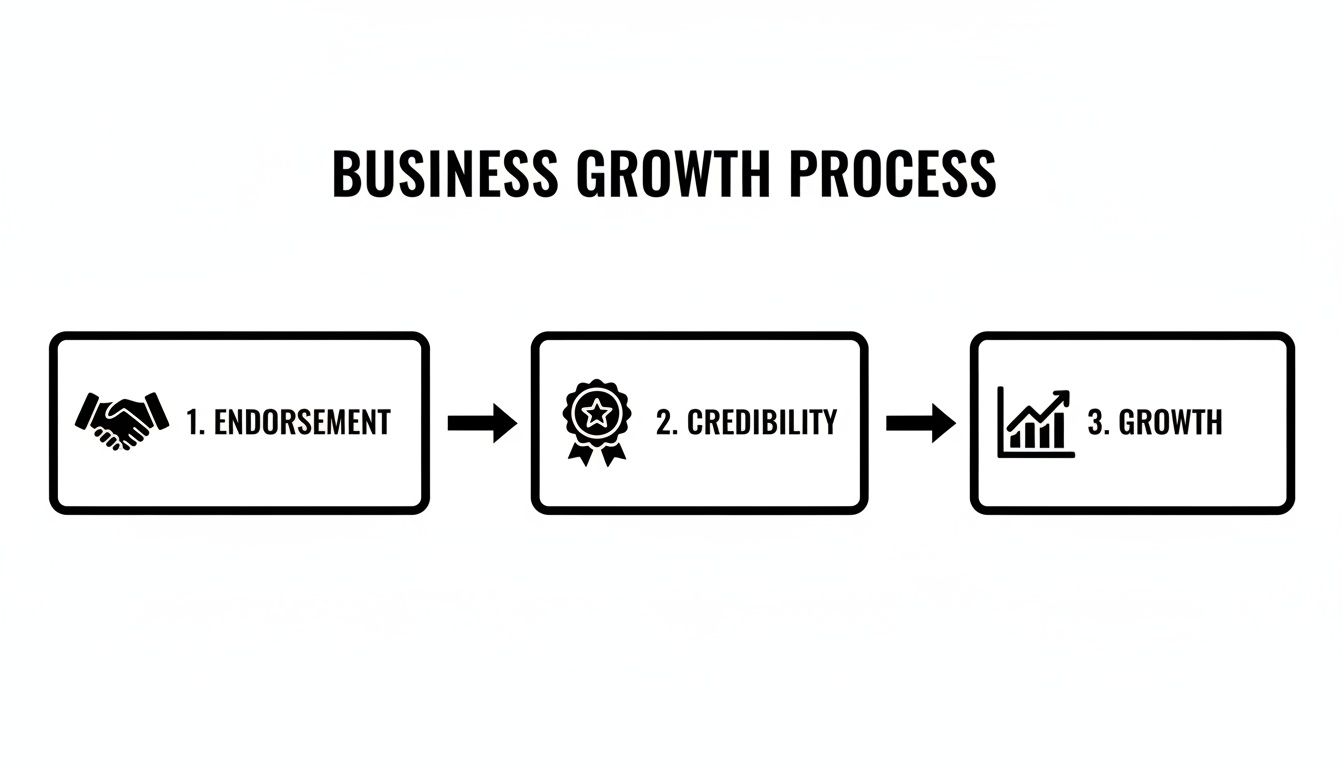
This process is straightforward: a digital endorsement (like a backlink) enhances your business's credibility, which ultimately leads to measurable growth.
Essential Google Search Operators for Backlink Hunting
Here’s a quick-reference table with the operators you'll use most often. We've included practical examples for a local contractor to show how these work in the real world.
| Search Operator | What It Does | Example for a Contractor |
|---|---|---|
" " (Quotes) |
Finds the exact phrase. Crucial for brand names or specific topics. | "best general contractor in Austin" |
- (Minus sign) |
Excludes a specific word or site from the results. | home renovation blogs -pinterest.com |
site: |
Limits the search to a single website. | site:houzz.com "kitchen remodel" |
OR |
Searches for results containing either one term or another. | home improvement "guest post" OR "write for us" |
These four operators are your bread and butter. By combining them, you can create specific queries that cut through the noise and deliver exactly what you're looking for.
Finding Links Pointing to Your Own Website
First, let's see who is already linking to you. This is a great way to discover surprising allies, find customer testimonials you didn't know existed, or spot incorrect information about your business that needs fixing.
The old link: operator has been mostly deprecated by Google. While it might show a small sample, it's far from complete.
A much more reliable method is to search for your brand or domain name while filtering out your own website.
Try This Query:"Your Company Name" -site:yourcompany.com
This query tells Google: "Show me every page that mentions 'Your Company Name' exactly, but exclude all results from my own website (yourcompany.com)." What you're left with is a list of other sites talking about you.
Spotting Unlinked Brand Mentions
Here's where you find the low-hanging fruit. Not every mention of your business will include a link back to your site. These unlinked brand mentions are prime opportunities. Someone already took the time to write about you; all you need to do is ask them to make that mention a clickable link.
Use the same query from the previous step. As you scroll through the results, look for mentions of your auto shop or dental practice that aren't hyperlinked. A polite email to the site owner is often all it takes to turn that mention into a valuable backlink.
Research shows that pages without backlinks struggle immensely to get seen. Only 1 in every 20 pages without any backlinks gets organic traffic from Google. You can discover more insights about how links impact traffic on Rankability.com. This statistic alone shows why turning a simple mention into an active link is a critical growth activity.
Practical Scenarios for Local Businesses
Let's move from theory to practice. How can a local business owner use these operators to find real opportunities?
Imagine you run a dental practice in Menifee, California. You want to find local health blogs or community resource pages that could list your practice.
- To find resource pages:
menifee "health resources" OR "local businesses" - To find blogs that might review your service:
"local dentist review" menifee - To find guest post opportunities:
"write for us" + "dental health"
Now, let's say you're a contractor in Murrieta. Your queries might look different:
- To find local directories:
murrieta "contractor directory" OR "home services" - To find blogs about home improvement:
"home renovation tips" + "guest post"
The key is to think like your customers and potential partners. What websites would be relevant for them to see your business on? Start there, and you’ll quickly uncover a map of potential link opportunities in your area.
Analyzing Your Competitor's Backlink Strategy
Your competitors have already done much of the hard work. They've invested time and money finding websites willing to link to businesses just like yours. Learning from their efforts isn't about copying; it's about smart reconnaissance to build a better, more efficient strategy.
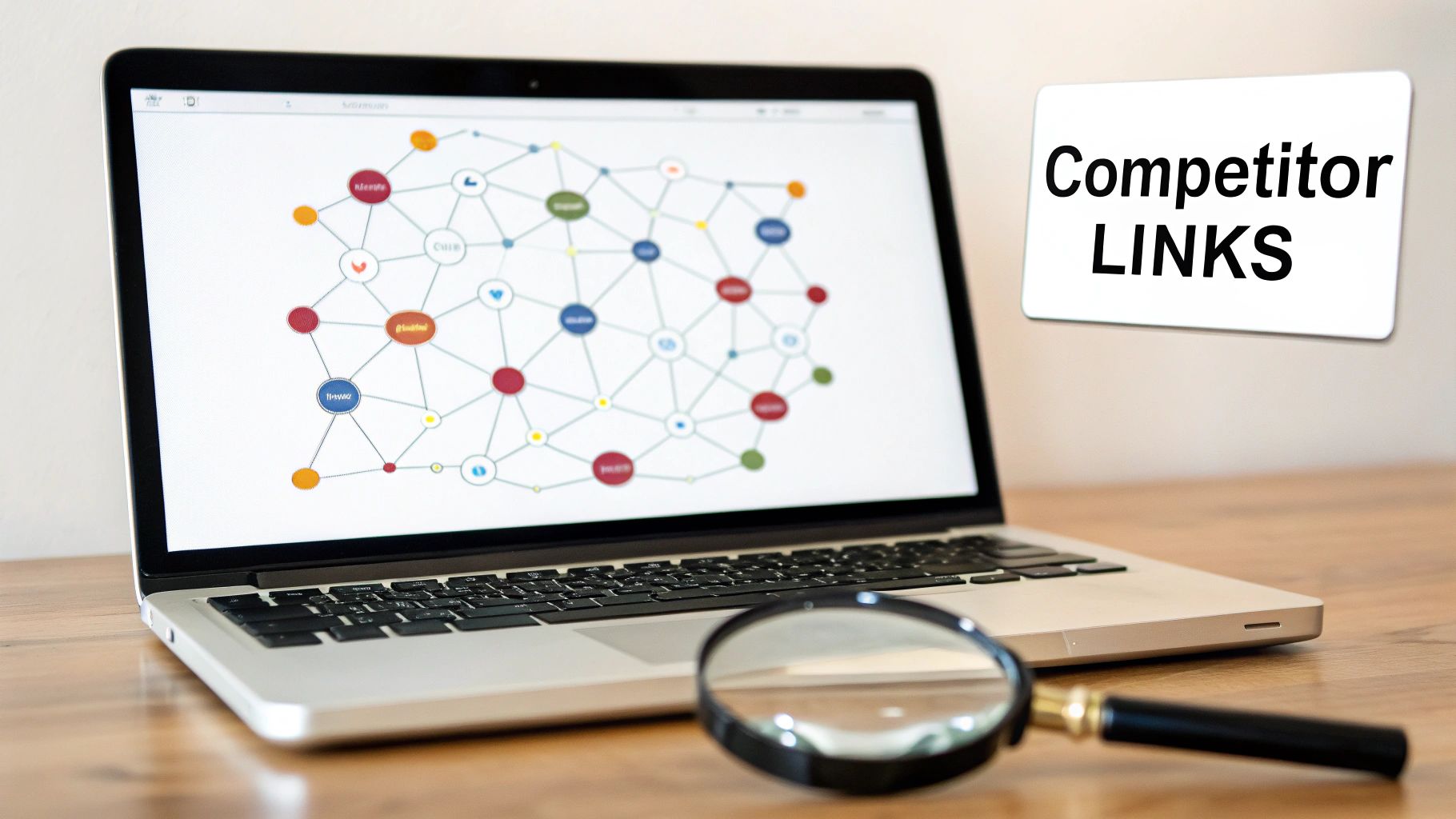
If you own a local contracting business and see your top competitor’s trucks at a new housing development, you’d want to know who the developer is. Digital marketing is the same. Using search operators, you can create a high-level map of where your competitors get their most powerful "digital referrals."
This process is about spotting patterns. Are they sponsoring local charity events? Are they consistently featured in a regional home and garden magazine? Finding these answers gives you a proven list of opportunities to pursue.
Identifying Your True Online Competitors
First, a crucial point: your biggest real-world competitor might not be your biggest online competitor. You may compete with "Bob's Auto Repair" down the street for local customers, but online, you could be fighting a high-traffic auto maintenance blog for search rankings.
Your real online competitors are the websites that consistently show up on page one for the search terms your ideal customers use.
- Start by Googling your top 3-5 service keywords (e.g., "Murrieta plumber," "custom kitchen cabinets Temecula").
- Note the local businesses that appear repeatedly. These are your primary targets for analysis.
Reverse-Engineering Their Success
Once you have your list, it's time to investigate. We'll use the same search operators, but this time, we'll swap your domain for your competitor's.
Let’s say you run an HVAC company and your top online competitor is "PrecisionAirPros.com." You can start digging with a simple query:
link:PrecisionAirPros.com
While Google's link: operator isn't exhaustive, it often provides a quick snapshot of their most prominent links. It’s a good starting point to get a feel for their network.
For a more thorough look, the brand name query is often more revealing.
Try This Query:"Precision Air Pros" -site:precisionairpros.com
This search uncovers websites that are talking about them. As you review the results, you're not just building a list of URLs. You're trying to understand the story behind their links.
The goal is to identify the types of backlinks they're earning. A single link from an authoritative industry publication is worth more than a hundred links from low-quality directories. It's about quality, not just quantity.
Spotting Patterns and Opportunities
As you analyze a few competitors, patterns will emerge. We recommend keeping a simple spreadsheet to categorize the links you find. This step turns a messy list of search results into an actionable plan.
Common Backlink Categories to Look For:
- Local Directories & Citations: Are they listed in the Menifee Chamber of Commerce directory? These are usually easy for you to get, too.
- Industry Publications: Did they write a guest article for a major HVAC industry blog? This tells you they're seen as an expert, and you can likely pitch an article to the same publication.
- Sponsorships & Community Events: Do you see links from a local high school sports team or a charity event? This is a great way to build community goodwill and earn a powerful local link.
- News & PR Mentions: Were they featured in a local news story about preparing your AC for summer? This signals an opportunity to build relationships with local journalists.
Take a dental office as another example. While analyzing a competitor, you might find links from several local parenting blogs that reviewed their pediatric services. That’s not just a backlink; it’s a strategic partnership. You now know that reaching out to other "mommy bloggers" in the area is a proven tactic for attracting new patients.
This process is more than just SEO; it's market intelligence. You're discovering who the key players are in your digital community and learning the most effective ways to get in front of them, turning a guessing game into a clear process for growing your business.
How to Vet and Prioritize Your Backlink Opportunities
You’ve run a few searches and now have a list of potential backlink targets. The temptation is to start emailing every site on the list. Don't. This is where most people waste a ton of time.
Pursuing the wrong links can be worse than doing nothing. You need to shift from being a link collector to a strategic marketer. It's not about the quantity of links; it's about getting the right links that will actually make a difference for your business.
A Quick Framework for Sizing Up Links
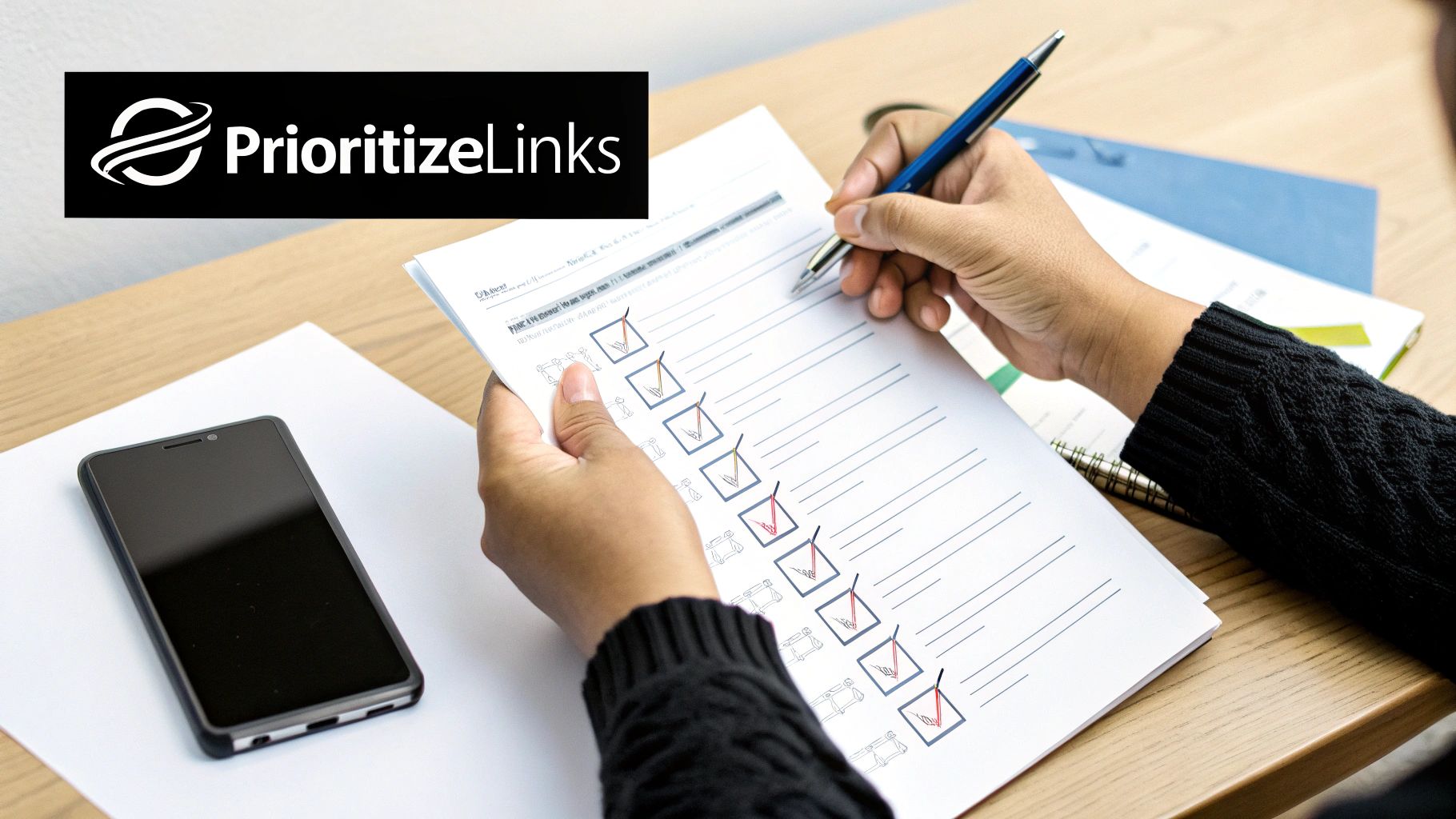
Before you draft an outreach email, every potential site needs to pass a quick gut check. We run every opportunity through a simple three-part filter: Authority, Relevance, and Quality.
Does the Site Have Authority?
Think of "authority" as a website's credibility with Google. A link from a trusted, established site is a powerful vote of confidence that gives your own site a real boost.
But how do you gauge authority without expensive tools? Here’s a quick method:
- Check Their Rankings: Does this website show up on the first page of Google for its main topics? For example, if you're a plumber and find a home improvement blog, search "fix leaky faucet." If that blog ranks high, it’s a good sign it has authority.
- Scan Their Content: Is the content well-written and genuinely helpful, or is it thin and generic? Authoritative sites don't skimp on quality.
- Look at Their "About Us" Page: Is this a real company with a real team? A transparent and professional "About" page usually signals a legitimate operation.
Is It Actually Relevant?
This is critical. A link from the biggest website in the world won’t move the needle if it has nothing to do with what you do. Google wants to see links that make sense in the real world.
For instance, a link from the local Chamber of Commerce to your auto repair shop is highly relevant. A random link from a cat grooming blog in another country? Not so much.
For local businesses, geographic relevance is a massive factor. Getting links from other businesses and organizations in your service area should be a top priority. For a deeper dive, our guide on local SEO best practices is a great place to start.
Here's a simple test: Would a potential customer be confused to find a link to your business on this website? If the answer is yes, it's probably not the right fit.
What’s the Overall Quality Vibe?
Finally, step back and look at the site as a whole. Ask yourself, "Would I be proud to have my brand associated with this?"
- Website Design: Does the site look clean and modern, or is it a cluttered mess from 2005? A professional design shows they care.
- Ad Overload: Is the site plastered with flashing ads? Too many ads often signal a low-quality site focused on ad clicks, not user experience.
- Site Security: Look for the padlock and
https://in the URL bar. An unsecured site (http://) is a major red flag for visitors and Google.
This vetting process helps you focus your limited time on opportunities that will actually help you grow. After all, backlinks are still one of the top 3 Google ranking factors. A strong profile of quality links almost always leads to better rankings and more traffic. To build out your knowledge, you can explore these comprehensive link building strategies. Smart prioritization turns link building from a frustrating chore into a predictable system for attracting customers.
The Limits of Google Search and What Comes Next
Using Google search operators is a fantastic, zero-cost starting point. It gives you a real-time feel for who's talking about you and your competitors. But it's crucial to understand where this method hits a wall.
Frankly, free tools have blind spots. Think of it like looking at a city from a scenic overlook—you can spot the major landmarks, but you miss the side streets and what's happening inside the buildings. Google gives you that high-level view, but it's far from the complete picture.
What Google Search Doesn't Show You
Here’s the biggest catch: Google will never show you a complete backlink profile. Not for your site, and not for your competitors. What you see is just a sample, handpicked by Google’s algorithm. You might find a dozen great links while missing hundreds of others.
On top of that, Google Search offers zero context or quality metrics. It won't tell you:
- Link Authority: Is that link from an industry powerhouse or a spammy blog?
- Follow vs. No-Follow: Is the link actually passing authority, or does it have a
nofollowtag telling search engines to ignore it for ranking purposes? - Historical Data: You have no way of knowing if a competitor just lost a ton of valuable links, creating an opportunity for you to swoop in.
Without this data, you’re flying blind. It's tough to build a repeatable strategy when you're working with an incomplete dataset.
Your Essential Next Step: Google Search Console
If Google Search is step one, then Google Search Console (GSC) is your non-negotiable step two. This is another free tool from Google, but it’s built specifically for website owners. It’s the closest thing to an official source of truth on how Google sees your website.
Once you verify your site, you gain access to a "Links" report. This report is the most comprehensive free list of backlinks pointing to your domain. It details which pages get the most links and which external sites are sending them.
Think of it this way: Using Google Search is like asking around town who’s heard of your business. Setting up Google Search Console is like getting a detailed report from the city planner showing every road leading to your front door. It’s essential.
When to Consider Professional Tools or a Partner
As you grow, your time becomes your most valuable asset. The DIY approach is fantastic for getting started, but eventually, you'll hit a ceiling. That's when investing in professional SEO tools or partnering with an expert makes sense.
Dedicated platforms like Ahrefs or Semrush provide the deep, actionable data that Google doesn't offer. They deliver detailed metrics, historical tracking, and competitive insights that unlock a much more effective strategy.
To make the difference clear, here's a quick breakdown:
Google Search vs. SEO Tools: A Quick Comparison
| Capability | Google Search | Dedicated SEO Tools (e.g., Ahrefs, Semrush) |
|---|---|---|
| Backlink Discovery | Shows a small, algorithmic sample of links. | Aims to crawl and index nearly every backlink on the web. |
| Data Completeness | Highly incomplete; misses the vast majority of links. | Provides a comprehensive backlink profile for any site. |
| Quality Metrics | None. No way to judge a link's value. | Detailed metrics like Domain Rating, URL Rating, and Spam Score. |
| Historical Data | No historical tracking available. | Tracks new and lost backlinks over time, revealing trends. |
| Competitor Analysis | Very basic and manual. | Deep-dive analysis of competitors' entire link profiles. |
| Cost | Free | Paid subscription (often starting around $100/month). |
For most business owners running a 5-10 person team, the question isn’t if you'll need a more robust system, but when. Once your focus shifts to managing your team and closing deals, delegating your online growth to someone who lives and breathes this becomes a powerful investment. These advanced efforts are a key part of our broader search engine marketing strategies designed to build predictable growth.
The roadmap is clear: start with the powerful free tools you have. Master the basics. Then, when you're ready to scale, graduate to a system that matches your ambition.
A Few Common Questions About Finding Backlinks
Even with the best instructions, building backlinks for the first time usually sparks a few questions. As a business owner, you don't have time for fluff; you need straight answers. Let's clear up some of the most common things we get asked.
How Long Does It Take to See Results From Building Backlinks?
Honestly, it’s a long game. Think of it like building a solid reputation in your community, not like flipping a switch on a paid ad. You won't see a huge jump in leads overnight.
Realistically, you should expect to see a noticeable impact on your rankings and traffic in 3 to 12 months. Several factors can influence this timeline:
- Market Competition: An electrician in a major city has a much steeper climb than a specialty contractor in a smaller town.
- Link Quality: One great link from a well-known industry blog can do more than 50 low-quality directory listings.
- Your Site's SEO Health: Backlinks deliver the best results when your website is already technically sound and has genuinely helpful content.
The key takeaway is that the effort you invest now builds a foundation that pays dividends for years. Ads stop working the second you stop paying; good backlinks don't.
Can I Hurt My Website by Building the Wrong Backlinks?
Yes, absolutely. Years ago, the game was about getting as many links as possible, which led to people buying cheap, spammy links.
Google got wise to that. Its algorithm is now incredibly sophisticated at spotting unnatural link schemes. If it thinks you're trying to manipulate rankings, it can hit your site with a penalty, and your traffic can disappear overnight. It's why this entire guide is built around quality over quantity.
Our rule of thumb is simple: Before pursuing a link, ask yourself, "Would I be proud for a potential customer to find my business on this website?" If the answer is no, walk away. It’s not worth the risk.
A single, relevant link from a source your customers trust is worth more than a thousand spammy links from junk sites.
Should I Find Backlinks Myself or Hire an Agency?
This boils down to your time and expertise. As the business owner, your time is almost always better spent running the company, leading your team, and serving customers.
The Google Search methods we walked through are a great way to get started and lock in some easy wins. You should definitely give it a shot.
But a serious, ongoing backlink strategy is a full-time job. You'll hit a ceiling where the hours you'd need to spend finding prospects, vetting sites, and doing outreach just don't make sense anymore. That's when an agency becomes an investment, not an expense. They bring expensive tools, existing relationships, and proven workflows to scale your efforts much faster than you could alone.
At Uncommon Web Design, we build the systems that turn this kind of strategic work into predictable, consistent growth. If you feel like you're ready to go beyond DIY and build an online presence that brings in leads around the clock, let's have a conversation.