When you’re trying to figure out how to choose a website designer, it’s easy to get sidetracked by flashy visuals. But the real goal isn’t a good-looking site; it’s finding a partner who builds a tool that actively grows your business.
You're not just hiring a 'designer.' You're investing in a growth engine.
Move Beyond Pretty Designs and Demand a Growth Partner

Most business owners start by scrolling through portfolios. It’s a natural first step, but it's a critical mistake. You see a slick design for another local business and think, "I want one just like that." But that mindset misses the entire point of your investment.
The right question isn't, "Can you make my website look good?"
The question you should be asking is, "How will this website generate more qualified leads and sales for my business?" Shifting your perspective is the key to getting a real return. Your website should be your hardest-working salesperson, on the clock 24/7—not a fancy digital brochure.
Think Like a CEO, Not a Creative Director
You're busy running a business, managing your team, and watching the bottom line. Every dollar has to count. Your website is no different. A designer who only talks about aesthetics will never ask about the metrics that actually matter to your company.
A true growth partner digs deeper. They'll ask questions like:
- What’s the lifetime value of an average customer?
- Walk me through your current sales process.
- How much is a qualified lead worth to your business?
- What are your revenue goals for the next 12-24 months?
These conversations are far more important than debates over fonts and color schemes. They connect the website build directly to your financial goals. This is exactly what a solid web page strategy does—it’s designed from the ground up to guide visitors toward taking a specific, profitable action.
Your website’s primary job is to solve a problem for your customer. In doing so, it solves a problem for your business: the need for more revenue. A design that fails at this is just an expensive piece of art.
The Real Cost of a "Pretty" Website
Here's the hard truth: a beautiful site that doesn't convert visitors into customers is a net loss. It’s an expense, not an investment. You might save a few thousand dollars upfront by hiring a designer who skips the strategy phase, but you'll pay for it tenfold in missed opportunities and the eventual cost of a complete do-over.
Imagine a local contractor who spends $5,000 on a website that looks amazing but only brings in one or two calls a month. Now, picture that same contractor investing $15,000 on a strategic site that generates 15-20 qualified project inquiries every single month. The second option isn't an expense; it's a lead-generation machine that pays for itself over and over.
This mindset is critical, whether you're selling high-ticket services or products online. If you want to move beyond aesthetics and find a real strategic ally, the principles discussed by these expert Shopify website designers are universally applicable. When you demand a growth partner, you ensure your website works just as hard for your business as you do.
How to Read a Portfolio for Business Results
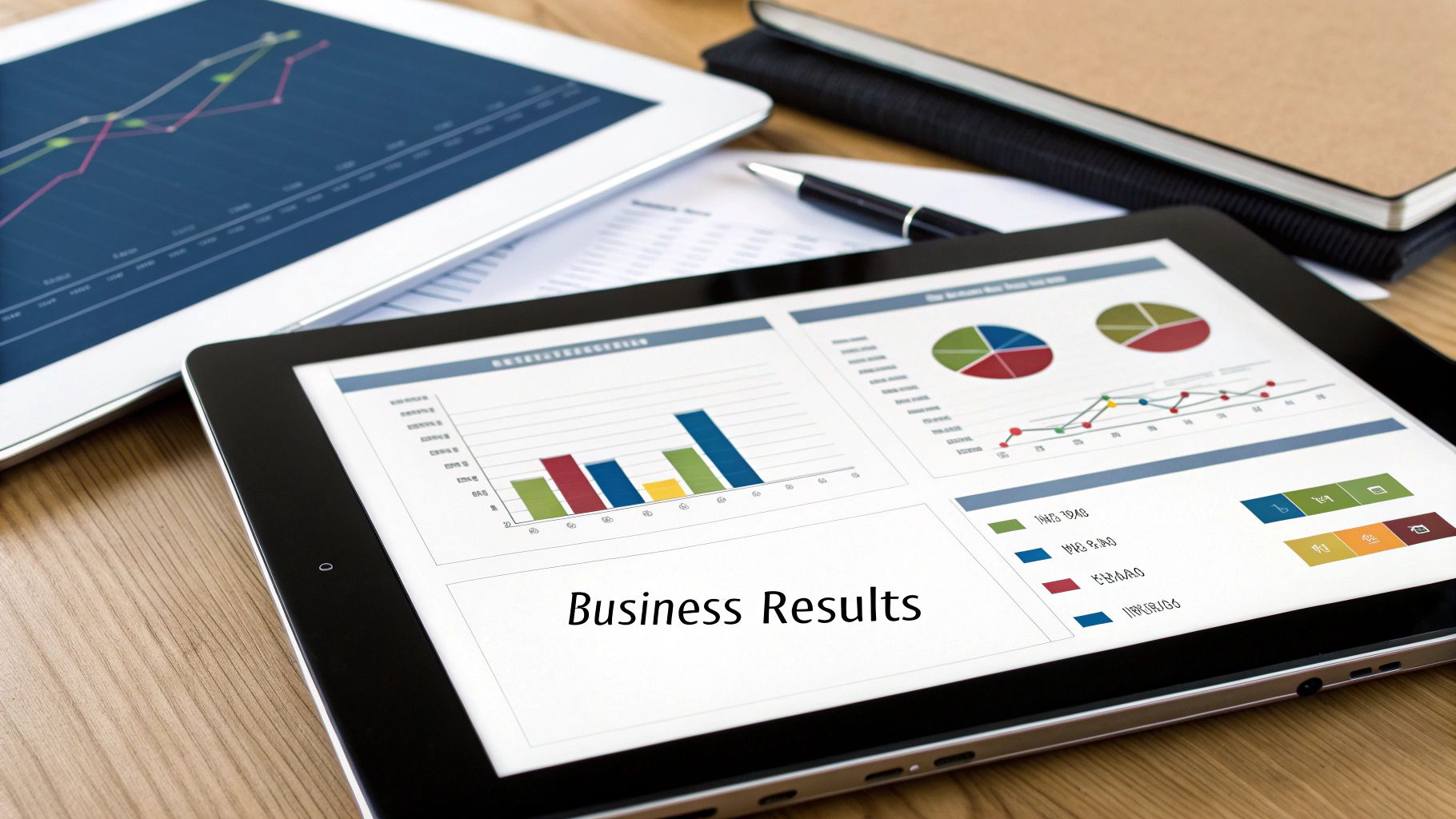
Any designer can show you a gallery of pretty pictures. But a slick-looking portfolio only proves they have an eye for modern aesthetics—it tells you next to nothing about their ability to build a website that actually grows your business.
To find a true growth partner, you have to look past the visuals and find hard evidence of business impact.
The best place to find this proof isn't in a gallery. It's in their case studies. A solid case study moves beyond "before and after" screenshots and tells the full story of how the project solved a specific business problem and delivered measurable results.
Moving Past Vanity Metrics
Your first job is to separate fluff from real KPIs (Key Performance Indicators). Many designers highlight vanity metrics that sound impressive but don’t contribute to your bottom line.
Here’s what to look for and what to ignore:
-
Vanity Metric: "Increased social media followers by 200%."
-
What You Want to See: "Increased qualified leads from social channels by 45%, resulting in a lower customer acquisition cost."
-
Vanity Metric: "Achieved a sleek, modern look."
-
What You Want to See: "Reduced bounce rate by 30% and increased time on page by 90 seconds by clarifying the core message and improving site navigation."
This distinction is everything. A strategic partner understands that every design choice must serve a business goal. A beautiful website that doesn't convert is just an expensive digital painting.
The Anatomy of a Strong Case Study
A compelling case study doesn’t just show off the final product. It takes you on a journey, explaining the thinking behind the design and connecting it directly to tangible outcomes. When you review a potential designer's work, look for a clear narrative that hits these key points.
A well-defined problem.
The case study should kick off by outlining the client’s specific business challenge. It shouldn't be vague, like "they needed a new website." A strong problem statement gets right to the point:
"The client, a local HVAC company, was spending $4,000/month on Google Ads but their website was only converting 1% of visitors into service calls. Their outdated, non-mobile-friendly design was costing them leads and driving up their marketing spend."
This immediately frames the project around a clear business objective. The goal isn't just a new site; it's to improve ROI on their ad spend.
A clear process.
How did they get to the solution? Look for evidence of a strategic process: customer research, competitor analysis, and a real understanding of the client's sales funnel. This shows they don't just jump into a design tool—they build with purpose.
Measurable results.
This is the most critical part. The case study absolutely must present specific, quantifiable results that tie directly back to the initial problem. For example:
- "Increased online appointment bookings by 60% in the first quarter."
- "Lowered the cost-per-lead from Google Ads from $120 to $75."
- "Grew organic search traffic to key service pages by over 150% in six months."
These are the numbers that prove the website is a high-performing business asset, not just a line item on an expense report. First impressions are shaped almost entirely by design, but it’s a responsive, conversion-focused layout that turns those impressions into profit. You can learn more about the latest web design stats and see why they matter for your business.
Remember, when you choose a website designer, you're not just buying a product. You're investing in a system designed to generate revenue. Look for a partner who proudly showcases their ability to deliver exactly that.
Evaluating Technical Skills and SEO Knowledge
A beautiful website that Google can’t find is an expensive, digital paperweight. Worse, a slow and unsecured one is a business liability. This is where we pivot from pretty designs to the rock-solid technical foundation that turns a website into a genuine business asset.
Plenty of designers can make a site look good, but far fewer truly understand the mechanics of what makes it fast, secure, and visible to search engines. For a business owner, this isn't just tech-speak; it's the difference between a site that brings in leads and one that's buried on page ten of Google.
You don't need to become a developer overnight, but you do need to know the right questions to ask. This is how you hire someone who builds websites that work as hard as you do.
Beyond the Visuals: Performance and Speed
A visitor's first impression isn't your logo—it's speed. If your site takes more than a few seconds to load, a huge chunk of your potential customers are gone. This isn't just about user experience; Google actively penalizes slow websites in its rankings.
A designer's technical chops directly impact this. They should be able to talk confidently about:
- Image Optimization: How they shrink image file sizes without turning them into a pixelated mess. This is one of the biggest culprits of slow load times.
- Clean Code: Bloated, messy code is like trying to run a race with a backpack full of rocks. A skilled developer writes lean, efficient code that browsers can process in a snap.
- Quality Hosting: The server your website lives on matters. A good partner will recommend high-performance hosting, not just the cheapest plan they can find.
When vetting a designer, ask them this point-blank: "Can you walk me through your process for optimizing site speed?" A solid answer will touch on image compression, code minification, and choosing the right hosting. A weak one will be vague or brush it off as unimportant.
Is the Site Actually Built for Search Engines?
Search Engine Optimization (SEO) isn't magic dust you sprinkle on after the website is built. It has to be baked in from the beginning. The way your site is structured, how pages link together, and the underlying code all send signals to Google about who you are and what you do.
A designer with real SEO knowledge builds with purpose. They know how to structure a site so that search engine crawlers can easily find and understand your most important pages. For a deeper look at this, our guide on how to improve website rankings breaks down the entire process. This technical setup is the launchpad for every marketing effort you'll make down the road.
Here’s another direct question for your potential hire: “How do you structure a website so Google can find it?”
Listen for answers that include:
- Proper Heading Structure (H1, H2, H3): This creates a logical outline for your content, helping both users and search engines grasp what’s important on each page.
- Mobile-First Design: Since most traffic now comes from phones, Google prioritizes sites that work flawlessly on smaller screens.
- Internal Linking Strategy: A smart plan for how pages link to each other to spread authority and guide visitors (and Google) through your site.
Security and Ongoing Maintenance
Finally, your website needs to be a fortress. A hacked site can tank your reputation, expose customer data, and get you blacklisted by Google. It's a nightmare scenario for any business.
A true professional will insist on security best practices from day one. This means things like SSL certificates (the little padlock in the browser bar), strong admin credentials, and keeping all software up-to-date.
This brings us to the crucial topic of ongoing maintenance. A website is not a "set it and forget it" deal. It’s a living asset that requires regular updates, security scans, and backups to stay healthy. Any designer or agency worth their salt will have a clear plan for what happens after your site goes live. This isn't an upsell; it's essential insurance for your investment.
Freelancer vs. Agency: Which Partner Is Right for Your Business?
One of the biggest crossroads you'll hit when looking for a web designer is the choice between a solo freelancer and a full-service agency. This decision is about much more than the price tag—it’s about accountability, breadth of skills, and your plans for long-term growth.
For many business owners, the lower upfront cost of a freelancer looks like an easy win. But you need to view this choice through the lens of business risk and opportunity cost. What are you really getting for your money?
The Appeal and the Risk of a Solo Professional
A great freelancer can be a phenomenal partner, especially for smaller, clearly defined projects. They often provide a personal touch and can be more flexible on pricing. The catch? You're putting all your eggs in one basket, investing entirely in a single person's skills and availability.
This creates a significant risk.
What happens if they get sick, take a two-week vacation, or get swamped with other client work? Your project can grind to a halt. Even worse, if they're a brilliant designer but just okay at SEO or copywriting, you're forced to either accept those compromises or start hiring more contractors to fill the gaps. Suddenly, you've become a project manager.
A lot of the same principles apply when understanding the differences between a consultant and an agency—it boils down to the depth of expertise and sheer capacity.
A freelancer is a specialist. An agency is a system. For a business that relies on its website for leads and sales, the reliability of a system almost always outweighs the lower cost of a single specialist.
This hits home when you want to connect your website to other marketing efforts, like Google Ads campaigns or email automation. A freelancer might not have the experience to wire all those pieces together, leaving you with a handful of disconnected tools instead of a cohesive growth machine.
The Power of a Dedicated Team
When you partner with an agency like ours, you aren't just hiring one person. You're getting access to an entire team of specialists who work together every day:
- A Strategist to map out your business goals and customer journey.
- A Copywriter to craft a message that connects and converts.
- A UI/UX Designer to create an intuitive, user-friendly experience.
- A Developer to write clean, fast, and secure code.
- An SEO Specialist to ensure Google can find you from day one.
This integrated approach gets rid of the gaps. Everyone is on the same page, working toward the same goal: building a website that delivers tangible business results. There's also built-in redundancy and accountability. If one person is out, the project doesn't stop.
The web design market is exploding, with projections showing it will grow from $61.23 billion in 2025 to $92 billion by 2030. But with nearly 203,000 businesses in the space, not all of them are created equal. This simple checklist can help you see if a potential partner is focused on the core technical pillars every successful website needs.
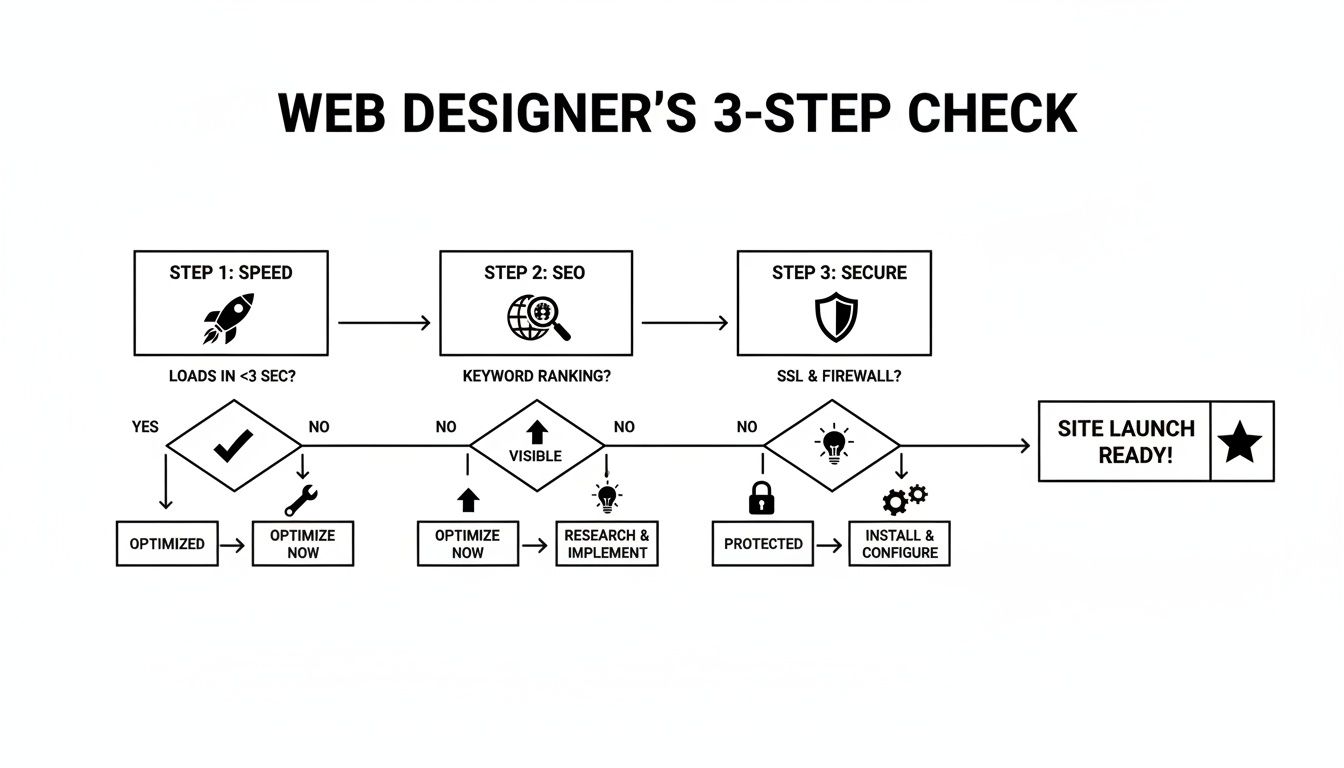
A quick check on their process for site speed, SEO, and security tells you if they’re building something pretty or a high-performance business asset.
To help you decide, here’s a quick breakdown.
Freelancer vs. Agency: Which Partner Is Right for Your Business?
| Factor | Freelancer | Web Design Agency |
|---|---|---|
| Cost | Typically lower upfront cost; may have variable hourly rates. | Higher initial investment, but often a more predictable, project-based price. |
| Expertise | Specialized in 1-2 areas (e.g., design, development). | A diverse team of specialists (SEO, copy, design, strategy, etc.). |
| Availability | Dependent on one person's schedule; risk of delays. | Team-based workflow means projects continue even if someone is out. |
| Accountability | Single point of contact, but also a single point of failure. | Multiple points of contact and built-in project management. |
| Scope | Best for smaller, well-defined projects with limited complexity. | Ideal for complex projects requiring strategy, marketing integration, and ongoing support. |
| Scalability | May struggle to support your business as it grows. | Designed to scale with you, offering long-term support and growth services. |
For a business that’s serious about growth, the risk of depending on a single person often outweighs the initial cost savings. If your goal is a reliable marketing system that generates leads 24/7, the comprehensive skillset and accountability of an agency is the smarter long-term investment.
The Critical Questions to Ask Before You Hire Anyone
The first chat with a potential designer is your best defense against a bad investment. This is your chance to cut through the slick sales pitch and figure out if they really know how to build a website that grows a business, not just one that looks pretty in a portfolio.
You need to ask questions that reveal their process, their strategic thinking, and their focus on getting you results.
Let’s move past the generic stuff. Here are the questions we recommend every business owner asks before signing on the dotted line.
Moving Beyond Price to Value
I get it. The first thing on your mind is cost. But asking about price first is a mistake, because a number without context is meaningless. Start with questions that dig into how they create real, measurable value for your business.
Question 1: "How will we measure the success of this new website?"
This one question immediately separates the strategists from the visual designers. A weak answer will focus on aesthetics—"You'll get a modern, professional-looking site." That’s table stakes, not a business goal.
A strong answer comes from a business partner. They'll probably turn the question back on you, asking things like, "What does a qualified lead look like for your business?" or "Which of your services is the most profitable?"
Then, they should start talking about tracking key metrics, like:
- The number of qualified leads your site generates each month.
- The conversion rate of your most important landing pages.
- Your cost per acquisition for new customers coming from the site.
This tells you they're already thinking about your ROI. They see the website as a tool for achieving business outcomes, not just a creative project.
Understanding the Full Process
Many business owners get hung up on the design phase, but what happens before and after is just as important. The right questions will show you how comprehensive (or flimsy) their process is.
Question 2: "Can you walk me through your process from our first call to post-launch?"
Listen carefully for a structured, repeatable process. A vague answer like, "Well, we'll design some mockups and then build it," is a massive red flag. A real professional will outline clear, distinct phases.
It should sound something like this:
- Discovery & Strategy: A deep dive into your business, your ideal customers, and your goals.
- Content & Messaging: Crafting the words that will persuade visitors to take action.
- Design & Development: Building the site on that solid strategic foundation.
- Launch & Optimization: A clear go-live plan followed by ongoing analysis and improvement.
This shows they have a reliable system for getting results, not just winging it and hoping for the best.
Question 3: "What does your support look like after the site is live?"
A website isn't a brochure you print and forget. It's a living asset that needs ongoing care. This question reveals if you're hiring a one-time vendor or a long-term partner.
Look for clear, confident answers about security, software updates, performance monitoring, and how they handle future change requests. If they don't have a solid plan, you risk being left with a site you can't manage or, worse, one that breaks down the road.
Focusing on What Truly Matters: Conversions
At the end of the day, your website has one primary job: to turn visitors into customers. A designer's understanding of conversion optimization is non-negotiable.
Question 4: "What's your approach to conversion rate optimization?"
This question might make some designers sweat. An amateur will talk about "making the buy button bigger." An expert will discuss user psychology, crafting clear calls-to-action, building trust with reviews and testimonials, and even A/B testing.
They should be able to explain how they strategically guide a visitor from the moment they land on your site to the moment they fill out a form or make a purchase. This is the science behind a high-performing website.
It's a tough reality that average website conversion rates are often disappointingly low. But choosing a designer who lives and breathes conversion-focused design can completely change that for your business. For businesses in competitive markets like ours here in Southern California, this intense focus on measurable growth is what separates the winners from everyone else.
Don't be afraid to ask for proof. A great follow-up is, "Can you show me a specific example where a design choice you made for a past client directly led to more conversions?" Their ability to answer that clearly will tell you everything you need to know.
For more context on what a strategic website investment looks like, check out our guide on the average web design cost for small businesses.
Common Questions We Hear When Choosing a Web Designer
After walking hundreds of business owners through this process, we've noticed the same questions come up time and again. These are the real-world, practical concerns that matter most. Let's get right to them with some straight answers.
How Much Should a Business Website Cost?
This is always the first question, and the honest answer is: it depends. A better way to frame it is, "What's the value of a new lead to my business?" A website is an investment, and its price tag should make sense in the context of the results you expect it to bring in.
A simple online brochure for a local auto shop is a completely different project than a complex lead-generation machine for a multi-state construction company.
For a professionally designed, strategy-driven website built to attract customers, expect to invest somewhere in the range of $5,000 to $25,000+. Anything much cheaper than that, and you're likely getting a basic template with very little strategy behind it. It might look nice, but it won't do much for your bottom line. The real cost isn't the price—it's the lost opportunity from a site that fails to convert.
Custom Site vs. Template: What's the Real Difference?
The difference is like buying a custom-tailored suit versus one off the rack. A template is a pre-built design where you just drop in your text and pictures. It can be a decent starting point for new businesses on a tight budget, but you’re forcing your unique message into a generic box.
A custom-designed website is built from the ground up, starting with your business goals and your ideal customer.
- Templates are one-size-fits-all. They are designed for general use, which makes it incredibly difficult for your brand to stand out.
- Custom sites are built for your specific sales process. Every element, from the page layout to the color of the "Request a Quote" button, is strategically placed to guide visitors toward becoming a customer.
While a template might seem cheaper upfront, a custom site is built to be a high-performance business asset. It's designed to solve your specific problems and will grow with your company, not hold it back.
How Long Does a Professional Web Design Project Take?
A rushed website is almost always a flawed website. Building a powerful digital presence takes time because it's so much more than pretty pictures. A proper project involves discovery, strategy sessions, copywriting, design, development, and rigorous testing.
For a standard business website, a realistic timeline is anywhere from 8 to 16 weeks. More complex projects, like those with e-commerce features or special software integrations, can take longer.
Be skeptical of anyone promising a fully custom, strategic website in just a few weeks. That’s a huge red flag. It almost certainly means they're skipping the crucial strategy and content phases—the very things that ensure your site actually works.
Can I Update the Website Myself After It Launches?
Absolutely. You should demand it. Any modern website should be built on a user-friendly Content Management System (CMS) like WordPress. This gives your team the power to easily update text, swap out photos, or add new blog posts without having to call a developer for every little thing.
When we hand over a finished site, we include training to make sure you feel comfortable managing your own content. The goal is to empower you, not to lock you into a dependent relationship. Your web partner should handle the technical stuff like security and updates, but day-to-day content changes should be firmly in your hands.
Feeling clearer about what you need? The next step is finding a partner who sees your website the same way you see your business—as a powerful tool for growth. If you’re ready to build a site that works as hard as you do, we should talk. We help turn your digital presence into your most valuable asset.