A solid content marketing strategy for a small business is your system for attracting ideal customers 24/7. It’s not about posting randomly on social media when you find a spare moment. It's about turning your website from a passive brochure into an automated salesperson that answers questions, builds trust, and warms up leads before you ever speak to them.
This is how you systematically drive real, measurable growth.
Why Random Posts Don’t Drive Business Growth
If your current "strategy" is posting on Instagram whenever you remember, you’re leaving money on the table. Let's be blunt: there's a huge difference between being active online and being strategic. Random activity creates noise. A documented plan builds an asset for your business.
For many business owners we work with, their website is little more than a digital business card. It lists their services, looks nice, and then just sits there, waiting for someone to hopefully find it. That’s a massive missed opportunity. A real content marketing strategy for a small business makes that passive website your hardest-working employee—one that works around the clock without ever needing a coffee break.

From Passive Brochure to Active Salesperson
Let’s think about a local auto shop. For years, they’ve gotten by on word-of-mouth. Their website is online, but it’s not generating any calls. Then they decide to create genuinely helpful content that answers the exact questions their customers are always asking.
Suddenly, they’ve got articles on their blog like:
- "5 Signs Your Brakes Need a Professional Inspection"
- "How Often Should I Really Get an Oil Change in Southern California Heat?"
- "Choosing the Right Tires for Your Commute: A Murrieta Driver’s Guide"
Before they know it, they’re showing up in Google when someone types in "reliable brake repair near me." People find their articles, start to see them as trustworthy experts, and book an appointment. Their website is no longer just a brochure; it’s an automated lead-generation machine. That's the power of a documented strategy in action.
The goal is to answer your customer's questions before they even have to ask them. When you do that consistently, you build a level of trust that your competitors can't just buy with ads.
The True Cost of Inconsistency
Posting sporadically doesn't just fail to get you results; it can actually hurt your credibility. An inconsistent social media feed or a blog that hasn't been updated in a year sends a signal to potential customers that you might not be on top of your game. It creates doubt right when you need to be building confidence.
To get past sporadic efforts and create a consistent impact, you need a plan. A great resource for this is a modern small business social media strategy, which lays out a framework for sustained growth.
This isn't about creating more content. It’s about creating the right content with a clear purpose, aimed at a specific audience, and designed to achieve a measurable business outcome. It’s the difference between hoping for leads and systematically engineering them.
Know Your Audience, Know Your Goals
Before you write a single blog post or film a single video, we need to get two things crystal clear: who you're talking to and what you want to achieve. This isn't busywork; it's the bedrock of a content marketing strategy for a small business that actually makes you money instead of just eating up your time. Without it, you're just guessing.
Most business owners can give you a basic sketch of their customers—age, location, that sort of thing. That’s a start, but it’s not enough to create content that truly connects. We have to go deeper.
What problem is really keeping them up at night? What specific thought makes them pick up their phone and start searching for someone like you?
Go Beyond Basic Demographics
Let's get practical. Imagine you're a local HVAC contractor. Your ideal customer isn't just "homeowners in Murrieta." It's "Mark, a 45-year-old father of two whose AC just gave out during a blistering July heatwave."
Think about it. Mark isn't casually browsing for "advancements in HVAC technology." He's frantically typing "emergency AC repair near me" into his phone. He's stressed about the cost, wondering how fast someone can get to his house, and worried about trusting a stranger.
Your content has to meet him right there, in that moment of panic, with immediate answers and reassurance.
The most effective content doesn't just sell a service; it solves a pressing problem. It meets your customer exactly where they are with a clear, helpful, and trustworthy answer.
Nailing this is the difference between content that gets ignored and content that gets clicked, read, and acted upon. You have to map out these real-world scenarios for your own business.
Start by asking yourself these questions about your ideal customer:
- What are their biggest frustrations with your industry? (e.g., "Contractors never show up on time," or "I have no idea which dental procedure I can actually afford.")
- What specific questions are they typing into Google? (e.g., "How much does a new roof cost in 2024?" is very different from just "roofing services.")
- What was the trigger that started their search? (A sudden breakdown, a seasonal need, a new business challenge.)
Focusing on these customer pain points is why many small businesses are shifting their priorities. In fact, 28% of the average small business marketing budget now goes toward content. And it pays off—companies that use analytics to really understand their customers see an average revenue bump of 30% over two years. This is about turning search traffic into actual leads. You can dig into more stats like these in a report on content marketing metrics for small businesses from Finepoint Design.
Set Goals You Can Actually Measure
Once you have a sharp picture of who you're talking to, you need to define what a "win" looks like for your business. Vague goals like "get more leads" or "increase brand awareness" sound nice, but they're useless because you can't measure them. You have to translate those wishes into concrete Key Performance Indicators (KPIs).
This is about tying your content directly to your bottom line. It's the only way to know if your investment of time and money is actually working.
Let's make this simple. The table below shows how to turn those fuzzy business objectives into hard numbers that prove your content is delivering a return on investment (ROI).
Translating Business Goals into Content KPIs
| Common Business Goal | Vague Metric to Avoid | Actionable Content KPI |
|---|---|---|
| Get more leads | Just "more traffic" | "Generate 15 qualified quote requests per month from the blog." |
| Increase online sales | "Boost e-commerce revenue" | "Increase add-to-carts from organic traffic by 20% this quarter." |
| Build authority | "More followers" | "Achieve a top-3 Google ranking for 5 core service keywords." |
| Improve customer retention | "Better engagement" | "Reduce support tickets by 10% with a new FAQ resource section." |
Setting these specific targets is a game-changer. It forces you to be strategic and ensures every piece of content you create has a clear purpose tied to a real business outcome. When you can see the numbers, it's a whole lot easier to justify the effort.
How to Plan and Create Content That Works
Alright, you know who you’re talking to and what you want to achieve. Now for the fun part: turning that strategy into actual content. This is where many business owners hit a wall, picturing a massive content machine they don't have the staff to run.
But here’s the good news: you don’t need one.
A smart content plan isn't about churning out something new every day. It's about being strategic and creating the right pieces that will work for you for months, even years, to come. We’re going to focus on a practical workflow that builds your authority without causing burnout.
This diagram nails the core philosophy. You start with your audience, connect your content to your goals, and then measure what actually matters.
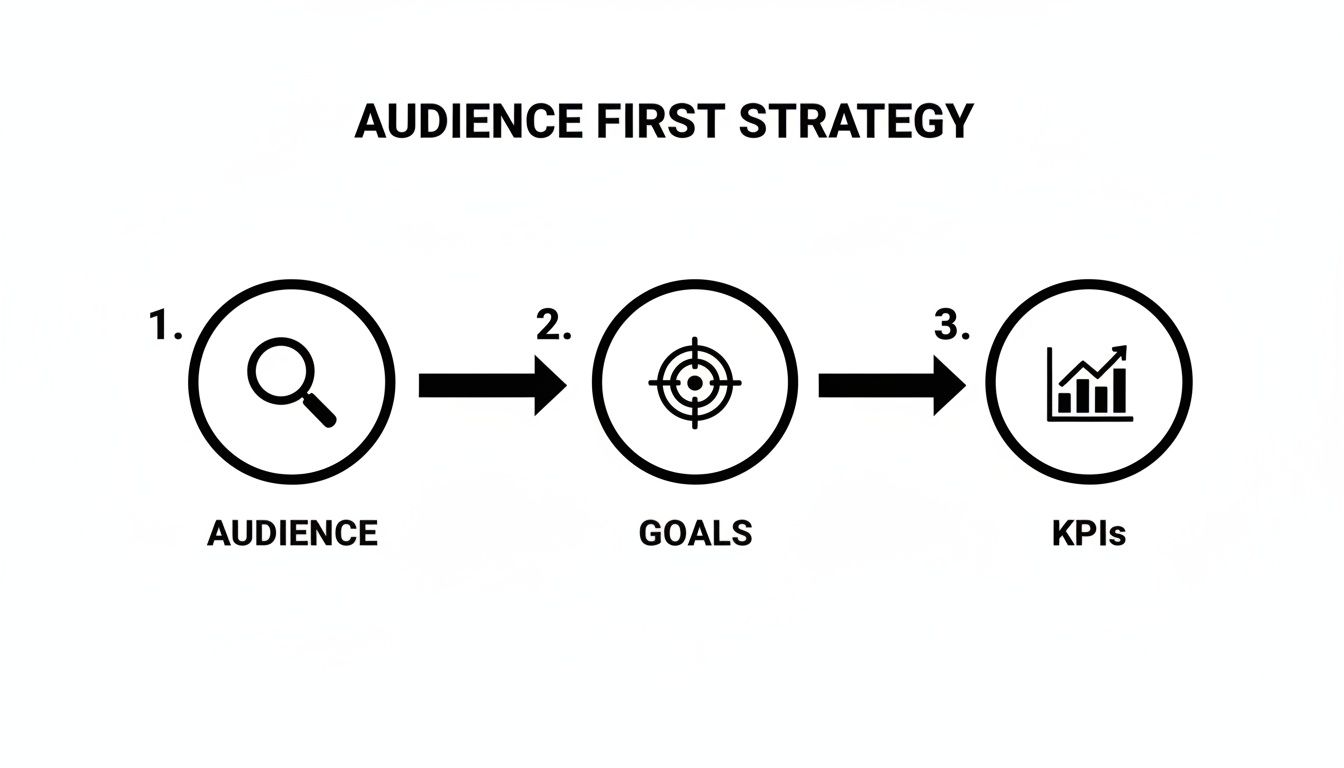
Keeping this simple flow in mind ensures every single thing you create is designed to deliver a real business result.
The Pillar and Cluster Model Explained
If you want the most efficient way to become the go-to expert in your niche, you need to know about the "pillar and cluster" model. It might sound like marketing jargon, but the concept is simple and incredibly powerful, especially for small teams.
Instead of trying to come up with random blog ideas every week, you identify a few core "pillar" topics. These are the big, meaty subjects your customers are desperate to understand. For a local landscaping company, a pillar topic could be "A Homeowner's Complete Guide to Drought-Tolerant Landscaping."
Think of your pillar content as the single most helpful, comprehensive resource on a topic that exists online. It's the guide you wish you could just send to every potential customer to answer all their questions at once.
From that one massive guide, you then create smaller, more focused "cluster" pieces. These are blog posts, videos, or social media updates that dive deeper into one specific idea you mentioned in the main pillar article.
For our landscaper, cluster content might look like:
- A blog post on "The Top 5 Water-Wise Plants for Local Gardens."
- An Instagram Reel showing the right way to install a drip irrigation system.
- A quick tip in an email newsletter about seasonal succulent care.
This model is a game-changer because it forces you to create content with a clear purpose. Every cluster piece links back to your pillar page, signaling to Google that you're an authority on the subject and helping you rank for the keywords that bring in customers. The whole system builds on itself.
Keyword Research for the Rest of Us
Keyword research isn't just for SEO specialists—it's market research. It’s how you discover the exact words and phrases your ideal customers are typing into Google when they have a problem you can solve. Nailing this is the foundation of your entire content strategy.
Forget the complicated tools for a minute and just think like your customer.
What's really on their mind? For a local dentist, it’s not just "dental implants." It’s "how much do dental implants cost?" or "what is the recovery time for a dental implant?" These longer, more specific questions are called long-tail keywords. They're pure gold for small businesses because they show someone is much closer to making a decision.
This focus on answering real questions is why organic search traffic is so valuable. Research shows that businesses with a blog attract 55% more website visitors, and nearly half of buyers check out a company's blog before making a purchase.
Build a Simple, Realistic Editorial Calendar
A plan is only useful if you can actually stick to it. An editorial calendar isn't a complex document that stresses you out; it's a simple roadmap for what you'll publish and when, providing clarity and consistency.
A basic spreadsheet is all you need to get started. All the brilliant ideas in the world don't mean much without a system to keep them organized. In fact, we put together a whole guide on how to create a content calendar that your team will actually use, helping you turn your big-picture strategy into a manageable, week-by-week plan.
For every piece of content, your calendar just needs to answer four simple questions:
- What’s the topic and target keyword?
- What’s the format? (e.g., Blog post, video, infographic)
- Who is creating it?
- When does it go live?
That's it. Start small—maybe one blog post every other week. Consistency is far more powerful than frequency, especially when you're just getting started. This is how you build a marketing asset that brings in leads for years, not just a one-off traffic spike.
Getting Your Content Seen by the Right People
Creating great content is only half the battle. If no one sees it, it might as well not exist. This is where your hard work starts paying off, but it hinges on a smart, efficient promotion plan that doesn’t burn through your time or budget.
The biggest mistake we see is the "publish and pray" approach—you post a blog, hope someone stumbles upon it, and then move on. A far better method is to build a simple, repeatable system for distribution that gets every piece of content in front of the right audience. You don't need to be everywhere at once; you just need to be where it counts.

Start With Your Warmest Audience: Your Email List
Your email list is your single most powerful promotion tool. Period. These are people who have already raised their hand and said they want to hear from you. Unlike social media, where mysterious algorithms decide who sees your posts, email gives you a direct line of communication.
When you publish a new blog post, your first move should always be to share it with your list. But don't just send a link. Frame it in a way that highlights the immediate value. Explain the problem it solves or the key takeaway they'll get from reading it. Using your email list this way turns your content into an instant source of traffic from a highly qualified audience.
A Practical Approach to Social Media
For a small business, trying to be active on every social platform is a recipe for burnout. The key is to be selective. Instead of posting sporadically on five different channels, go all-in on the one or two platforms where your ideal customers actually spend their time.
Here's how that might look in practice:
- For B2B service providers (like a contractor or consultant): LinkedIn is probably your best bet. Share articles that demonstrate your expertise and solve real-world business problems.
- For visually-driven businesses (like an auto shop or a local restaurant): Instagram and Facebook are perfect for showing behind-the-scenes work, customer results, and quick video tips.
Don't just broadcast your content. Use social media to start conversations. Ask questions related to your blog post, pull out a compelling quote to create a graphic, or turn key stats into a quick, shareable infographic.
The goal isn't just to get clicks; it's to use your content as a conversation starter that reinforces your authority.
How Content and Paid Ads Work Together
Many business owners see content marketing and paid ads as two separate things. In reality, they're a powerhouse when used together. Instead of running an ad that goes straight to a generic "Contact Us" page, try sending that traffic to a genuinely helpful blog post first.
Let’s walk through an example. A dental office wants to promote its Invisalign services. Instead of an ad that screams "SALE ON INVISALIGN!", they could run a low-cost Facebook ad campaign targeted to their local area that links to their new article, "5 Things to Know Before Getting Invisalign."
This approach does two things brilliantly. First, it educates potential customers and builds trust before ever asking for a sale. Second, it lets you build a retargeting audience of people who have shown a clear interest in that specific service. Now, your follow-up ads can be more direct, because you know you're talking to a warm, informed audience. For small businesses looking to maximize their reach, selecting the right technologies to optimize for AI-driven search experiences is paramount. A guide on the 12 Best AI SEO Tools to Dominate Search can offer a significant advantage here.
This strategic combination of helpful content and targeted advertising is exactly how you turn a small budget into a powerful lead-generation system.
Measuring Your Content ROI The Right Way
Let's cut right to it. Likes, shares, and a growing follower count feel great, but they don't pay the bills. The only real measure of a successful content marketing strategy for a small business is whether it's putting money back into your pocket.
If you can't draw a straight line from your content to tangible business results, you're essentially just shouting into the void. This is all about making smart, data-driven decisions so you can confidently double down on what’s working and ditch what isn’t.
Leading vs. Lagging Indicators
To really get the full picture, you need to look at two different kinds of metrics: leading and lagging indicators. Both are crucial, but they tell you completely different parts of your content's story.
Leading indicators are your early warning system. They're the first signs that tell you if you're heading in the right direction, often long before you see a single sale. Think of them as the initial dominoes you're carefully lining up.
On the other hand, lagging indicators are the final, bottom-line results you're chasing. These are the numbers that directly impact your revenue, but they can take weeks—sometimes months—to show up after you’ve hit publish.
Here’s a practical breakdown for a typical service business:
-
Leading Indicators (Early Signs of Success):
- Keyword Rankings: Are your key articles starting to climb the search results? Seeing movement onto the first few pages of Google is a huge win.
- Organic Traffic Growth: Is your website seeing a steady increase in visitors from search engines month after month?
- Time on Page: Are people actually sticking around to read what you've written, or are they bouncing away immediately?
-
Lagging Indicators (The Bottom-Line Results):
- Leads Generated: How many people actually filled out a contact form or called your office directly from a blog post?
- Conversion Rate: What percentage of the people reading your content are turning into qualified leads?
- Sales Attributed to Content: Can you trace new customer revenue back to specific content marketing efforts?
A classic mistake is getting impatient and focusing only on the lagging indicators. You might kill a brilliant content strategy just because the sales haven't materialized yet. Watching your leading indicators gives you the confidence to stay the course, knowing the real results are on their way.
Setting Up a Simple Analytics Dashboard
Forget about complicated, enterprise-level analytics software. A clean, simple dashboard in Google Analytics is more than enough to track what really matters. The goal here is clarity, not a tidal wave of data.
We guide our clients to focus on just a handful of metrics that tell the whole story without any of the fluff. This setup makes it easy to understand the critical difference between organic traffic vs paid traffic and see which channels are truly delivering value. Your dashboard should give you quick, at-a-glance answers.
The most valuable marketing metric is the one that tells you whether you're getting closer to a sale. Everything else is secondary.
Your time is your most precious resource. The point of tracking data isn't to create more work for yourself; it's to make smarter decisions, faster. Now, let’s dig into which numbers actually move the needle and which are just noise.
Essential Content Marketing Metrics vs Vanity Metrics
It’s easy to get distracted by numbers that look good on paper but have zero impact on your business. Here’s a simple way to separate the signal from the noise.
| Metric Type | Metrics That Drive Business (Focus Here) | Vanity Metrics (Ignore These) |
|---|---|---|
| Traffic Quality | New Users from Organic Search: Shows you're reaching new potential customers. | Total Page Views: High views on the wrong pages don't lead to business. |
| Engagement | Conversion Rate (Form Fills/Calls): The percentage of visitors who take a valuable action. | Likes and Shares: Can be easily bought or faked and rarely correlate with sales. |
| Lead Generation | Goal Completions: Tracks how many quote requests or consultation bookings you receive. | Follower Count: A large, unengaged audience is less valuable than a small, targeted one. |
| SEO Impact | Top Landing Pages from Organic: Tells you which specific articles are attracting search traffic. | Impressions: Shows how many times your content appeared, but not if anyone clicked. |
When you zero in on the metrics in that middle column, you get an honest, unfiltered look at your content's performance. You can clearly see that your in-depth article on "choosing the right commercial HVAC system" is bringing in three qualified leads a month, while your generic company updates get plenty of likes but generate zero business.
That’s how you justify your marketing investment. That’s how you build a predictable engine for growth.
Answering Your Top Content Marketing Questions
Committing to a content marketing strategy can feel like a huge leap, and you’ve probably got a few nagging questions. We've heard them all from business owners just like you. So, let’s clear the air with some straight, practical answers—no jargon, just what you need to know.
How Much Should a Small Business Actually Spend on This?
This is always the first question, and the honest answer is: it depends. But you don't need a massive budget to get started.
A good rule of thumb is to set aside 5-15% of your total marketing budget for content. Let's make that real. If you're a local landscaping company with a $5,000 monthly marketing budget, you could start with $500. That's enough to get a couple of expertly written blog posts and some basic social media promotion to get them seen.
The most important shift is to stop thinking of it as an expense. It's an investment. An ad disappears the moment you stop paying for it, but a great blog post can pull in organic traffic and new leads for years. That initial investment just keeps paying dividends.
Seriously, How Long Until I See Results?
We won't sugarcoat this: content marketing is a long game. It's not like flipping a switch on a Google Ad and seeing clicks roll in immediately. You're building a real asset, earning trust, and climbing the search rankings one piece of content at a time.
You'll likely see early signs of life—like better keyword rankings and a slow, steady climb in organic website traffic—within 3 to 6 months of consistent work. But the results you're really after, the significant business impact like a predictable stream of qualified leads and sales, often takes closer to 6 to 12 months to really kick in.
Patience and consistency are your secret weapons. The businesses that truly win with content are the ones who stick to their plan long enough for that snowball effect to take over.
It might feel slow at first, but the leads you get from your content are often much higher quality because they've already seen your expertise and decided they trust you.
What’s More Important: Video or Blogging?
The ideal answer is "both," but when you're just starting, you have to be realistic. The right choice depends entirely on your business and your customers.
Blogging is an absolute powerhouse for SEO. It's perfect for answering detailed customer questions in-depth, which makes it an incredible tool for service businesses like consultants, contractors, or B2B companies.
At the same time, you can't ignore the tidal wave that is video. The numbers are staggering: 91% of businesses now use video as a marketing tool, and a whopping 98% of marketers say it’s an essential part of their strategy. For small businesses, short-form video on platforms like Instagram Reels or TikTok often delivers the best bang for your buck. Want to see more data? Check out these powerful content marketing statistics on Digital Silk.
Here’s a smart way to tackle this without doubling your work:
- Start with blogging. This is your foundation. Write helpful, keyword-focused articles that solve real customer problems and build your SEO authority.
- Then, repurpose that content into video. Take your most popular blog posts and turn them into short, punchy videos. An article on the "Top 5 Mistakes Homeowners Make" is a perfect script for a 60-second Instagram Reel.
This workflow lets you capture the long-term SEO benefits of blogging and the immediate engagement of video.
Do I Really Need to Use AI to Create Content?
You don't need it, but you'd be crazy not to. For a small team, AI tools are a massive accelerator. The proof is in the numbers: 67% of small business owners are already using AI for things like content creation and SEO, and most of them are seeing a real return on that investment.
Don’t think of AI as a robot that writes for you. Think of it as the most efficient intern you’ve ever had. It can help you:
- Brainstorm a month's worth of blog post ideas in five minutes.
- Whip up a detailed outline for a comprehensive guide.
- Get a solid first draft on paper that you can then polish.
- Instantly summarize a long article into a few bullet points for an email.
Your personal expertise, your stories, and your unique voice are still the most important ingredients. AI just helps you get your brilliant ideas out of your head and in front of your customers way, way faster. For a small business owner juggling a dozen other tasks, that’s a game-changer.
Ready to stop guessing and start building a content strategy that actually grows your business? At Uncommon Web Design, we help businesses like yours turn their websites into 24/7 lead-generation machines. Book a no-obligation strategy call with us today and let’s talk about your goals.