
Choosing the right web hosting isn't a technical chore; it's a core business decision. Get it right, and your website becomes a 24/7 salesperson driving leads and revenue. Get it wrong, and you're stuck with a digital brochure that costs you money and frustrates potential customers.
The goal is to match your business needs to the right server foundation. This prevents you from overpaying for power you don't need while ensuring your most important marketing asset has the resources to perform.
Your Website Is an Employee, Not a Brochure
Before we talk servers and specs, let's reframe this. Many business owners treat their website like a line item expense—a static, digital business card.
We see it differently. Your website should be your hardest-working employee.
Think about it. This "employee" works 24/7 without breaks, never calls in sick, and can be your top salesperson, scheduler, and customer service rep all at once. It answers questions, qualifies leads, and closes sales while you're asleep. But for it to work that hard, it needs a solid foundation.
And that foundation is your web hosting.
The Office Environment for Your Digital Employee
Choosing a web host is like deciding on the office for this star employee. Will you stick them in a loud, crowded, unreliable cubicle farm? Or will you give them a private, high-performance office with the tools they need to succeed?
- Cheap, shared hosting is that crowded cubicle farm. Your website is crammed onto a server with hundreds, sometimes thousands, of other sites. If one of them gets a sudden flood of traffic or gets hacked, your site’s performance takes a nosedive. It’s slow, unpredictable, and sends a terrible message to your customers.
- Quality, managed hosting is the private, corner office. Your website gets dedicated resources, rock-solid security, and an expert support team on standby. It’s fast, reliable, and ready to grow with you, ensuring every visitor has a great experience that builds trust and prompts them to act.
A slow or unavailable website doesn't just annoy visitors—it actively costs you money. A mere one-second delay in page load time can lead to a 7% drop in conversions. For a business generating $500k in revenue, that's a potential loss of $35,000 annually from a simple technical issue.
This guide isn't about upselling you on the most expensive plan. It's about helping you make a smart, ROI-driven decision. The few extra dollars you spend on premium hosting can translate into thousands in protected revenue and new business.
Let’s walk through how to choose a hosting plan that turns your website into the growth engine it’s meant to be.
First, Assess Your Business Needs, Not Hosting Features
Most guides on choosing web hosting get it completely backward. They throw a comparison chart at you filled with jargon like RAM, CPU cores, and bandwidth. That’s like a car salesman talking about engine displacement before asking if you need to haul lumber or just commute to the office.
The technical specs are meaningless until you know what job your website needs to do.
Before you even look at a hosting plan, you need a clear "job description" for your website. What is its primary purpose? Is it a simple digital storefront for your local contracting business, designed to get the phone to ring? Or is it a complex e-commerce store for a parts distributor with thousands of products and real-time inventory management?
The answer changes everything.
Define Your Website's Job Description
Let’s get practical. Grab a notepad and answer these questions. This isn't about technology—it’s about your business goals. Ten minutes here will save you from the massive headaches of costly migrations and unexpected downtime later.
- Traffic Expectations: How many visitors do you get now? More importantly, where do you realistically see that number in the next 12 to 24 months? A site expecting 1,000 visitors a month has vastly different needs than one aiming for 50,000.
- Business Function: Is your website just a portfolio to showcase your work and generate calls? Or are you actively processing payments, managing user accounts, or running online courses? The more your site does, the more horsepower it needs.
- Essential Integrations: What other software does your website need to "talk" to? Think CRMs like HubSpot, appointment schedulers like Calendly, or specialized inventory software. These connections demand a stable hosting environment to work without a hitch.
- Security & Compliance: Are you handling sensitive customer data, like credit card info or patient records? For any business in e-commerce, healthcare, or finance, security is a foundational requirement, not a feature. HIPAA compliance, for instance, is non-negotiable for a dental practice.
This decision tree illustrates how the health of your website directly impacts your bottom line.
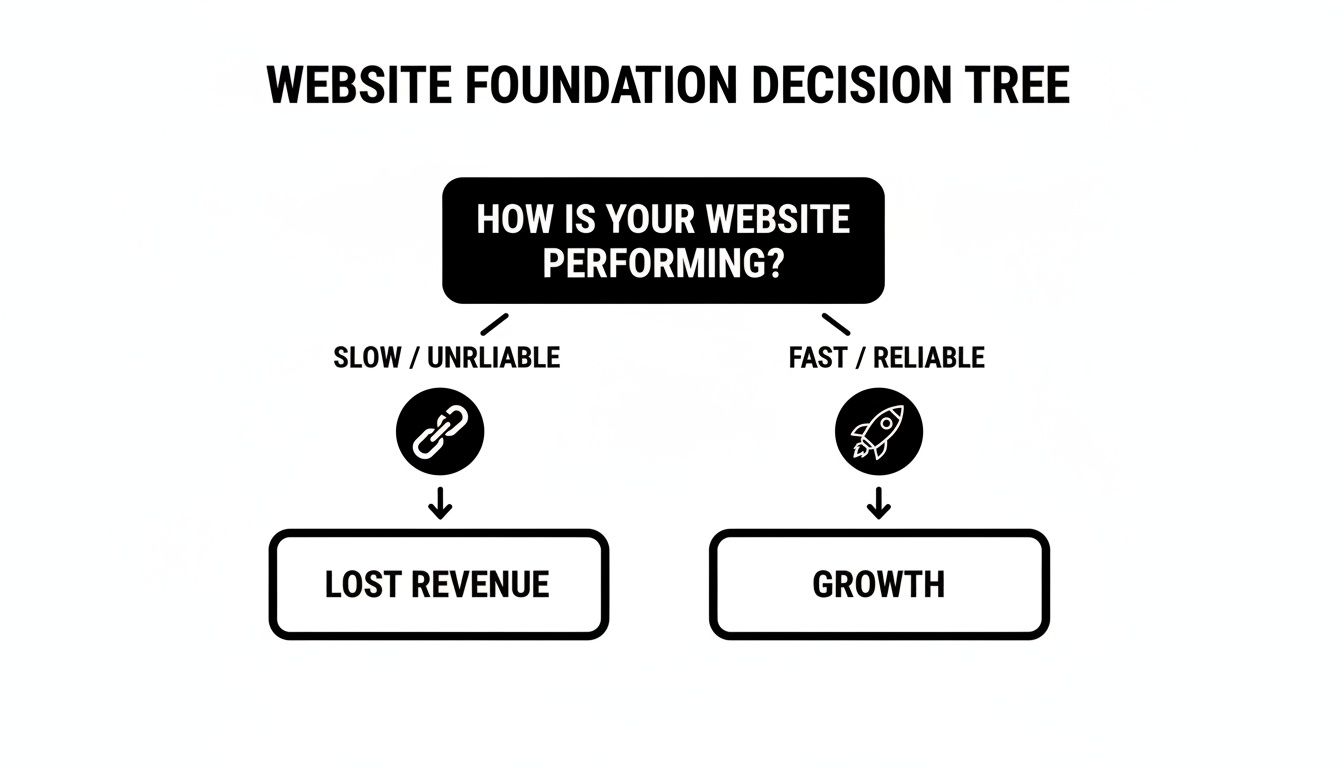
As you can see, there's no middle ground. A slow or unreliable website actively erodes revenue, while a high-performing site is a direct path to growth.
From Vague Ideas to a Concrete Checklist
Once you have those answers, you can translate them into actual requirements. Don't worry about technical terms yet; just frame your needs in plain English.
For example, a local auto shop’s assessment might look like this:
- Traffic: We get about 500 visitors a month now, but our goal is 3,000 a month within a year.
- Function: We need to show our services, build trust with testimonials, and capture leads with a contact form. We also need an integrated online booking tool for oil changes.
- Integrations: Has to work flawlessly with our third-party scheduling software.
- Security: Needs to securely handle customer names, emails, and phone numbers. We don't process payments on the site itself.
That simple rundown tells us a lot. The auto shop needs hosting that’s reliable, secure, and can handle a modest but growing stream of traffic without slowing down—especially when people are using the booking tool. They don’t need a massive, dedicated server, but gambling on the cheapest shared hosting is a huge risk to their lead generation.
This self-assessment is the single most important step in the process. By defining your requirements first, you stop shopping based on price and start choosing a hosting plan that’s perfectly aligned with your business goals. It turns a technical decision into a strategic one.
Decoding the Jargon: A Plain-English Guide to Hosting Types
Shared, VPS, Cloud, Dedicated—the hosting world loves its jargon. It’s easy to get lost in the technical weeds, but the concepts are simple when you frame them with real-world analogies. You don't need to become a server expert, but you do need to understand what you're buying.
Think of it this way: you’re choosing the "business premises" for your website. The type you pick directly affects its performance, security, and how many customers it can handle at once. Let's break down the main options in plain English.
Shared Hosting: The Co-Working Space
Shared hosting is like renting a desk in a bustling co-working space. It's the most affordable option and gets you in the door quickly. You get essential amenities, but you’re sharing them with hundreds of other businesses.
This model works when you're just starting. But what happens when the business next to you starts hosting loud, all-day meetings? Their activity disrupts your work. The same is true for shared hosting. If another website on your server gets a massive surge in traffic or gets hacked, your website’s performance will suffer.
It's cheap for a reason. For a brand-new blog or a simple "digital business card" site, it can be a temporary solution. But for a serious business where the website is a key tool for generating leads or sales, the unpredictability is a significant risk.
VPS Hosting: The Private Office Lease
A Virtual Private Server (VPS) is like leasing your own private, secured office within a larger office building. You still share the building's main infrastructure, but you have your own locked space with dedicated resources. Those noisy neighbors can’t disrupt your workflow anymore.
A VPS carves out a specific amount of the server's resources—like memory (RAM) and processing power (CPU)—that are yours and yours alone. This results in much more consistent and reliable performance. Your site speed won't suddenly drop because someone else’s website went viral.
This is the sweet spot for most growing small to mid-size businesses. It offers a huge step up in performance and security from shared hosting without the high cost of a dedicated server. If your website is crucial for operations—like for an HVAC company with an online booking system—a VPS is often the minimum viable foundation.
Dedicated Hosting: Owning the Entire Building
Dedicated hosting is the equivalent of owning your entire office building. You have complete control over every single resource. No one else has a key. You get maximum power, security, and customization.
This option gives you an entire physical server just for your website. It's built for high-traffic, resource-intensive applications, such as a large e-commerce store with thousands of daily transactions or a custom web application managing complex logistics.
The trade-off? You're responsible for all maintenance and security, or you have to pay a premium for a team to handle it. For the vast majority of small and mid-size businesses, this is overkill.
Managed WordPress Hosting: The Full-Service Executive Suite
Finally, there’s a special category that often overlaps with the types above: Managed WordPress Hosting. This isn’t a server type itself but a service level. Think of it as leasing a full-service executive suite.
With managed hosting, an expert team handles all the technical heavy lifting for you. This includes:
- Performance Optimization: Servers are specifically configured to make WordPress sites run as fast as possible.
- Security: Proactive measures are in place to block threats, scan for malware, and protect your site.
- Automatic Backups: Daily backups are taken automatically, giving you a safety net if anything goes wrong.
- Updates: The team manages core WordPress updates, ensuring your site is always running the latest, most secure version.
This service can run on shared, VPS, or cloud infrastructure, but the key benefit is the "done-for-you" management. For a busy business owner, this is a game-changer. It frees you to focus on running your business, knowing your most important marketing asset is in expert hands. We believe this offers the best ROI for most service businesses that rely on their website to drive growth.
Hosting Types Compared for Business Owners
Here’s a quick-glance table comparing the main hosting types from a business owner's perspective. It cuts through the tech-speak to focus on what really matters: cost, performance, and control.
| Hosting Type | Best For | Analogy | Performance | Control | Typical Monthly Cost |
|---|---|---|---|---|---|
| Shared | New sites, blogs, hobbies, very low traffic | Co-working desk | Low to Medium | Low | $5 – $20 |
| VPS | Growing businesses, lead-gen sites, small e-commerce | Private office | Medium to High | Medium | $25 – $100 |
| Dedicated | Large e-commerce, high-traffic sites, custom apps | Owning the building | High to Very High | Full | $100 – $500+ |
| Managed WordPress | Any business wanting hands-off, expert management | Full-service suite | Optimized High | Low (by design) | $30 – $150 |
This comparison should help you map your business needs directly to the right hosting foundation, ensuring you invest in a platform that will grow with you, not hold you back.
The 7 Factors That Truly Matter for Business Growth
After assessing your needs and understanding the hosting types, it's time to evaluate providers. This is where most people get overwhelmed by marketing hype, confusing price charts, and promises of "unlimited everything."
Let's cut through the noise.
When choosing a web host, only seven things really move the needle for your business. Get these right, and your website becomes a reliable engine for growth. Get them wrong, and you've bought yourself a set of expensive headaches. These are your non-negotiables.
Performance and Uptime
Performance is how fast your website loads. Uptime is the percentage of time your website is actually online. They're the first impression you make on every visitor.
A slow website is a business killer. We've seen the data: a one-second delay in page load time sends conversion rates plummeting. Your potential customers have zero patience; they'll just hit the 'back' button and go to your competitor. This isn't just about frustrating users—Google sees a slow site and penalizes it in search rankings. To dig into this, we have a complete guide on how to improve page load speed.
Uptime is even more critical. If your website is down, your business is effectively closed. No leads, no sales, no credibility. Always look for a host that guarantees 99.9% uptime or higher. Anything less is a red flag.
Security and Backups
For a business owner, website security is about protecting your reputation, customer data, and your bottom line. A single hack can get you blacklisted by Google, destroy customer trust, and saddle you with thousands in cleanup costs.
Your hosting provider is your first line of defense. Ask them direct questions about their security:
- Web Application Firewall (WAF): Do they have one to block malicious traffic before it reaches your site?
- Malware Scanning: Do they proactively hunt for and remove malicious code, or is that your problem?
- DDoS Protection: What happens when an attack tries to knock your site offline? Do they have a plan?
And then there are backups—your ultimate safety net. When something goes wrong, a recent backup is the only thing that gets you back online quickly. A great host provides automated, daily backups stored off-server that can be restored with a single click.
Don't assume reliable backups are included. Many cheap hosts use them as an upsell or make the restoration process a technical nightmare. Make sure one-click restores are part of the deal.
Customer Support
It's 10 PM on a Friday, your site is down, and you're losing money every minute. The only thing that matters is the quality of your web host's support. You need a real expert on the line who can diagnose and solve the problem.
The difference between cheap, outsourced support and a skilled, in-house team is night and day. One will read from a script and "escalate your ticket." The other will understand the server architecture and fix the issue on the first try.
Before you commit, test them. Hop on their live chat. Ask a specific, semi-technical question. See how quickly they respond and how knowledgeable they seem. That five-minute test can tell you everything about how they'll perform in a real crisis.
Scalability
Your goal is to grow. Your hosting needs to be ready for that. Scalability is the ability to easily add more resources—like processing power (CPU) and memory (RAM)—as your traffic increases.
Imagine your e-commerce shop gets a shout-out from a major influencer. Your traffic could spike by 1,000% in an hour. A scalable host will handle that surge without breaking a sweat. A cheap, inflexible one will crash, turning a huge opportunity into a customer service disaster.
Look for a provider with a clear and easy upgrade path. Moving from a VPS to a more powerful server shouldn't require a complex migration. The best hosts let you scale resources from your dashboard in just a few clicks. For businesses anticipating significant growth, it's also worth reading how to choose a cloud provider for more advanced options.
Pricing and True Cost
Finally, let's talk money. Hosting companies often use a bait-and-switch. They'll lure you in with a low introductory price, knowing it will jump 300-400% at renewal.
The "true cost" of hosting goes beyond that monthly fee. You have to account for the renewal rate, extra charges for things like SSL certificates or security scans, and most importantly, the cost of downtime and poor performance to your business.
A cheap host that costs you one good lead per month is infinitely more expensive than a premium $50/month host that runs flawlessly. Stop thinking of hosting as a utility bill to be minimized. It's a core investment in your business infrastructure.
Putting It All Together: Hosting Decisions in the Real World
Theory is great, but it’s much easier to understand how to choose web hosting when you see it applied to actual businesses. Let’s walk through three common scenarios we see all the time. By understanding the why behind their choices, you’ll be able to map your own goals to the right hosting solution with more confidence.

Scenario 1: The Local Contractor
A local roofing contractor's website is a simple, 10-page portfolio designed to do one thing: generate high-quality leads. It's packed with project photos, customer reviews, and a prominent "Request a Quote" form.
They get modest traffic, maybe 1,500 visitors a month, but every lead could be worth thousands. Speed and reliability are non-negotiable. If a potential client finds them on Google, that site needs to pop up instantly.
The Wrong Choice: A dirt-cheap, $5/month shared hosting plan. The risk of slowdowns from other websites on the server is too high. One lost lead because the quote form timed out would cost them far more than a full year of better hosting.
The Right Choice: A solid Managed WordPress Hosting plan. For around $30-$50 per month, they're buying peace of mind. They get a server environment built for WordPress speed, automatic daily backups, and security that’s handled for them. That "managed" part is the real prize—they can stay on the roof and out of the server panel. It’s a small cost to protect their most important lead-generation tool.
Scenario 2: The Multi-Location Dental Practice
A dental group with three offices has a more complex website. It handles Protected Health Information (PHI) through new patient forms and an online booking system. For them, HIPAA compliance is a legal mandate.
Security and uptime are paramount. A data breach would be a disaster, destroying patient trust and leading to massive fines. The site also needs enough power to run a sophisticated scheduling system that syncs appointments across all locations.
The Wrong Choice: Any type of shared hosting. The shared environment can't provide the security, control, or resource isolation required to handle sensitive patient data. It's not worth the risk.
The Right Choice: A Virtual Private Server (VPS) or a secure cloud hosting plan. A VPS carves out a private, isolated space on a server. This gives them dedicated resources and the control they need to lock things down for HIPAA compliance. It guarantees that other websites won't impact their operations, ensuring patient data is protected and their booking system is always online.
Scenario 3: The Growing E-commerce Store
An online store selling specialty auto parts started as a hobby but is now a full-blown business with over 2,000 products. They manage inventory in real-time and see massive traffic spikes during sales events like Black Friday.
For an e-commerce site, downtime is lost money. A slow checkout is the number one cause of abandoned carts. They need a hosting powerhouse that can handle thousands of simultaneous database lookups and scale on a dime when a promotion goes viral.
The Wrong Choice: A VPS. While a huge improvement over shared hosting, a single VPS could still choke during their biggest traffic surges, leading to a sluggish customer experience.
The Right Choice: A Dedicated Server or a scalable cloud solution. A dedicated server gives them an entire physical machine to themselves—no sharing, no compromises. This is the horsepower needed for a large, busy store. As they keep growing, they'll eventually need to move again, so it's smart to plan ahead with a good e-commerce website migration checklist to make the process smoother.
From Picking a Host to Powering Your Growth
You've matched your business needs to a hosting plan and laid down a solid digital foundation. That’s a major accomplishment. But choosing a host is just the beginning.
Think of it like laying the foundation for a new storefront. It’s critical, but it doesn't build the business. Now, the real work begins.
Turning Your Website Into a 24/7 Sales Engine
The conversation needs to shift from infrastructure to impact. Your website is more than just code on a server; it's your most powerful marketing asset. It needs to speak directly to your ideal customer, guide them toward a purchase or a phone call, and protect their trust with rock-solid security.
These are the elements that transform a well-hosted site into an automated lead generator. Getting the security right from day one is non-negotiable; our guide on how to secure a WordPress site is a great place to start.
Once the site is built and secured, you have to prepare for the launch. A detailed website launch checklist is invaluable here, ensuring no detail is overlooked before you go live.
This is where having a true partner comes in. Your expertise is running your company—serving customers and perfecting your product. Ours is turning your digital presence into a measurable growth driver.
If you’re ready to build that engine and turn your high-performance website into real-world results, we should talk. Book a no-obligation strategy session, and let's map out a plan to make it happen.
Common Web Hosting Questions Answered
Even with all the information, a few nagging questions can make it tough to pull the trigger. These are the same questions we hear from business owners all the time, so let's clear them up.
What Happens If I Choose the Wrong Host?
Picking the wrong host isn't usually a single, dramatic disaster. It's more like death by a thousand papercuts.
Your site will feel sluggish, and you'll watch potential customers bounce before your page even loads. Google will notice, and your search rankings will suffer. Then comes the random downtime, where your site disappears for an hour, making your business look flaky.
The real kicker? When something breaks, you’ll find yourself stuck in a support chat for hours with someone who doesn't seem to care. It’s a constant drag on your time, pulling you away from what you should be doing: running your business.
Can I Switch Web Hosts Later?
Absolutely, you can always switch. But be clear: it's rarely a walk in the park. Migrating a website means carefully moving every single file, database, and setting to a new server, then rerouting your domain.
It’s a standard process for web professionals, but it’s loaded with potential pitfalls. A botched migration can lead to lost data, broken links, and hours (or even days) of downtime. Getting it right the first time saves you from a massive, and often expensive, headache down the road.
Is Free Web Hosting Ever a Good Idea?
For a legitimate business? That's a hard no. Think of free hosting as running your business from a folding table in a public park.
Free hosts are a trifecta of bad news: they're slow, unreliable, and insecure. They often plaster their own ads on your site, offer zero meaningful support, and reserve the right to shut you down without warning. Your website is a core business asset; it deserves a professional foundation.
Choosing the right host is the first critical step in building a website that actually grows your business. At Uncommon Web Design, we don't just build beautiful sites; we build them on rock-solid infrastructure to ensure your digital salesperson is always working at peak performance.
Ready to build a website that delivers real, measurable results? Let's talk.