Growing your ecommerce sales boils down to a simple, two-part formula: first, stop losing the customers you already have, and then get better at attracting new ones.
It’s tempting to jump straight to running more ads, but we’ve seen time and again that the fastest, most sustainable gains come from plugging the leaks in your existing sales funnel. Pouring more traffic into a leaky bucket is just an expensive way to stand still.
Start With a No-Nonsense Ecommerce Growth Audit
Before you tweak a single product page or spend another dollar on advertising, you need a clear picture of what’s actually happening on your site. Most business owners are sitting on a goldmine of data they never look at. This audit is about finding out exactly where your customers are getting stuck and why.
You don't need to be a data wizard. This is about being a savvy business owner who knows where the real problems are. Is your checkout process a confusing mess? Are your product pages simply not convincing? A quick dive into your analytics tells the whole story.
Pinpointing the Leaks in Your Sales Funnel
Your website is a pipeline. Visitors pour in one end, and paying customers should come out the other. An audit helps you find the cracks where potential sales are escaping. By zeroing in on the biggest drop-offs, you can prioritize fixes that make an immediate impact on your bottom line.
This simple process shows how we approach it: dig into the data, identify the leaks, and then prioritize the most impactful fixes.
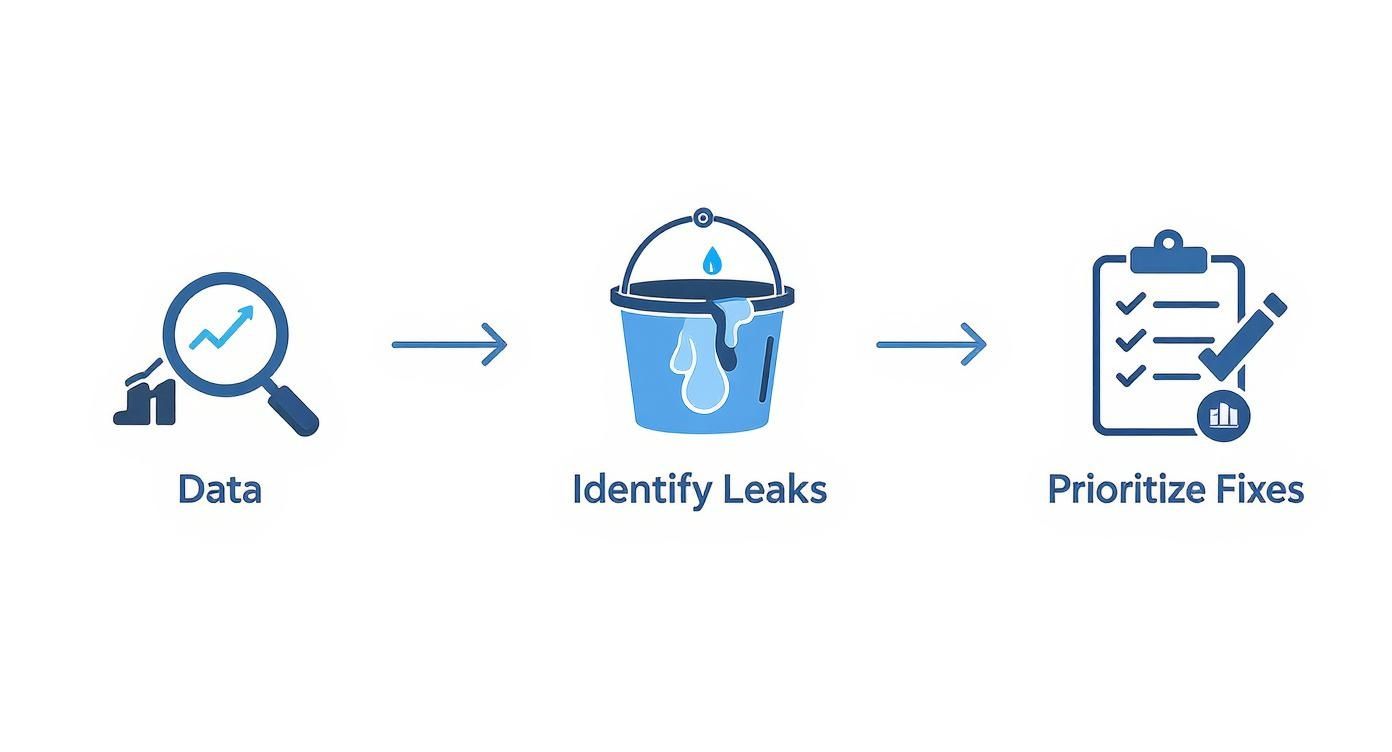
The big takeaway? You can't fix what you can't see. A data-first approach replaces guesswork with a clear, actionable plan.
To get you started, here’s a quick-win checklist focusing on the areas that provide the biggest and fastest returns.
Your Quick-Win Ecommerce Audit Checklist
| Audit Area | Key Metric to Check | Why It Matters for Sales |
|---|---|---|
| Homepage Bounce Rate | Bounce Rate / Exit Rate | High numbers mean your core message is unclear or the design is confusing. First impressions are everything. |
| Site Speed | Page Load Time (seconds) | Every extra second of load time directly correlates with lost sales. 47% of consumers expect a page to load in 2 seconds or less. |
| Product Page Engagement | Add to Cart Rate | A low rate means your photos, descriptions, or pricing aren't convincing buyers to take the next step. |
| Cart Abandonment Rate | % of users who add to cart but don't start checkout | High abandonment here points to friction like unexpected shipping costs, a confusing cart layout, or lack of trust signals. |
| Checkout Abandonment | % of users who start checkout but don't complete it | This is the final hurdle. Drop-offs are often caused by required account creation, too many form fields, or payment issues. |
This table isn't exhaustive, but it covers the critical points in the customer journey where sales are won or lost.
From Data to Dollars
Once you know where people are leaving, the next step is figuring out why. A huge drop-off between adding an item to the cart and starting checkout almost always points to surprise shipping costs. A high bounce rate on product pages could mean your photos are blurry or your descriptions fail to sell the benefits.
The goal of an audit isn't to find every single flaw. It's to identify the 20% of problems causing 80% of your lost sales. Focusing your energy here delivers the highest return with the least effort.
After this review, you should have a short list of the top 2-3 leaks in your sales process. These are your priorities. To guide you, we've put together a comprehensive resource. Get our complete web audit checklist to walk through the process step-by-step.
This isn’t about making your website prettier; it’s about turning it into a reliable, 24/7 salesperson that consistently grows your business.
Secure Quick Wins by Fixing Your Store's Foundation
Once your audit is done, you'll have a clear list of where your sales funnel is leaking. Now it’s time to plug the biggest holes. It’s easy to get distracted by shiny new marketing tactics, but the most significant gains come from fixing foundational issues that are quietly bleeding sales every day.
We're talking about the simple stuff that makes a customer feel confident enough to pull out their wallet. Many stores lose sales not because their products are bad, but because their site feels slow, confusing, or just a bit sketchy. This is where we focus first to lock in immediate, measurable wins.
Speed Sells and Delays Kill
Honestly, the single most underrated factor in ecommerce is website speed. It's not a sexy topic, but its impact on your revenue is brutal. The data doesn't lie: a one-second delay in page load time can cause a 7% nosedive in conversions. For a store doing $500k a year, that’s $35,000 lost to something as basic as a slow-loading image.
Put yourself in your customer's shoes. They click a product and… wait. In their mind, the site is broken. They don’t know you, and they don't trust you yet. A slow site screams unprofessionalism, making them wonder if their credit card info is even safe. Hitting the 'back' button is the path of least resistance.
Here’s how we tackle it:
- Crush Your Images: Large, unoptimized photos are the #1 offender. Before you upload anything, run images through a compression tool. You can slash file sizes by over 70% with zero noticeable drop in quality.
- Simplify Your Storefront: All those flashy apps, complex sliders, and pop-ups can bog things down. Get rid of anything that isn’t directly helping someone make a purchase.
- Check Your Hosting: That cheap, shared hosting plan might feel like a win, but it’s a false economy. If your traffic is growing, you may need to upgrade to a provider that can handle the load.
Build Instant Trust with Clear Signals
When a new visitor lands on your site, they're subconsciously asking: "Can I trust this place?" Your job is to make the answer a resounding "yes" before they even have a chance to doubt it. This is all about trust signals—visual cues that scream credibility and security.
Think about it: a local contractor wouldn't show up to a job in a beat-up, unmarked van. Your website is your digital storefront, and it needs to project professionalism from the first click.
Trust is the currency of the internet. You don't build it with grand gestures, but with dozens of small, reassuring details that tell a customer you're a legitimate business that stands behind its products.
Start by placing these elements across your site, especially on product pages and at checkout:
- Customer Reviews & Ratings: This is non-negotiable. Get star ratings right under your product titles and show detailed reviews further down the page. A staggering 90% of shoppers read reviews before buying.
- A Clear Return Policy: Don't bury your return policy in the footer. Link to it proudly from product pages. A generous, easy-to-find policy removes risk for the buyer and shows you’re confident in what you sell.
- Security Badges: Make sure the logos for Visa, PayPal, and other payment options are visible. These familiar symbols are a shortcut to creating a sense of safety.
Reduce Checkout Friction
You got a customer all the way to the checkout page. This is the final yard, and it's where an astonishing number of sales go to die. The main culprit? Checkout friction—anything that makes the payment process slow, confusing, or annoying.
Your goal is to make giving you money as effortless as possible. Every extra form field, every forced account creation, and every unexpected fee is just another reason for someone to ditch their cart. Forcing customers to create an account is a notorious conversion killer; always make guest checkout a big, obvious option.
Think like a customer in a hurry. They just want to pay and move on. By removing these tiny roadblocks, you stop losing people at the finish line and can see an almost immediate lift in completed sales.
Turn Product Pages from Browsing to Buying

Your product pages are your digital salespeople. They have one job: to convince a visitor that what you're selling is the exact solution they've been looking for. If these pages aren't pulling their weight, all your marketing efforts are for nothing.
Too many store owners treat these pages like a simple catalog entry—a few specs, a price, and an "Add to Cart" button. That's a mistake. A great product page doesn’t just show an item; it builds desire, answers questions before they’re asked, and crushes any doubt. This is where browsing must turn into buying.
Write Descriptions That Solve Problems
It's time to stop selling features and start selling outcomes. Nobody buys a drill because they want a drill; they buy it because they need a hole. Your product descriptions have to connect those dots, translating what your product is into what it does for them.
For instance, a boutique clothing shop shouldn't just list a dress as "100% silk." Instead, paint a picture: "Made from 100% Mulberry silk that feels weightless and drapes beautifully, keeping you cool and confident during that summer wedding." One is a fact; the other is a feeling. Your customer is buying the feeling.
Here's a simple way to structure your descriptions:
- The Hook: Kick things off with a bold, benefit-driven line that hits on a key pain point.
- The Story: Briefly explain how your product solves that problem or makes their life better.
- The Benefits: Use a bulleted list to call out the top 3-5 tangible outcomes. This is perfect for skimmers.
This approach works because it captures both the emotional buyer who reads every word and the logical buyer who just wants the highlights. You're speaking directly to their needs.
Use Visuals That Build Perceived Value
You can write the most persuasive copy in the world, but if your product photos are dark, blurry, or look generic, you've already lost. High-quality visuals are non-negotiable. They are the single fastest way to increase the perceived value of your products.
Imagine a specialty coffee roaster. A grainy phone picture of beans in a bag does nothing. But a crisp shot of the rich, dark beans, another of steam rising from a freshly brewed cup, and a short video of the roasting process? That tells a story of quality and craftsmanship. Suddenly, that $20 bag of coffee feels like an affordable luxury.
Your product photos and videos aren't just for show; they are your most powerful trust-building tools. They provide tangible proof of quality that words alone can't convey, bridging the gap between the digital and physical worlds.
Invest in professional photography or a solid lighting setup. Show your product from multiple angles, in context of how it’s used, and with close-ups of key details. A 30-second video demonstrating the product in action can do more selling than 500 words of text. These visuals are a core part of the toolbox to boost your website's conversion rate with proven strategies.
Leverage Social Proof to Eliminate Doubt
When a potential customer is on the fence, they don’t want to hear more from you—they want to hear from people just like them. This is the power of social proof, and it's one of the most effective tools for closing a sale.
Integrating customer reviews, ratings, and user-generated content directly onto your product pages is essential. In fact, one study found that products with reviews have a 12.5% higher conversion rate than those without. Don't bury your reviews on a separate page. Feature your best testimonials and star ratings prominently, right under the product title where they can’t be missed.
You can take this a step further by encouraging customers to upload photos of them using your product. If you sell handmade leather bags, a gallery of real customers carrying their bags in different settings is far more authentic and persuasive than a dozen sterile studio shots. It gives real-world context and makes that "Add to Cart" click a much easier decision.
Drive Targeted Traffic That Actually Buys
Now that your site is a well-oiled machine, it's time to open the doors. We're not aiming for a crowd; we're looking for the right crowd. Getting more traffic is a vanity metric if none of those visitors are buying. The real win is attracting people who are actively searching for what you sell.
This isn't about being everywhere online. It's about being in the right places at the moments that matter most.
Chasing the wrong audience is an expensive mistake. It torches your marketing budget and clogs your analytics with noise. So, let's shift the goal from simple traffic acquisition to strategic customer acquisition. We'll focus on three powerful channels that consistently bring in buyers, not just browsers.
Master Foundational Ecommerce SEO
Search Engine Optimization (SEO) is your engine for long-term, profitable growth. Paid ads are great, but they stop working the second you stop paying. A strong SEO presence is a business asset that works for you 24/7, bringing in high-intent customers for free.
When someone types "waterproof leather work boots" into Google, they aren't window shopping. They have a problem they need to solve now. Your job is to make sure your product pages show up as that solution. This starts with understanding the exact phrases your ideal customers use.
- Product Page Keywords: Get specific. Instead of a generic term like "men's boots," target "men's 8-inch steel toe work boot." This captures buyers who are much further along in their decision-making process.
- Category Page Keywords: Go a bit broader here. A page showcasing all your work boots could be optimized for "best work boots for construction" or "men's durable work boots."
By aligning your site's language with what people are searching for, you ensure the traffic you get from Google is highly qualified and ready to convert. For a deeper dive, our guide on how to increase website traffic walks through building a complete SEO plan.
Run Smart, ROI-Focused Paid Ads
Without a tight strategy, paid advertising can feel like setting money on fire. The secret isn't a massive budget; it's precision targeting. Platforms like Google Shopping and Facebook Ads let you get your products in front of incredibly specific audiences, maximizing the return on every dollar.
Google Shopping is a powerhouse because it's so visual and intent-driven. When someone searches for a product, your ad—complete with an image, title, and price—appears right in the results. It’s the digital equivalent of placing your product on the perfect shelf just as the right customer walks by.
With Facebook and Instagram, you can get even more granular. A local auto shop, for instance, could run ads for high-performance tires targeted specifically to users in their area who are members of car enthusiast groups. That’s how you make sure your ad spend finds people likely to buy.
The goal of paid ads isn't just clicks—it's to acquire customers profitably. Always track your Customer Acquisition Cost (CAC) against your Customer Lifetime Value (LTV). A successful campaign is one where the long-term value of a customer far exceeds what you paid to get them.
Leverage Marketplaces to Reach Built-In Buyers
Finally, don't overlook the power of established online marketplaces. Platforms like Amazon, Walmart, and Etsy aren't just your competition; they can be incredibly effective sales channels that put your products in front of a massive, built-in audience of active buyers.
Thinking of these platforms as a strategic extension of your brand can significantly improve ecommerce sales. In 2024, U.S. e-commerce retail marketplaces generated a staggering $428.3 billion in sales, an 11.4% jump from the previous year. For sellers, expanding to these platforms can lead to a sales uplift of 20-30% compared to relying solely on their own website.
This approach isn't about abandoning your own store. It's about meeting customers where they already are. A buyer might discover your brand on Amazon, make a purchase, and then visit your website directly for future orders—turning a one-time marketplace transaction into a direct, long-term customer relationship.
Turn One-Time Buyers Into Lifelong Customers
The constant hunt for new customers is exhausting and expensive. While fresh traffic is good, the real, sustainable profit in ecommerce comes from the second, third, and tenth sale.
We've seen it time and again: the most reliable path to growth is turning one-time buyers into loyal, repeat customers. It costs five times more to acquire a new customer than to keep an existing one. We need to shift our thinking from quick transactions to long-term relationships. The goal is to maximize Customer Lifetime Value (LTV) and build a community that keeps your business thriving.
Put Your Relationship Building on Autopilot
You can't personally email every customer, but you can build systems that feel just as personal. That's where automated email and SMS marketing come in. These are timely, relevant messages triggered by what your customers actually do on your site.
These automations work for you 24/7, building relationships and recovering sales while you're busy running the business. Two of the most powerful automations to set up this week are:
- Abandoned Cart Reminders: A staggering 70% of shopping carts are abandoned. A simple, automated email sequence is your best tool for clawing back that lost revenue. Start with a gentle nudge an hour after they leave, and maybe follow up 24 hours later with a small incentive if they still haven't checked out.
- Post-Purchase Follow-Ups: The moment someone clicks "buy" is when they're most excited about your brand. Don't let that momentum fade. Send an automated email to thank them, confirm their order, and offer tips for using their new product. A week later, ask for a review. This simple sequence builds trust and sets the stage for their next purchase.
Reward Your Best Customers with a Loyalty Program
Your best customers deserve VIP treatment. A good loyalty program isn't about giving away freebies; it's about recognizing the people who champion your business and giving them a reason to stick around.
A simple points-based system is a great place to start. Customers can earn points for purchases, leaving reviews, or sharing on social media. They can then cash in those points for discounts or exclusive products. It turns shopping into a game and builds a much deeper connection to your brand.
The top 10% of your customers likely spend 3 times more per order than the other 90%. A loyalty program helps you identify and nurture this incredibly valuable group, ensuring your efforts are focused where they'll have the biggest impact.
Create Predictable Revenue with Subscriptions
If you sell products people use up and buy again, subscriptions are a game-changer. Think of a local coffee roaster, a craft soap maker, or even a dental office selling electric toothbrush heads. Adding a "subscribe and save" option can transform your business from one-off sales to a stable, recurring revenue stream.
This model is powerful because it offers incredible convenience for your customers—they get their favorite products without even thinking about it. For you, it dramatically increases LTV by locking in future purchases automatically.
Best of all, it creates predictable cash flow. That makes it easier to manage inventory, forecast growth, and plan for the future. You're no longer just selling a product; you're selling a service that makes your customers' lives easier.
Measure What Matters to Keep Growing
So, you've put in the work. How do you know if any of it is moving the needle? You stop guessing and start measuring. This isn't about getting tangled in spreadsheets; it's about focusing on a few key numbers that tell the real story of your store's health.
Making changes without tracking their impact is like driving blindfolded. You feel busy, but you have no idea if you're on the right road. A simple, consistent approach to testing and tracking ensures your decisions are backed by real data, not just a gut feeling.
Adopt a Simple Testing Mindset
You don’t need a data science degree to get meaningful results. A/B testing is just a simple way to compare two versions of something to see which one performs better. Think of it as a competition between two of your ideas.
The golden rule is to test one thing at a time. If you change your headline, button color, and main image all at once, you'll have no idea which change actually made the difference.
Here are a few straightforward tests you can run:
- Headline A vs. Headline B: Does a benefit-focused headline outperform a simple, descriptive one?
- Button Color: Does a green "Add to Cart" button convert better than your standard orange one?
- Product Image: Pit a lifestyle photo showing your product in action against a clean studio shot.
By isolating one variable, you get clean, actionable feedback. This is how you learn what your customers actually respond to, allowing you to make your entire site more effective over time.
Track the KPIs That Drive Growth
It’s easy to get overwhelmed by the data available in platforms like Google Analytics or Shopify. Instead of trying to monitor everything, zero in on the handful of Key Performance Indicators (KPIs) that are directly tied to revenue.
Your goal isn't to become a data analyst; it's to become a business owner who can spot trends and make smarter decisions. These core metrics give you the clarity to turn raw numbers into a clear roadmap for growth.
Honestly, these three metrics will tell you almost everything you need to know about the health of your sales engine:
- Conversion Rate: What percentage of your visitors make a purchase? This is the ultimate report card for how persuasive your website is.
- Average Order Value (AOV): On average, how much do customers spend each time they check out? Small bumps here have a massive impact on your bottom line.
- Customer Lifetime Value (LTV): What’s the total profit you can expect from a single customer over their entire relationship with your brand? This tells you if you're building a loyal following or just processing one-off sales.
Common Questions About Growing Your E-commerce Sales
When business owners get serious about growing their store, the same questions tend to pop up. Let's get straight to the answers based on what we see every day.
"How quickly can I actually see results?"
This is always the first question, and it’s a fair one. The honest answer: it depends on what you tackle first.
If you jump on the low-hanging fruit—like speeding up your site or simplifying your checkout process—you can genuinely see a difference within a few weeks. These are direct fixes to the user experience that often give you an immediate bump in conversion rates.
Bigger strategies, like climbing Google's ranks with SEO or building loyalty through email marketing, are more of a slow burn. These are long-term plays. You’ll start seeing compounding returns in about three to six months as your search visibility improves and you build a solid base of repeat customers.
"Out of everything, what's the one metric I should obsess over?"
If you only track one thing, make it your Conversion Rate. It’s the single most important number for growth.
This metric tells you what percentage of people who visit your store actually buy something. You can drive all the traffic in the world, but if nobody is converting, you're leaving a ton of money on the table.
Focusing on your conversion rate means you're squeezing more value out of the traffic you already have. It is, without a doubt, the most efficient way to increase your ecommerce sales.
"Do I need a huge budget to make any of this happen?"
Absolutely not. In fact, some of the most powerful changes you can make cost more in time than in money.
Rewriting your product descriptions to be more persuasive, setting up a basic abandoned cart email sequence, or removing unnecessary fields from your checkout form don't require a big financial outlay.
Our advice is always to start with the foundational audit we talked about earlier. Nail those "quick wins" first. The extra revenue they generate can then be reinvested into bigger-ticket items like paid advertising when you're ready to scale.
Ready to stop guessing and start growing with a clear plan? At Uncommon Web Design, we build strategic websites designed to turn visitors into customers. Let's talk about what a data-driven roadmap would look like for your business. Book a free consultation today.